
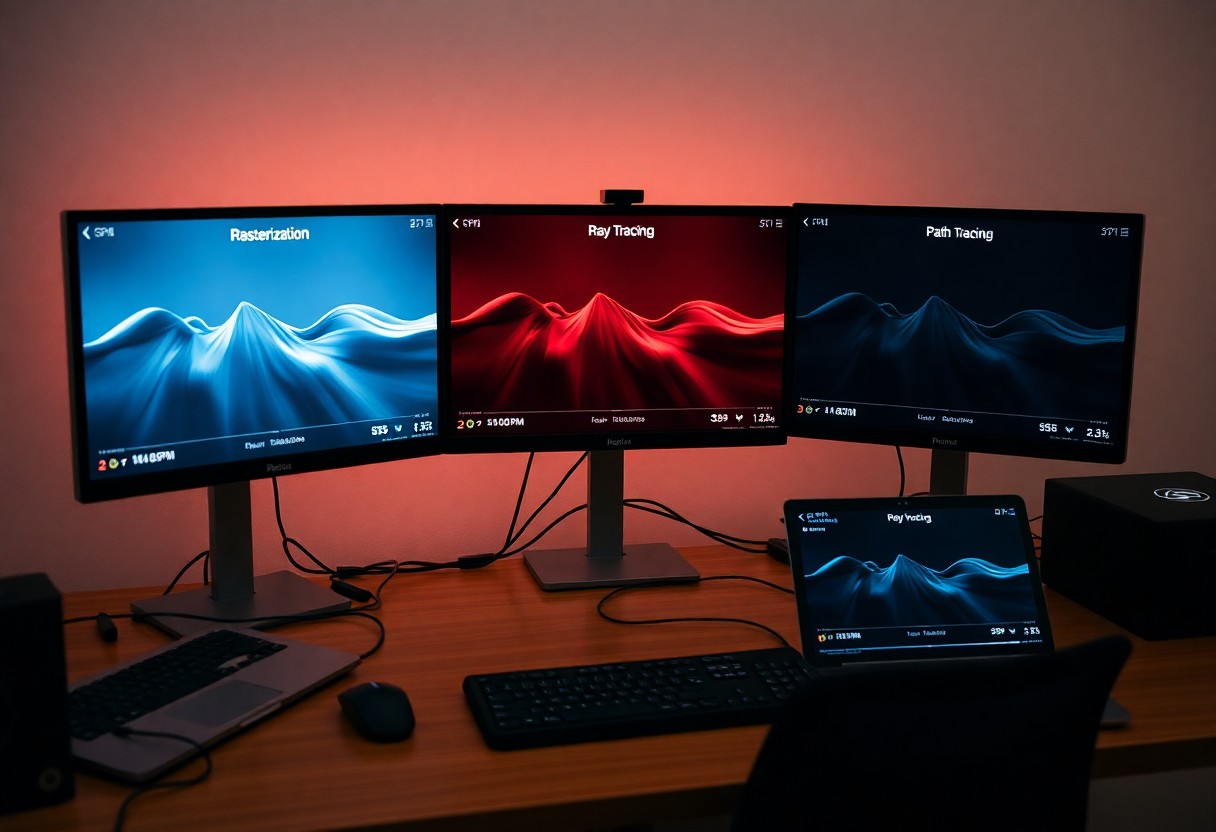
Render types determine how your site is generated and delivered, so you should assess server-side, client-side and static options to match your goals: favour server‑side rendering for SEO and initial load, weigh the security risks and runtime complexity of client-side approaches, and consider cost savings and scalability from static rendering when performance and maintenance matter.
Understanding Render Types
As you choose between approaches, focus on how each method maps to your project’s needs: rasterization gives you real-time speed for interactive apps, while ray tracing and path tracing deliver physically accurate lighting for film or high‑quality visuals; hybrid pipelines blend both to hit target frame rates. Expect trade‑offs: GPUs can handle hundreds of millions of triangles per second, yet advanced lighting often multiplies compute and memory demands.
| Rasterization | Fast, GPU-optimised; ideal for 30-240+ fps; susceptible to lighting/aliasing limits |
| Ray Tracing | Accurate reflections/shadows; RT cores speed it up; typically 5-20× cost vs rasterization |
| Path Tracing | Monte Carlo global illumination; used in films; often minutes-hours per frame offline |
| Hybrid | Rasterise geometry, ray trace selective effects; common in modern games (e.g., Control) |
| Choosing | Pick rasterization for consistent real‑time performance, ray/path tracing for film‑quality lighting |
- Rasterization
- Ray Tracing
- Path Tracing
- Hybrid Rendering
- Denoising
Rasterization
You rely on rasterization when you need predictable latency and high frame rates: modern GPUs process tens to hundreds of millions of triangles per second, enabling 60-240 fps in games. Developers commonly pair it with per‑pixel shaders and screen‑space effects to simulate indirect light, but be aware of aliasing and limited global illumination unless you add supplementary techniques like SSAO or light probes.
Ray Tracing
You use ray tracing to achieve correct reflections, refractions and soft shadows; hardware RT units (introduced in consumer GPUs circa 2018) accelerate BVH traversal and ray packets. Real‑time implementations often cost several times more GPU cycles than rasterization, so you should budget for denoisers, LODs and hybrid fallbacks to retain interactive performance.
Further practical detail: studios render film frames with path tracing that can take minutes to hours per frame, while game engines use selective ray tracing for effects and rely on temporal denoisers to reach playable frame rates; examples include RTX‑enabled titles and offline renderers like Arnold and RenderMan that demonstrate the quality gap and the operational cost of full global illumination.
Thou should profile both approaches on your target hardware and pipelines to balance visual fidelity against performance.
Pros and Cons of Each Render Type
| Rasterization | Ray Tracing |
|---|---|
| Extremely fast for real‑time-can push millions of triangles at 60+ FPS on modern GPUs. | Photorealistic lighting and reflections, used in film pipelines and high‑end visualisation for accurate results. |
| Excellent for complex geometry batching and GPU pipelines; very low latency for interactive apps and games. | Handles global illumination, soft shadows and refractions natively, reducing the need for cheats or approximations. |
| Lower hardware requirements overall; runs well on a wide range of consumer GPUs and mobile devices. | Requires dedicated RT hardware or heavy compute; performance often limited without NVIDIA/AMD ray cores. |
| Well supported in engines and tools; mature optimisation techniques and broad tooling. | High memory and bandwidth demands; scenes with many light bounces need lots of samples to remove noise. |
| Limits in realistic lighting-relies on screen‑space tricks (SSAO, SSR) that can produce artefacts. | Can be used hybrid‑style to augment rasterisation (e.g. ray‑traced reflections + rasterised base) to trade cost vs quality. |
| Works well for fast iteration and production where interactivity matters (gameplay, UI). | Common in VFX and archviz where per‑frame render time of minutes to hours is acceptable for true realism. |
Advantages of Rasterization
When you need interactive speed, rasterisation delivers: it can render scenes with millions of triangles at 60+ FPS, enabling tight feedback loops for gameplay and editor workflows. You benefit from mature GPU pipelines, broad tool support and low latency, so tasks like LOD, culling and instancing give predictable performance on mobile to desktop hardware.
Disadvantages of Rasterization
If you rely on rasterisation for realism, you’ll often need screen‑space hacks and bake tricks to simulate indirect lighting; these produce artefacts like clipped reflections and inaccurate soft shadows, so the result can feel visually inconsistent compared with physical light behaviour.
In practical scenes-interiors with complex indirect bounces or caustic effects-rasterisation struggles: techniques such as screen‑space reflections only sample visible pixels and fail when reflective sources are off‑screen, while lightmaps and probes require manual setup and can blow memory budgets for dynamic scenes.
Advantages of Ray Tracing
Ray tracing gives you physically accurate lighting-true reflections, refractions and global illumination-so visuals converge toward film‑quality results; studios commonly accept minutes to hours per frame for path‑traced fidelity, and modern APIs (DXR, Vulkan RT) plus RTX/RDNA2 accelerators let you bring parts of that fidelity into interactive apps.
Adopting ray tracing lets you simplify material setups and reduce artist workarounds: a single path‑tracer pass can replace multiple baked passes, and hybrid pipelines (rasterise base, trace highlights) let you target only the elements where accuracy matters, saving samples and GPU time.
Disadvantages of Ray Tracing
You’ll pay in computation: pure ray tracing needs thousands of rays per pixel to converge in noisy scenes, making real‑time use expensive without specialised hardware and denoising strategies; latency and power consumption rise quickly with scene complexity.
For example, path tracing often requires temporal accumulation and neural denoisers to reach acceptable noise levels at interactive sample counts, which introduces temporal artefacts and demands careful tuning; film pipelines accept long render times, but games must balance sample count, denoiser quality and frame budget to stay responsive.
Real-World Applications
Gaming
If you prioritise competitive performance you’ll pick rasterisation to hit high frame rates (≥120 FPS) on eSports titles, while ray tracing is used for fidelity in AAA games-PS5 and Xbox Series X/S include hardware RT. Cyberpunk 2077 showed real-time RT reflections and shadows but incurred ~30-50% frame‑rate cost without upscaling; using DLSS 2.0 typically recovers ~1.5-2× performance. Hybrid pipelines and UE5’s Lumen/Nanite let you balance quality and speed depending on your target platform and FPS budget.
Film and Animation
In film production you routinely accept render times of minutes to hours per frame to achieve studio‑level photorealism using path tracers such as RenderMan RIS, Arnold or V-Ray; a feature can consume tens of thousands of render‑hours on large farms. You use high sample counts, layered AOVs and distributed rendering to preserve shot integrity, and often reserve GPU renderers for look development to accelerate iterations without sacrificing final‑frame quality.
For optimisation you rely on denoisers, adaptive sampling and compositing to avoid full re‑renders; GPU engines like Redshift or Octane speed turnaround, while virtual production (StageCraft/LED volumes used on The Mandalorian) lets you render backgrounds in real time to camera, reducing render‑farm load but introducing new challenges in colour matching and on‑set synchronisation.
Performance Considerations
Hardware Requirements
If you target interactive viewport work, a mid-range GPU such as an NVIDIA RTX 3060 or AMD RX 6600 with 12 GB VRAM suffices; for production path-traced renders, aim for an RTX 4090 or multiple GPUs and at least 64 GB RAM plus a 12-16 core CPU (for example, Ryzen 9 5900X/5950X). Insufficient RAM or disk I/O causes swapping and large slowdowns, so plan fast NVMe storage and ample memory.
Rendering Time
When you benchmark, simple product shots at 1080p with 200-500 samples often render in 2-10 minutes on an RTX 3080; cinematic frames at 4K with 2,000-5,000 samples can take hours on a single GPU. Use denoisers to reduce samples by 4-10×, but validate fine details; progressive rendering helps you stop early while bucket rendering gives predictable completion for complex scenes.
Adjusting tile size, sampling strategy and light-path depth has large impact: CPUs favour larger tiles (32-256 px) while GPUs often run best with full-frame or small tiles, and path-tracing cost scales roughly linearly with samples. If you distribute renders, a 10-node farm can cut a 10-hour per-frame job to roughly 1-1.5 hours net, minus overhead; factor cloud GPU pricing (~£0.50-£5/hour) and data transfer into your cost/performance decision.
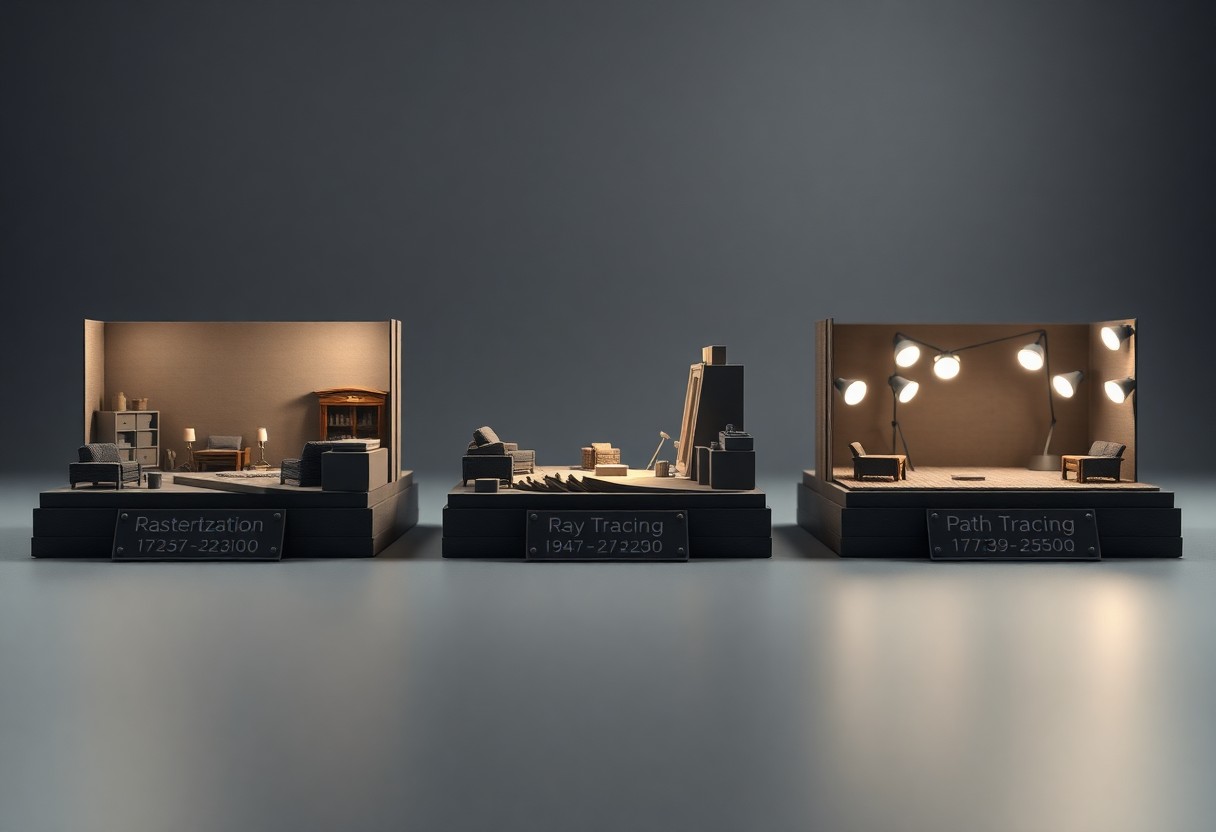
Choosing the Right Render Type
If you need photoreal stills, animations or interactive visualisations, match the render type to your deliverable and timeline: for example, a photoreal interior still at 4K often takes 1-4 GPU hours on a high‑end card, whereas a ray‑traced 30s animation at 25fps can demand 750-1,500 render hours total – so you should weigh fidelity against available time and compute.
Project Requirements
Assess asset complexity, final resolution and lighting needs: high poly models with 4K textures and displacement plus global illumination typically require 256-4096 samples or more and may force offline rendering, while interactive projects with LODs and baked lighting suit real‑time engines; if you need multiple camera angles or client revisions, factor in multiplied render hours and storage for raw frames.
Budget Considerations
Balance licence, hardware and cloud costs: a single photoreal still can range from about £50-£500 (including artist time and cloud render), whereas longer animations commonly hit £500-£3,000+; choose real‑time for rapid iteration to cut hours, or offline ray tracing when image quality must be absolute.
To quantify, estimate frame cost: a 30s animation at 25fps is 750 frames; if each frame averages 2 GPU hours on your setup that’s 1,500 GPU‑hours – at £1 per GPU‑hour on a cloud service you’d incur ~£1,500 in compute alone; add artist fees (£30-£100/hr), storage and licence fees and you reach final budget. You can reduce expense by using denoisers, adaptive sampling, baking indirect light, or hybrid workflows (real‑time for previz, offline for final frames), and be aware that pushing resolution or ray depth can exponentially increase times and costs.
Future Trends in Rendering
Real-time ray tracing, AI-driven denoising/upscaling and cloud rendering are converging to change workflows: NVIDIA’s RTX (2018) plus DXR and Vulkan RT made hardware acceleration mainstream, while Unreal Engine 5’s Lumen (2021) proved real-time global illumination is viable. You can cut iteration cycles substantially by combining these tools, but expect higher hardware and energy costs and plan hybrid pipelines that use local GPUs for interactivity and cloud farms for final-frame throughput.
Emerging Technologies
You should monitor neural rendering (NeRFs for view synthesis), differentiable rendering for material optimisation and AI upscalers like NVIDIA DLSS (notably DLSS 2.0 in 2020) and AMD FSR; DLSS often yields 2-4× frame‑rate improvements in practice. Dedicated RT cores on modern GPUs plus path‑tracing hardware support mean real‑time path tracing is becoming feasible for high‑end production and virtual sets, letting you iterate faster on lighting and camera moves.
Industry Predictions
Studios will move to hybrid, real‑time‑centric pipelines: virtual production (The Mandalorian’s LED stages) already reduced location and compositing workload, and you’ll see more projects adopt that model. Expect greater cloud reliance for final rendering, standardisation around RTX/DXR and USD, and increased vendor lock‑in and energy bills as trade‑offs; invest in shader, GPU optimisation and ML denoising skills to keep your team competitive.
When you plan adoption, benchmark real tasks-texture baking, denoised path‑traced frames and interactive streaming-to model total cost of ownership between buying GPUs and paying per‑hour cloud instances (e.g., AWS G4/G5). Prioritise open standards (Vulkan RT, USD) to reduce lock‑in and aim for sub‑100 ms interactivity targets if you rely on remote streaming, so your toolchain delivers both quality and practical iteration speed.
To wrap up
On the whole you should select the render type that balances performance, visual fidelity and production constraints: choose real-time for interactivity and fast iteration, offline/physically based for highest-quality stills and complex lighting, and hybrid approaches when you need both-align your choice with project goals, hardware and delivery timelines to ensure efficient, predictable results for your workflows.
FAQ
Q: What are the main render types and how do they differ?
A: The primary render types are rasterisation, ray tracing, path tracing and hybrid methods. Rasterisation is a fast, real-time approach that projects geometry to pixels and is common in games and interactive applications; it handles lighting with approximations such as baked maps or screen-space effects. Ray tracing simulates rays of light to produce accurate reflections, refractions and shadows and can be used in both interactive and offline pipelines; it is generally slower but more physically accurate. Path tracing is a form of unbiased ray tracing that samples many light paths to achieve photorealism, often used for final-frame rendering; it requires high sample counts and denoising for clean results. Hybrid methods combine rasterisation for primary visibility with ray tracing for reflections, shadows or global illumination to balance speed and quality.
Q: Which render type should I choose for real-time projects like games or VR?
A: For games and VR, rasterisation remains the practical choice due to its low latency and efficient GPU pipelines; use techniques such as level-of-detail, lightmap baking and screen-space effects to improve visual fidelity. Recent hardware supports real-time ray tracing features (hardware-accelerated rays) that can be added selectively for reflections, shadows and ambient occlusion to enhance realism without replacing rasterisation entirely. Choose a real-time engine that matches your target platforms and optimise assets, textures and shaders to meet frame-rate constraints.
Q: Which render type is best for photorealistic stills and animations?
A: For highest photorealism in stills and final-frame animations, path tracing or unbiased ray tracing engines are preferred because they simulate complex light transport and produce natural global illumination, caustics and soft shadows. These methods demand longer render times and benefit from denoising, adaptive sampling and render farms for animations. Hybrid or biased engines can be used when production timelines require faster throughput while still achieving convincing results through engineered approximations and precomputed lighting.
Q: How do hardware and software choices affect which render type I should use?
A: Hardware strongly influences render type selection: modern GPUs excel at real-time rasterisation and GPU-accelerated path or hybrid renderers, while CPU rendering can be preferable for very large scenes or when using specific plugins that favour CPU threads. Software compatibility matters: choose render engines that integrate with your DCC (digital content creation) tools and support features you need such as PBR materials, hair and volumetrics. Consider available VRAM, network rendering capabilities, licensing costs and whether you rely on denoisers or specialised accelerations like RTX to meet deadlines.
Q: How do I decide which render type to use for architectural visualisation, product shots or motion graphics?
A: For architectural visualisation, use path tracing or a hybrid approach for final imagery to capture accurate lighting and materials; employ GPU previews and baked lightmaps to iterate quickly. Product photography benefits from unbiased path tracing for accurate reflections and subsurface scattering, with careful studio lighting rigs and HDRIs; GPU rendering speeds iteration. Motion graphics often favour real-time engines or biased CPU/GPU renderers that allow fast turnaround and complex animation workflows; use progressive preview rendering and then commit to higher-quality offline renders for hero shots. In all cases balance desired image quality, deadline, hardware and budget – optimise sampling, use denoisers, and adopt proxies or layering workflows to reduce render time without sacrificing final quality.