
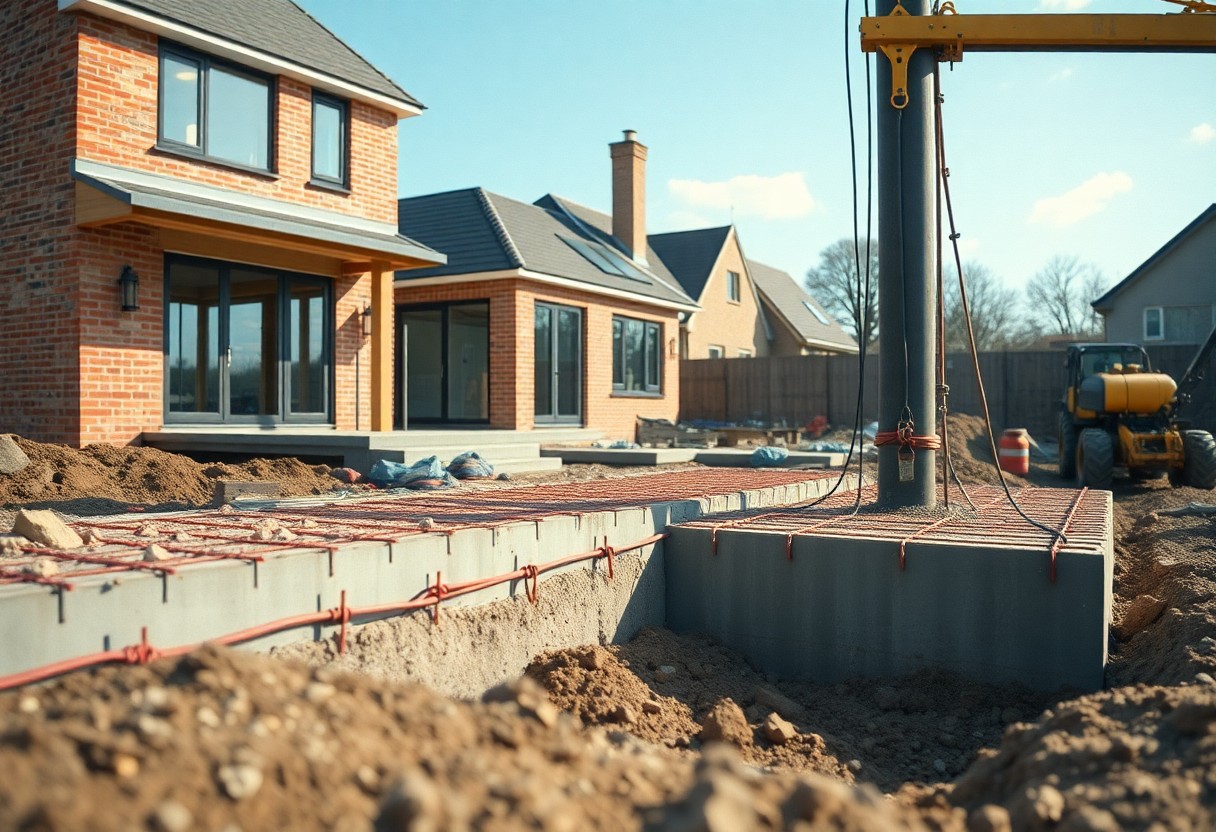
Building an extension requires choosing the right foundation to ensure stability, avoid subsidence and support your intended loads; you should base your choice on ground conditions, soil type and the extension’s weight, and follow a structural engineer’s recommendation to comply with building regulations and party wall obligations.
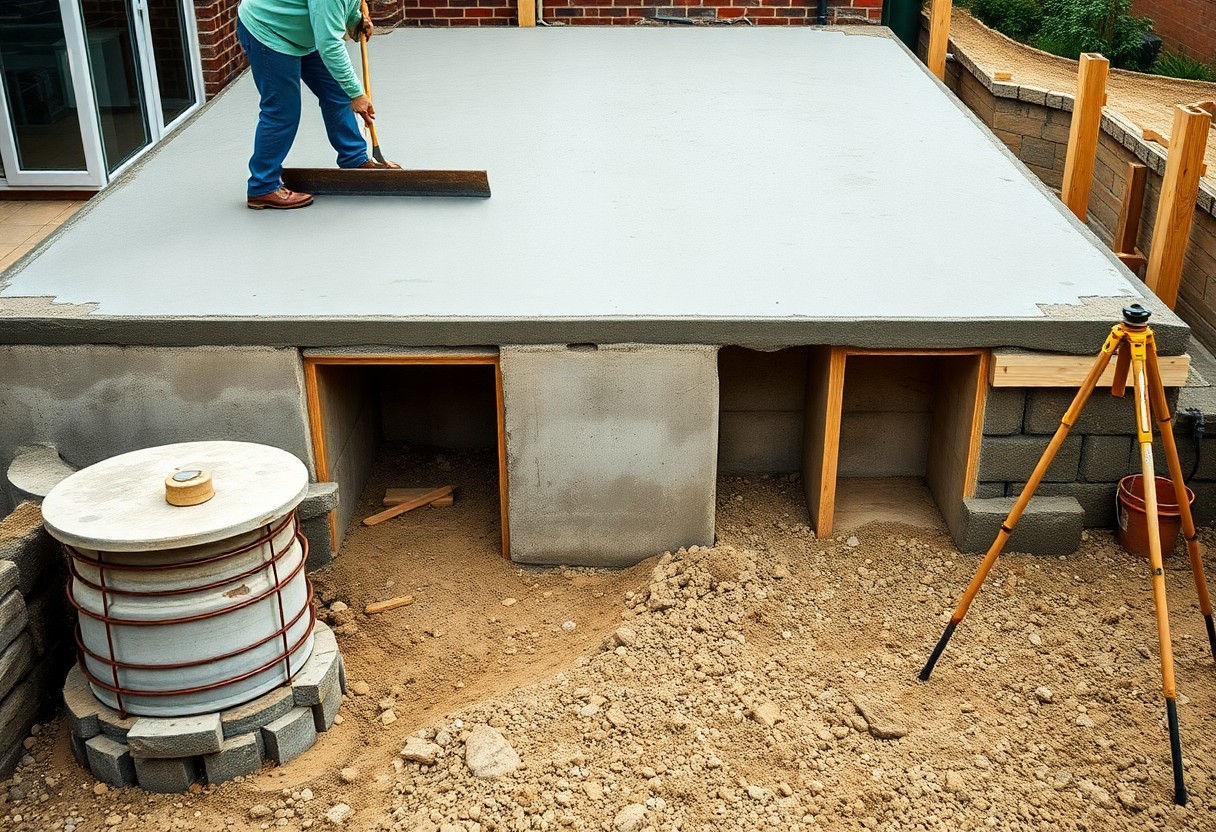
Understanding Different Types of Foundations
When planning an extension you need to match ground conditions, load and budget to the right foundation system; common options include shallow foundations for small loads and deep foundations where soft soils prevail. You should expect trade-offs in cost, programme and disturbance – for example, pile foundations can be 2-3× more expensive than a strip foundation. After assessing soil investigations (CPT or trial pits) you can select the most appropriate foundation type for your project.
- Strip foundations
- Pad foundations
- Raft foundations
- Pile foundations
- Caisson foundations
| Strip foundation | Used for load-bearing walls on competent near-surface soils; typical for extensions with linear loads and low settlement risk. |
| Pad foundation | Isolated footings beneath columns; economical for point loads but sensitive to uneven settlement on made ground. |
| Raft foundation | Spreads load across a large area for poor soils; often specified where net bearing pressure exceeds strip capabilities. |
| Driven piles | Steel or precast concrete driven to dense strata; fast installation but can cause vibration and noise in urban areas. |
| Bored piles / caissons | Drilled to required depth with minimal vibration; suitable where you need deeper capacity (often 5-20 metres) and controlled disturbance. |
Shallow Foundations
Shallow options such as strip and pad foundations suit extensions when competent soil is within the top metre or so; you can expect typical allowable bearing pressures of roughly 100-300 kN/m² for domestic work. They reduce plant and cost, but soft, variable made ground increases the likelihood of differential settlement, so you should plan for ground improvement or a raft if test pits show weak layers.
Deep Foundations
Deep foundations transfer loads to stronger strata and are chosen when shallow options would settle excessively; driven piles often reach dense layers quickly, while bored piles avoid the vibration associated with driving. You may encounter pile capacities from a few hundred to over 1,000 kN per pile, so you must coordinate pile type, length and spacing with your structural engineer to match design loads.
Where site constraints or sensitive neighbours limit disturbance you can specify bored piles (300-600mm diameters common) or screw piles that minimise spoil and vibration; for heavy structures you should insist on pile load tests (PLT) and an installation record so you and your engineer have verifiable capacity and settlement data before superstructure works proceed.
Factors Influencing Foundation Choice
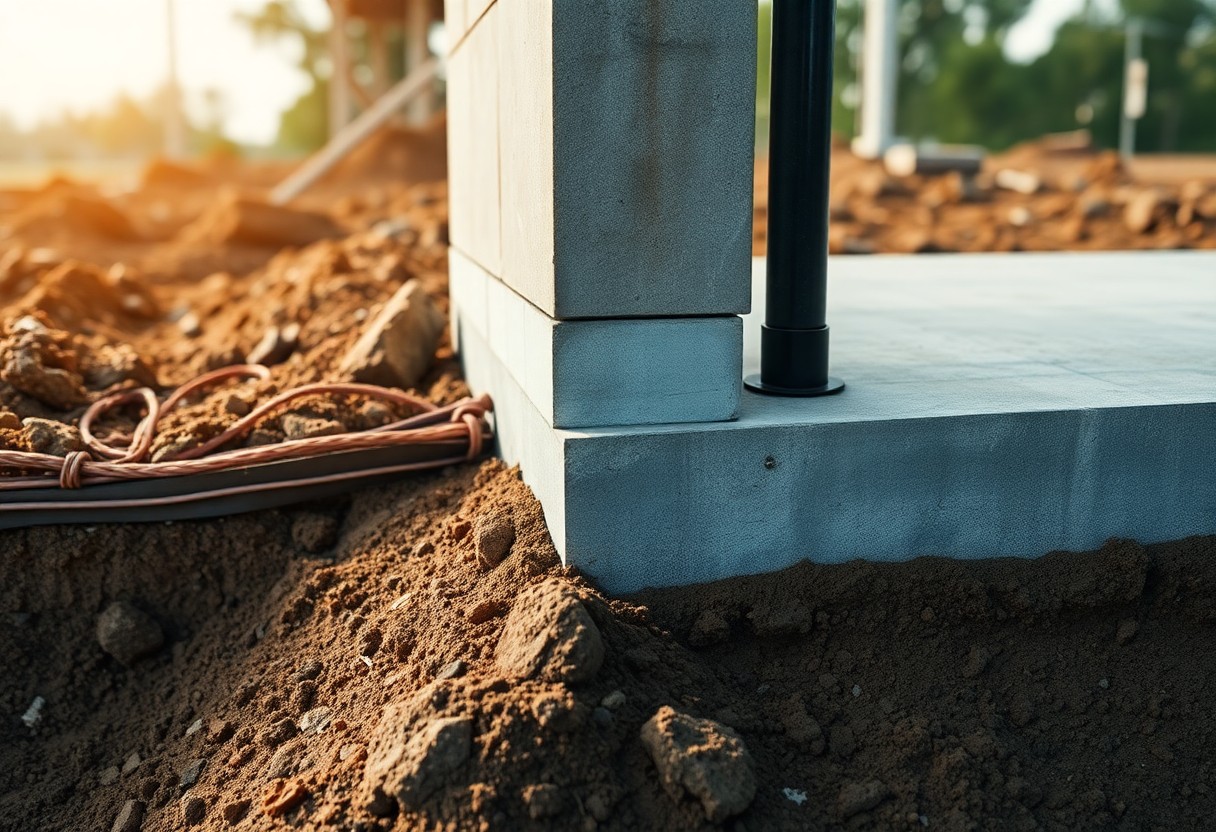
You must weigh ground conditions, structural load and local building regulations; strip foundations are commonly around 600 mm wide for single‑storey extensions, raft slabs often 150-200 mm thick, and piles typically reach 6-12 metres where soils are weak. You should plan for seasonal movement in clay and concentrated column loads. Any final selection must follow a site investigation and a structural engineer’s specification.
- Soil type
- Bearing capacity
- Water table
- Load type (linear vs point)
- Local regs
Soil Type and Condition
You should commission a trial pit or borehole: for small extensions 1-1.5 metres is often sufficient, while deeper issues need 3-6 metres. Clay can show seasonal movement of about 25-50 mm, sandy gravels generally offer bearing levels above 100 kN/m², and peat or made ground usually forces a piled solution; high groundwater raises excavation and durability concerns and increases costs.
Load-Bearing Requirements
You need to quantify dead and imposed loads: typical domestic imposed floor loads are about 1.5-2.0 kN/m², but a masonry party wall or steel beam can create point loads of tens of kN that demand pad or piled support. Single‑storey builds often suit 600 mm strips, while two‑storey or heavier roofs frequently require 900 mm strips, rafts or piles; concentrated loads on weak soils are particularly dangerous.
Assess how loads distribute: linear wall loads spread along strip footings, whereas columns introduce point loads that can produce bearing pressures exceeding soil capacity. For example, a 100 kN point load on weak clay may need a raft or 6-10 m piles to avoid settlement. You should always have a structural engineer size footings-incorrect sizing risks structural failure and costly repairs.
Site Assessment for Extensions
You should commission a site assessment that uses a mix of desk study, trial pits and boreholes-typically at least two across the footprint to depths of 1.5-3 metres-to identify made ground, high groundwater, or contamination. Soil logs and water-table readings tell you whether you can use shallow strip foundations or must consider piled or raft solutions; for example, made ground over clays often pushes costs up 15-30% due to deeper or piled foundations.
Evaluating Ground Stability
Analyse bearing capacities: soft clay may be only 50-100 kN/m², stiff clay 100-200 kN/m², and dense sand/gravel 200-400 kN/m², which dictates whether you use strip, pad, raft or piled foundations. Take into account slope, groundwater and tree root zones-mature trees can influence soil up to 10-15 metres-and use trial pits or SPT/borehole data to decide if lateral movement or settlement risks require deeper or reinforced footings.
Professional Consultations
You’ll want a qualified team: a geotechnical engineer to interpret borehole logs, a structural engineer to design footings, and a RICS surveyor for party-wall and boundary risk; a basic ground investigation and report typically costs between £600-£1,500, while structural design fees commonly run £400-£1,200 depending on complexity. Early instruction prevents surprises such as the need for piling or underpinning.
Geotechnical reports provide interpreted parameters-bearing capacity, compressibility, groundwater level and potential contamination-so your structural engineer can size footings or specify piles. In one London terrace case, a borehole revealed 2m of made ground, changing a planned strip footing to a piled solution and increasing foundation cost by roughly 20%; engaging specialists early lets you compare options (raft, piled, or underpinned) and obtain accurate costings for tendering.
Common Foundation Types for Extensions
| Strip foundations | You’ll typically use continuous concrete trenches 300-900mm wide and 450-900mm deep; they suit stable soils but can suffer differential settlement on made ground or variable fills. |
| Pad foundations | Isolated pads beneath point loads, commonly 600×600mm to 2m square; ideal for small posts or conservatory piers and are a cost-effective option for light loads. |
| Raft foundations | A reinforced concrete slab 150-300mm thick that spreads load across the footprint; chosen where soil bearing capacity is low (e.g. <100 kN/m²) to reduce settlement risk. |
| Pile foundations | Piles transfer loads to deeper strata; bored or driven piles (diameters 300-600mm, depths 3-20m) are used to bypass poor near-surface soils but are more expensive. |
| Screw piles (mini‑piles) | Helical screw piles install quickly with minimal excavation, provide immediate load capacity (up to several hundred kN per pile) and suit restricted-access sites. |
- Strip foundations
- Pad foundations
- Raft foundations
- Pile foundations
- Screw piles
Strip Foundations
For typical domestic extensions you’ll opt for strip foundations under load‑bearing walls; designers commonly specify widths from 300-900mm and depths of 450-900mm depending on load and soil. If your site contains made ground, peat or variable deposits you should deepen or redesign the footing, since even small changes in subsoil can produce significant differential settlement that damages finishes and requires expensive rectification.
Pile Foundations
When the surface layers won’t take your loads you’ll consider pile foundations, which transfer weight to deeper, competent strata; bored piles suit urban sites to limit vibration, while driven piles offer rapid installation. Typical pile diameters range 300-600mm and depths commonly span 3-20m depending on geology, and you should expect higher up‑front costs but reliable performance where shallow solutions fail.
The choice between bored, driven or screw piles depends on access, vibration sensitivity and load: bored concrete piles are often chosen in built‑up areas to minimise disturbance, screw piles are quicker and cheaper for lighter loads, and a 10m pile can carry from roughly 200-500kN depending on strata, so you must commission a geotechnical report and load testing to confirm design and avoid expensive failures. The
Cost Considerations for Foundations
Budgeting for Foundation Work
You should budget for three main items: site investigation (trial pits or boreholes typically £300-£800), the foundation installation (strip or pad foundations often account for 10-20% of a modest extension’s build cost), and contingency for unexpected ground issues. Labour commonly represents 40-60% of foundation spend, materials 30-50%, and you should allow a 10-20% contingency. If piling is required, expect an extra £1,000-£4,000+ per pile depending on depth and rig access.
Long-term Investment Value
Proper foundations support a valid structural warranty (typically 10 years) and improve buyer confidence; poor foundations can slash value or force expensive repairs. A well-designed foundation reduces the risk of settlement claims and may preserve several thousand pounds in resale value, while visible movement can lead to valuation reductions of £10,000-£50,000 depending on severity and location.
Over the building’s life you’ll save on maintenance and insurance if you invest up-front: correctly specified concrete and damp-proofing can last 60-100 years, and avoiding made-ground through piling or ground improvement often prevents recurrent repair bills. Surveyors commonly flag differential settlement as a major defect; remedial underpinning typically ranges from £2,000 for local repairs to £30,000+ for extensive works, so weighing higher initial costs against long-term liability is a sound financial strategy.
Building Regulations and Approvals
Building Regulations – specifically Approved Document A (Structure) and Approved Document C (Site preparation and resistance to moisture) – dictate the technical standards your foundation must meet, including geotechnical design to Eurocode 7 where appropriate. You’ll need structural calculations, appropriate damp-proof measures and inspections to prove compliance; failing to do so risks structural failure, enforcement action or problems when you sell the property.
Local Codes and Guidelines
Local authorities often impose additional rules: some councils in clay-rich areas require deeper strip footings or piled solutions, while coastal or flood-prone zones demand raised ground levels and enhanced damp-proofing. You should check conservation area controls, party wall requirements and any local planning conditions – for example, councils may request foundations 600-900mm deep or piles to 5-10m in poor ground.
Necessary Permits and Inspections
You must notify Building Control either via a Full Plans submission or a Building Notice and arrange key inspections at footing formation, drainage, damp-proof membrane/dpc and final sign-off. An approved inspector or the local authority will issue a Completion Certificate once satisfied; starting without the correct process exposes you to enforcement or costly remedial works.
Full Plans approval usually takes 4-8 weeks, whereas a Building Notice lets you start sooner but still requires staged inspections. Fees for Building Regulations vary – typically from a few hundred to over £1,000 for small extensions – and private inspectors can be quicker but charge differently. You should book footing and pre-backfill inspections early to avoid delays and ensure the final Completion Certificate is issued.
Conclusion
As a reminder you should choose foundations based on your extension’s size, soil type, load and local ground conditions; small single-storey builds often use strip or pad foundations, larger or heavy structures may need raft foundations or piled solutions, and poor or unstable ground demands specialist geotechnical advice. Building regulations and a structural engineer’s specification will determine depth, width and reinforcement. Early site investigation and consultation with professionals ensure your foundation provides lasting support and complies with statutory requirements.
FAQ
Q: What factors determine the type of foundations my extension needs?
A: Ground conditions (soil type, bearing capacity, depth to rock or made ground and groundwater level), the load from the extension (single-storey versus two-storey, heavy walls or concentrated loads), proximity to neighbouring buildings and boundaries, presence of trees and vegetation, and local planning/building-control requirements will all influence the foundation solution. A site-specific ground investigation (trial pits or boreholes) and structural engineer’s assessment are normally required to select an appropriate foundation type and depth.
Q: When are shallow foundations such as strip or pad foundations appropriate?
A: Shallow foundations are suitable where competent, non-compressible soils are present at relatively shallow depth and loads are moderate. Continuous strip foundations suit loadbearing walls, while isolated pad foundations are used for point loads such as columns. Trench fill foundations are a variation used where a wider, stiffer foundation is needed without deep excavation. These options are typically the most economical and quicker to build when ground conditions allow.
Q: When should I consider a raft (mat) foundation for my extension?
A: A raft foundation is appropriate where the soils are weak or variable and cannot economically support concentrated shallow footings, or where differential settlement across the footprint is a concern. The reinforced concrete raft spreads loads across the whole building area, often acting as the ground-floor slab, and is commonly used for single- or two-storey extensions on compressible clay or made ground. Rafts provide good resistance to minor ground movement and can simplify construction where soil improvement or deep foundations would otherwise be needed.
Q: Under what circumstances will piled foundations be required?
A: Piled foundations are required where near-surface soils cannot carry the load and competent strata lie at significant depth, where a high water table or risk of scour prevents shallow solutions, or where heavy loads or adjacent structures demand transfer of load to deeper stratum. Options include bored piles, driven piles and screw piles; selection depends on site access, noise/vibration limits and ground conditions. Piling requires specialist contractors, detailed engineering design and typically higher cost and programme time than shallow foundations.
Q: How do trees, vegetation and party walls affect foundation choice?
A: Trees and large shrubs can create shrinkage in clay soils and seasonal heave, so foundations near trees may need to be deeper, stiffer or of a piled or raft form to limit differential movement; root barriers and reduced excavation zones can also be used. Extensions adjacent to party walls or existing buildings may be constrained by limited working space and by the need to avoid undermining neighbours’ foundations, which can necessitate piled solutions, underpinning or contiguous piled retaining structures. In all cases consult a structural engineer and adhere to party wall and building-control procedures before work begins.