

Home extension costs in the UK in 2026 depend on size, specification and planning: you should budget roughly £1,200-£2,500 per m² for standard builds, but unexpected structural problems and party-wall or planning delays can add tens of thousands, while a well-executed extension can lift your property’s value and living space substantially; get detailed quotes and contingency funds to protect your project.
It’s likely you will pay between £1,200-£2,500 per m² for standard extensions in 2026, though higher-spec or complicated projects can exceed £3,000 per m²; you must budget for planning, structural work and VAT, and be aware of structural risks and unexpected costs that can escalate timelines and spend, while a well-executed extension can boost your home value significantly and improve living space – get detailed quotes and professional surveys to protect your investment.
Factors Influencing Home Extension Costs
Costs change quickly, and you should expect variation by specification, complexity and site conditions; a basic single‑storey rear extension typically ranges from about £1,500-£2,800/m², while high‑end finishes push that to £3,000+/m². Materials, labour rates and access can swing budgets by tens of thousands, and professional fees often add 10-15% to the build cost. Thou must factor in that unforeseen groundworks frequently add £5,000-£30,000 to your estimate.
- Size & Type – footprint, storeys and complexity
- Location – regional price variations and access
- Local Regulations – planning, conservation and party‑wall issues
- Materials & Finish – basic vs premium specifications
- Structural & Groundworks – foundations, piling, drainage
- Professional Fees – architect, engineer, planning consultant
- VAT & Contingency – typically include a 10-20% buffer
Size and Type of Extension
When you increase footprint or add a second storey, costs per square metre rise: expect a modest single‑storey kitchen extension around £1,200-£2,200/m², whereas two‑storey rear extensions often sit at £1,800-£3,000/m² because of extra structural work and stair/thermal considerations; wrap‑around designs and basements can more than double that, so set your brief to control finishes and complexity to manage costs.
Location and Local Regulations
Prices vary strongly by region – London and the South East frequently command premiums of 20-40% over national averages, and restricted access sites drive crane and labour surcharges; planning restrictions such as being in a conservation area or a listed setting add time and specialist fees, while party‑wall matters commonly cost between £800-£3,000 for awards and surveys.
Digging deeper, you should budget for specific local requirements: a standard householder planning application is commonly around £206 (England), ground investigation reports typically cost £500-£1,500, and arboricultural reports or heritage statements can add £500-£2,500. You will also face higher contractor rates in urban centres and potential traffic management charges; factor those into your early estimates to avoid surprise costs.
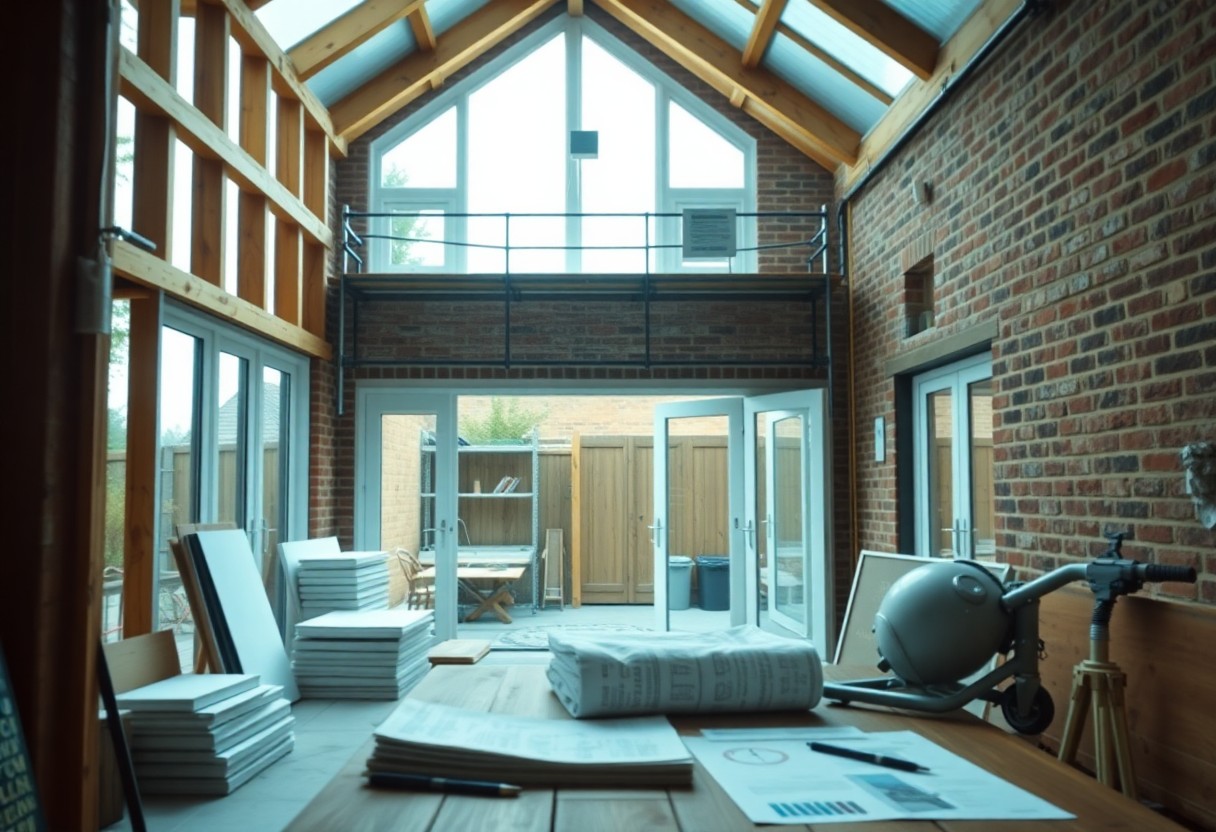
Factors Influencing Home Extension Costs
Many elements affect what you end up paying, from site access and ground conditions to the level of finishes and services you choose. For example, a basic single-storey rear extension might be around £1,500-£2,500/m², while a high-spec build can exceed £3,000-£4,500/m². You will also face fees for surveys, party-wall awards and temporary accommodation if needed. Assume that these variables compound quickly on constrained urban sites or when adding structural work.
- Size and type of extension
- Location and local market rates
- Materials and finishes
- Labour and contractor margins
- Planning permission & surveys
- Groundworks and structural works
Size and Type of Extension
The scale directly alters your cost per square metre: a modest single-storey rear extension is typically cheapest, while a double-storey or wrap-around adds 30-50% due to extra structure and services. You should expect loft or basement work to be substantially pricier – basements often double overall budgets because of excavation and waterproofing. Smaller projects can be more expensive per m² because fixed fees (design, permits) are spread over fewer metres.
Location and Local Market Rates
Your location drives labour and material pricing: London and the South East often command a premium of 20-40% over northern regions, and urban sites may attract higher contractor mobilisaton charges. You should check local comparables; for instance, contractors in large cities might add travel and congestion costs to their quotes, pushing per‑m² rates up noticeably.
Digging deeper, you will find postcode-level differences matter – in high-demand boroughs a simple extension can be markedly more expensive than nearby commuter towns. Subcontractor availability, planning authority behaviour and local ground conditions (made ground, clay) all influence quotes; unfavourable ground can add tens of thousands for piling or specialist foundations, while accessible suburban plots typically keep costs down.
Average Costs of Home Extensions in 2026
Nationwide averages in 2026 put single-storey extensions at roughly £1,800-£3,500 per m² and multi-storey works at about £2,500-£5,000 per m², so a modest 20m² single-storey project typically lands between £36,000-£70,000. You should expect regional variation-London and the South East sit at the top-and budget overspends of 10-20% are common if you change specifications mid-build.
Single-Storey Extensions
For a rear kitchen or garden-room you’ll usually pay between £1,800 and £3,500 per m²; a 20m² extension therefore often costs around £36,000-£70,000. You can cut costs by choosing standard rooflines, optimising glazing, and fixed-price contractor packages, while bespoke cladding, underfloor heating or complex groundworks will push you above the top of that range.
Multi-Storey Extensions
Adding a first-floor extension or full two-storey side return typically costs more because of structural work, with averages around £2,500-£5,000 per m²; a two-bedroom first-floor addition can range £60,000-£150,000. You’ll need a structural engineer, temporary scaffolding and often deeper foundations, all of which materially increase cost and programme length.
Expect multi-storey projects to take 12-24 weeks on site; planning applications are usually around £200-£250 and building-regs fees about £300-£1,000. You must factor in party wall awards (£1,000-£5,000+), scaffold hire (£1,000-£5,000) and potential VAT on contractors; if you skip early structural surveys you risk significant unforeseen costs.

Average Cost Breakdown
Typical extensions in 2026 range from about £1,200-£3,000 per m² depending on specification; therefore a 20m² single‑storey rear extension often sits between £24,000 and £60,000. Materials and labour usually split the bill, with services, planning fees and VAT adding another 10-25%. If you opt for premium glazing or underfloor heating expect the top end of that bracket, while basic brick-and-block shells push you towards the lower end.
Construction and Materials
Materials typically account for roughly 30-45% of your build cost; basic brickwork, block and mortar for a 20m² job might be £3,000-£8,000, while timber-frame systems or insulated panels can shift costs to £7,000-£18,000. Windows and bi‑fold doors vary from £700 to £4,000 each, and structural groundworks or piled foundations can add £3,000-£12,000, with poor material choice risking damp and long‑term repairs.
Labor and Project Management
Labour usually forms the single largest element, often around 35-55% of your budget – roughly £600-£1,800 per m² depending on complexity. A 20m² extension therefore commonly requires £12,000-£36,000 labour cost. Project management or main contractor overheads typically add 8-15% of the contract sum; fixed‑price contracts reduce your exposure to day‑rate inflation and surprise bills.
If you manage the build yourself you can save on contractor overheads but take on scheduling, compliance and payment risk; many homeowners use staged contracts (deposit 10-20%, then milestone payments) and a common 5% retention to protect against snags. Late design changes frequently inflate labour by 10-20%, so securing a clear scope and a signed contract (JCT or simple building agreement) is one of the most effective ways to control final costs.
Financing and Budgeting for Home Extensions
Plan your budget around realistic per‑m² figures-typical extensions range from about £1,200-£2,500/m² depending on finish-and build in a 10-20% contingency for unforeseen works. Get at least three detailed quotes, stage payments to match progress, and check whether VAT relief applies to specific works; if you’re adding structural elements, expect higher preliminary costs such as party‑wall or planning fees.
Funding Options Available
You can fund extensions through remortgaging, a second‑charge mortgage, personal/home‑improvement loans, or savings; remortgaging is often cheapest (typical mortgage rates generally lower than unsecured loans). Short‑term bridging finance suits fast transactions, while local grants may help energy‑efficiency upgrades. Avoid high‑cost credit where possible-credit cards and payday/PNC loans can carry double‑digit rates that quickly erode value.
Cost-Benefit Analysis
Assess return by comparing expected uplift to spend: extensions commonly recoup roughly 50-90% of their cost in added sale value, with kitchens and additional bathrooms typically higher. Factor in local market demand, comparables, and how the extension alters usable floor area; if resale isn’t immediate, include potential rental income or lifestyle value in your calculation.
Do the arithmetic: estimate uplift as added area (m²) × local price/m², then subtract your total build cost to see net gain. For example, if local price is £3,000/m² and you add 10 m² at £1,800/m², uplift ≈ £30,000 vs cost £18,000, giving a clear positive margin; also model scenarios for lower market values and increased borrowing costs to test downside risk.
Planning Permissions and Regulations
Check whether your project falls under Permitted Development (single-storey rear extensions commonly allowed up to 3 metres for terraced/semi-detached and 4 metres for detached) or needs full planning permission; listed buildings and conservation areas almost always require consent. You must also comply with Building Regulations for structural work and serve a Party Wall notice at least two months before starting if adjoining neighbours are affected, since non‑compliance can lead to enforcement, costly alterations or legal action.
Required Permits
You will typically need either a householder planning application or confirmation under Permitted Development; additionally obtain Building Regulations approval and, where relevant, Listed Building Consent or conservation‑area approval. For shared boundaries, serve Party Wall notices and consider a Party Wall Award; highways, drainage or tree‑protection consents may also be required if your extension affects access, sewers or protected trees.
Impact on Cost
Planning and regulatory processes add direct and indirect costs: you should budget for fees, drawings and consultant charges – often an extra £1,000-£5,000 for typical projects – plus potential delays that increase labour and site overheads. Using specialists for listed‑building or conservation work typically raises professional fees and materials costs.
For more detail, expect a householder planning fee and basic architect/technical drawings to total around £500-£2,500, a Party Wall surveyor to cost £500-£2,000 per neighbour, and structural engineer reports from £300-£1,200. In conservation areas or for listed buildings, allow an additional 10-30% on build costs for specialist materials and approvals; contested applications can add months and several thousand pounds in redesign and legal costs.
Financing Options for Home Extensions
Personal Savings vs. Loans
Using savings avoids interest and keeps you off lenders’ schedules, but committing £20,000-£60,000 can leave you without an emergency buffer; splitting funds is common. If you borrow, a secured remortgage usually offers lower rates than an unsecured personal loan; for example, a £50,000 loan over 10 years at 6% equates to roughly £555/month, so factor monthly repayments into your budget.
Government Grants and Incentives
Local authority grants and national schemes can reduce your upfront spend, with awards ranging from a few hundred pounds to several thousand depending on eligibility; Disabled Facilities Grants target adaptations, while energy‑efficiency programmes may subsidise insulation or low‑carbon heating. You should search council portals and gov.uk for current programmes, as availability and criteria vary by area and can change year to year.
Applications often require proof of income, detailed quotes and planning details, and can take weeks to approve, so start early. Combining a small grant (e.g. £2,000-£10,000) with a low‑interest green loan or part‑savings is a pragmatic route; checking eligibility before hiring contractors prevents delays and avoids having to retrofit qualifying works later.
Impact of Market Trends on Extension Prices
Market shifts directly affect your extension budget: between 2020-24 material and labour volatility added roughly 10-25% to typical quotes. When local demand surges or planning delays pile up, contractors simply pass costs on, so a job quoted at £25,000 pre‑pandemic can easily reach £31,000-£33,000. You should factor in a 5-15% contingency and expect quotes to vary by region and season.
Demand and Supply Dynamics
When you face strong local demand, lead times lengthen and subcontractors charge premiums; for example, specialist glazing frequently sees 8-12 week waits during busy months, adding labour standby costs. Labour shortages since 2021 mean builders may prioritise larger, higher‑margin jobs, so your small extension can attract a 5-10% uplift on labour rates in tight markets.
Material Price Trends
Timber and steel remain the most volatile inputs, with timber prices having spiked in 2020-21 and partially settling thereafter; insulation and basic blockwork have been steadier. If you choose higher‑end finishes, your materials bill can double, so material choice drives 30-40% of total cost.
For more detail, timber peaked by around +40-50% in 2020-21 and, by 2024, sat nearer 10-20% above pre‑pandemic levels in many supply chains; reclaimed brick or standard uPVC rather than aluminium windows can cut your material spend by an estimated 10-30%. As an example, a 25m² single‑storey extension might show material bills from roughly £6,000 (basic spec) up to £15,000+ (premium), so you can materially affect the final price by swapping specifications early in the design phase.

Estimated Return on Investment
Property Value Increase
You can typically expect a 5-15% uplift in your home’s value from a well-executed extension; on a £300,000 property that’s roughly £15,000-£45,000. In higher-priced markets like London uplifts often sit at the lower end (3-8%), whereas regional markets such as Manchester or Leeds can reach 10-15%.
Other Financial Considerations
You must budget for 20% VAT on most building work, planning fees (around £206), and professional charges-architects typically charge 6-12% of the build cost. Allow a 10-15% contingency, and expect potential costs like CIL or Section 106, higher council tax and increased insurance after enlarging your home.
Also factor in specialist fees: a structural engineer may charge £500-£2,000, party‑wall awards commonly cost £1,000-£3,000, and building‑regulation charges vary by council. If you finance the work, interest can add thousands, so compare personal‑loan or remortgage rates and consider how quickly the market will let you recover the spend on sale.
Planning Permission and Legal Considerations
When extending you must check both planning and building regulations early: a householder planning application typically costs around £206 and local authorities aim to decide within 8 weeks. If your property is listed, in a conservation area or an AONB you’ll almost certainly need full permission, which can take months and raise costs. Party Wall notices often add £1,000-£3,000 in fees if disputes arise. Failing to secure the right approvals can lead to enforcement notices and costly retrospective works.
Understanding Permitted Development
Permitted Development (PD) lets you avoid full planning for modest works: single‑storey rear extensions are generally allowed up to 4m for detached and 3m for other houses, subject to height, footprint and material limits, while two‑storey additions usually fall outside PD. PD is restricted in conservation areas, National Parks and for listed buildings, so you should check your property’s status on the planning portal and consult your council before assuming PD applies.
Navigating the Planning Process
Start with a pre‑application enquiry-many councils offer one for £50-£150-to clarify constraints and likely conditions; submit scaled plans, a location plan and a design and access statement where requested, and expect an 8‑week decision window for householder applications. You can speed approval by using an architect and consulting neighbours early to reduce objections that might force committee review.
If the council imposes conditions you’ll need to apply to discharge them before starting work-this can add 2-6 weeks; if refused you can appeal (written representations commonly take 6-9 months). For sensitive sites you may need heritage or ecology reports, so budget an extra £1,000-£5,000 for consultants. Keeping to the council’s checklist and keeping records reduces delay and the chance of enforcement action.
Hiring Professionals: Architects and Contractors
Architects, structural engineers and contractors each shape cost and risk. Architects typically charge between 5-12% of construction cost or a fixed fee of around £2,500-£10,000. Structural engineers often cost £500-£2,000. Builders commonly quote per m²-single‑storey extensions range about £1,200-£2,000/m²; a 20m² build at £1,600/m² is roughly £32,000. Always verify public liability and employers’ insurance: hiring an uninsured trader creates significant financial risk.
Selecting the Right Builder
Ask for at least three detailed quotes and visit live sites; tradespeople accredited by TrustMark or the Federation of Master Builders often deliver higher standards. If you want predictability, insist on a stamped schedule and a fixed‑price contract with a retention clause. Check contactable references and photos of completed work. Avoid the cheapest tender if it lacks insurance, VAT registration or a written warranty, as that commonly leads to defects and delays.
Cost of Professional Services
Expect to allocate roughly 6-10% of build cost for design and statutory services; for example, an architect fee of 8% on a £60,000 extension is about £4,800. Add structural engineering (£500-£1,500), party wall advice (£500-£1,500) and planning (£206 for a householder application). You should build in a professional services contingency of 10-20% of those fees to cover revisions, site surveys or unforeseen structural solutions.
Choosing design‑and‑build can reduce your upfront architect time but often carries higher contractor premiums; the traditional route costs more in fees but gives tighter cost control. If your project exceeds about £150,000, engage a quantity surveyor-QS fees typically run 0.5-2% of project value yet can save 3-6% via competitive tendering. Never waive independent cost checks-without them you risk overpaying.
Case Studies of Home Extensions
These real-world examples show what you can expect when you commission a home extension: costs, timescales and common issues. You’ll see how scope, materials and site conditions push budgets from modest to premium, and which factors most often create overruns or high resale value.
- If you add a single-storey extension of ~20 sqm to a semi-detached house, typical cost is £25,000-£35,000; build time 6-8 weeks; you may recoup ~10-15% of cost on sale. Issues reported: unexpected groundworks adding £4k-£8k.
- For a side return infill of 6-10 sqm expect £12,000-£22,000; most projects finish in 4-6 weeks and deliver a high day-to-day usability boost with minimal planning risk.
- A 40 sqm double-storey extension on a terraced property averaged £100,000-£150,000; programme 14-20 weeks; many owners needed a Party Wall agreement and structural steel, which added £8k-£20k.
- Combining a loft conversion (30 sqm) and small rear extension (12 sqm) cost ~£60,000-£90,000; you should allow 12-16 weeks and budget £3k-£6k for planning or building regulation drawings by an engineer.
- High-end 60 sqm contemporary luxury extension with zinc roof, oak floors and underfloor heating ranged £180,000-£260,000; build time 20-30 weeks; expected value uplift often 60-80% of cost in prime locations.
Budget-Friendly Extensions
You can keep costs down by choosing a compact footprint, a flat roof and standard finishes; typical budget builds run at about £1,200-£1,800 per sqm, so a 15-20 sqm rear extension may cost £18k-£36k. You should prioritise fixing drainage and structural unknowns early, since hidden groundworks and poor foundations are the main reasons budgets inflate.
High-End Extensions
Opting for bespoke design, high-spec materials and integrated systems commonly pushes costs to £2,500-£4,500 per sqm; a 50 sqm premium extension therefore often falls between £125k-£225k. You’ll get better long-term finishes and technology, but must budget for longer lead times and specialist contractors.
In practice, you should factor in a contingency of at least 10-15%, allow extra time for bespoke fabrication (often 4-8 weeks), and commission a structural engineer and experienced project manager when you pursue a high-end extension to avoid costly delays or specification changes during construction.
Summing up
Now you should expect small single-storey extensions to cost roughly £1,200-£1,800 per m², while larger or high-spec projects commonly reach £2,000-£3,500 per m²; overall project totals in 2026 typically range from about £20,000 to £100,000 depending on size, specification, planning and site work, so get detailed quotes and allow contingencies.
To wrap up
Taking this into account, your extension cost in 2026 will typically range from around £20,000 for a modest single‑storey addition to £70,000+ for larger or higher‑spec projects, with per‑square‑metre costs often between £1,500 and £3,000 depending on size, specification and location; planning, structural work, VAT, professional fees and a contingency allowance also affect the final figure, so obtaining several detailed quotes and a clear brief is the best way for you to manage and predict your budget.
FAQ
Q: How much does a typical single-storey rear extension cost in the UK in 2026?
A: A typical single-storey rear extension in 2026 is likely to cost between £1,200-£2,800 per m2 depending on specification and location. For a common 20-30 m2 extension that equates to roughly £24,000-£84,000. Lower figures assume basic finishes and straightforward ground conditions; higher figures reflect high-end finishes, large glazed areas, major structural work or expensive London labour rates. Always add a contingency of 10-20% for unexpected works and factor in 20% VAT on most home improvement work.
Q: What will a two-storey or full-height side extension cost in 2026?
A: Two-storey extensions tend to cost more per m2 because of added foundations, staircases and increased structural work. Typical 2026 rates are about £1,600-£3,500 per m2. A two-storey side extension of 40-60 m2 will therefore commonly cost between £64,000 and £210,000. Costs increase further if party wall work, extensive underpinning or bespoke architectural elements are required; access constraints and scaffolding time also raise budgets.
Q: Which factors influence the final cost and how can I estimate my own project?
A: Key cost drivers are size (m2), specification (kitchens, bathrooms, floors, glazing), structural complexity, ground conditions, local labour rates, access to the site, planning and building-regulation requirements, and the standard of finishes. To estimate, calculate the likely m2 and multiply by a local per-m2 rate (use the ranges above), then add 10-20% contingency, professional fees (architect/engineer typically 5-12%) and VAT at 20% where applicable. Obtain at least three detailed quotes and check what each quote includes to make realistic comparisons.
Q: What additional fees and surveys should I budget for beyond the build cost?
A: Extra costs commonly include architect and structural engineer fees (typically 5-12% of build cost combined), party wall awards (from a few hundred to several thousand pounds), planning-application fees and building-regulation charges, structural and ground surveys (£300-£2,000+), temporary services and site welfare, connection or diversion works for utilities, landscaping and decorating, and any road or skip licences. Allow for these by budgeting an extra 10-15% on top of the pure construction estimate.
Q: How can I reduce costs without compromising long-term value?
A: Keep the design simple and compact, avoid unnecessary corners and complex rooflines, reuse existing openings where possible, choose mid-range but durable materials, obtain fixed-price contracts, tender to several reputable builders, and order long-lead items early to avoid premium rush charges. Phasing works and using local contractors can reduce labour and logistics costs. Prioritise good insulation and efficient heating to reduce lifetime running costs rather than cutting vital structural or regulatory work.