
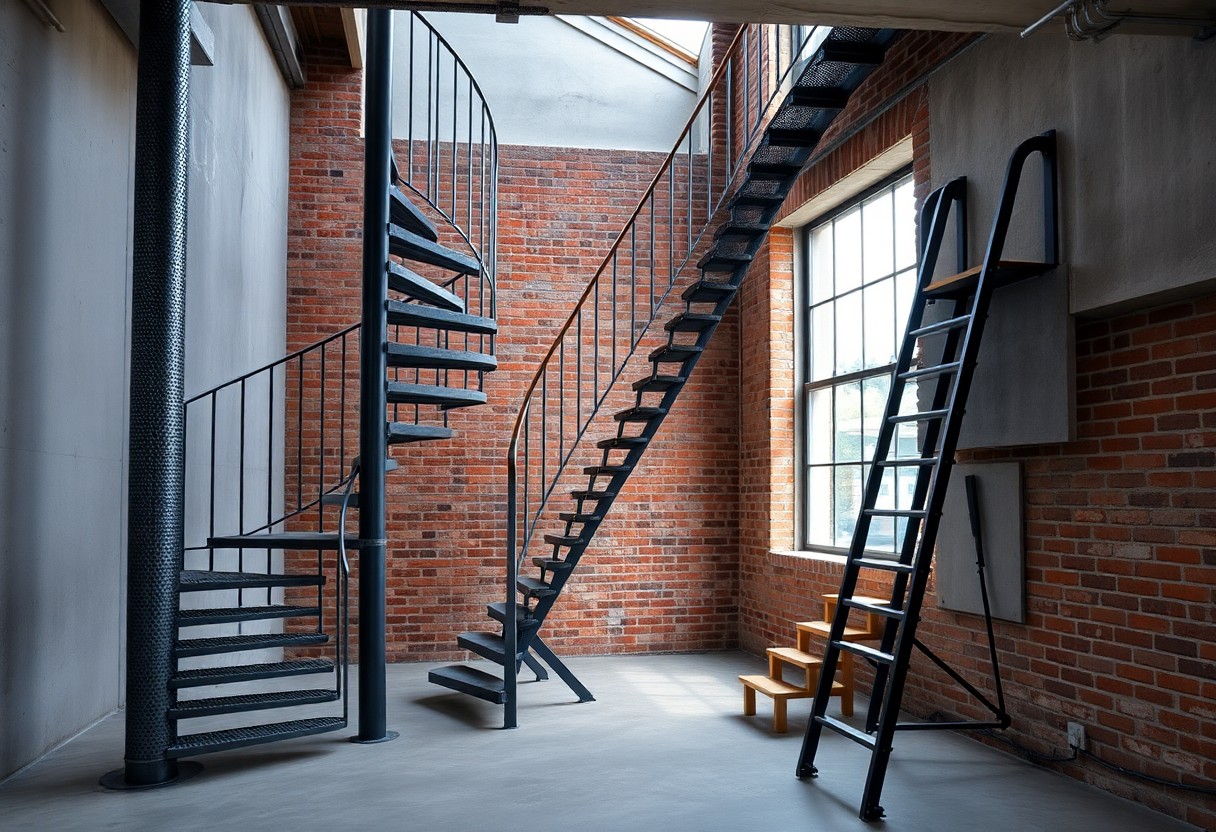
Over recent years you’ll find that choosing the right staircase for your loft conversion balances space optimisation, building regulations and aesthetics; prioritise adequate headroom and safe tread dimensions because poorly designed, steep or narrow stairs are dangerous, while well-planned options like compact spiral, alternating tread or bespoke storage-integrated stairs can add valuable space and increase property value while improving light, access and long-term usability for you and your family.
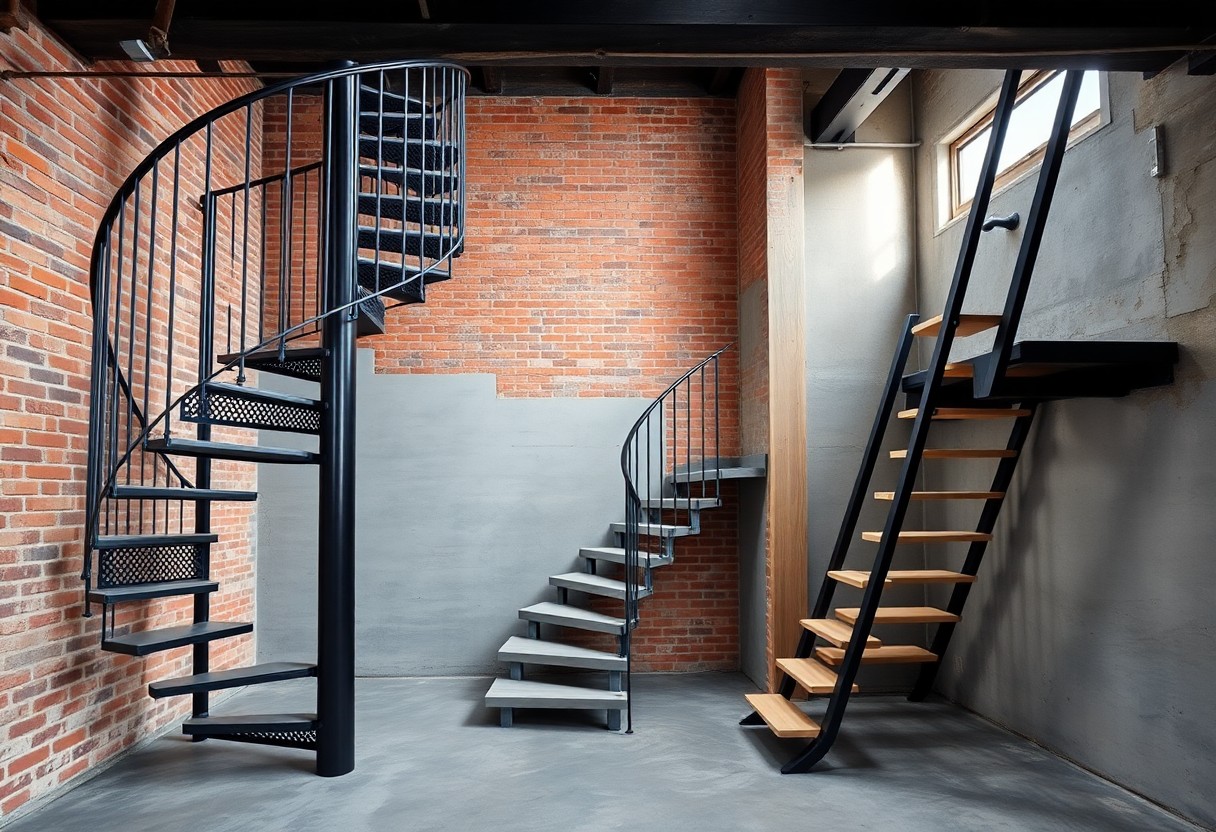
Types of Staircases
You choose a staircase for your loft conversion based on available headroom, footprint and desired style; common choices are straight, L-shaped, U-shaped, spiral and space-saving stairs. UK guidance typically limits riser height to around 220mm and suggests about 2m headroom, so factor those figures into any layout decision. Many homeowners prioritise a straight run for access or a quarter-turn for better landing space. This helps you match aesthetics, safety and regulations to the loft layout.
- Straight – simplest and most economical
- L-shaped – quarter-turn with landing for improved headroom
- U-shaped – double-flight that fits compact footprints
- Spiral – maximises floor space but limits furniture movement
- Space-saving – alternating treads or folding options for very tight areas
| Type | Key features |
| Straight | Direct run, easiest to build, usually cheapest and simplest for headroom planning |
| L-shaped | Quarter-turn with landing; improves headroom and creates visual separation |
| U-shaped | Two flights with landing; compact footprint and gentler pitch |
| Spiral | Very compact, saves floor area but restricts moving large items |
| Space-saving | Alternating treads or folding stairs for tight access; often used where full stairs won’t fit |
Straight Staircases
Straight flights are the most space-efficient when you have an unobstructed run; you’ll typically need between 2.5m and 3.5m of linear space depending on riser height, and a comfortable width around 800-1,000mm. If your loft requires roughly 12-14 risers at ~220mm each, a straight stair keeps calculations simple and usually costs less to install. You should also plan for at least 2m headroom above the nosing to avoid obstructions.
L-Shaped and U-Shaped Staircases
These turn-type stairs add a landing that increases comfort and reduces fall risk, so you’ll often see them in tighter loft layouts where a straight run won’t fit; they also create a visual break between floors and can conceal the loft entrance. For many conversions, a quarter-turn (L-shaped) fits neatly into a corner, while a half-turn (U-shaped) folds the run back on itself to save length.
With an L-shaped or U-shaped arrangement you get a landing that can be sized to meet Building Regulations and improve circulation-typical landing depth is at least the width of the stair, often around 800-1,000mm, which also provides a safer resting point. Designers often use winders to save space but they complicate construction and can feel uneven underfoot; for lofts you frequently balance storage opportunities under the lower flight with the need for continuous headroom above the landing. If you need to move furniture, a U-shaped layout with straight flights offers a wider turning area than a compact spiral, and splitting the run into two flights reduces the perceived steepness when you have 12-14 risers to accommodate.
Space-Saving Solutions
When floor area is at a premium you can prioritise designs that reclaim space: alternating-tread stairs cut the run by around 30-40%, while compact spirals and foldable ladders reduce the footprint further, often by more than 60%. You should aim for a minimum of 2.0 metres headroom where possible, integrate under-stair storage or cupboards into the void, and choose materials that balance slenderness with rigidity so the staircase feels both practical and robust.
Spiral Staircases
Spiral staircases typically range from about 900mm to 1,500mm in diameter, making them ideal where you need to preserve floorplan flow; they can save up to 70% of the space a straight flight uses. You must accept that they are often steeper and narrower, so they suit occasional access or secondary bedrooms rather than moving bulky items, and steel or timber options can be specified to match your loft’s aesthetic.
Foldable Staircases
Foldable loft staircases – hinged, three-section or telescopic – tuck away into the hatch and occupy only that opening when stowed, so you gain the full floor area below; most domestic units extend to between 2.4 and 3.0 metres and are commonly rated around 150kg. You’ll find aluminium models lighter and timber options warmer to the touch, but be aware they are generally less comfortable for frequent use than a fixed flight and require a reliable locking mechanism.
For more detail on foldable options, consider that telescopic ladders slide compactly and can be installed in under a day, whereas three‑section folding ladders need slightly larger trapdoors but offer quicker, firmer access. You should check hatch dimensions to ensure the folded unit fits, maintain insulation and airtightness around the trapdoor, and inspect hinges and locks periodically to keep the system safe and durable.
Design Considerations
When planning your loft staircase you must allow a minimum headroom of 2.0 m and comply with common UK guidance of riser max 220 mm and going min 220 mm; steep pitches above 42° feel cramped and can be unsafe. If space is tight, consider a compact winder or spiral, but note alternating-tread stairs are usually only acceptable for occasional access and may not meet Building Regulations for primary use.
Materials and Finishes
You can choose solid oak treads (typically 28-40 mm) for longevity, engineered oak for cost-effective stability, or powder-coated steel stringers for a slimmer profile; glass balustrades should use 10-12 mm toughened-laminated panels to be safe. Oil finishes give a natural matt look and spot-repairability, whereas lacquered surfaces resist wear but can be slippery if wet, so add non-slip nosing if you select a high-sheen finish.
Color Schemes and Aesthetics
Light colours on risers and walls increase perceived space, while a contrasting tread colour improves depth perception-aim for at least a 30% luminance contrast between tread and riser where possible. You might pair dark stained treads with white risers for a classic loft look, or use monochrome tones for a contemporary, minimal scheme that complements glass or steel balustrades.
For more impact, use a feature colour on risers or the stringer to draw the eye-patterned riser tiles or a bold 20-30% darker hue can add personality without overwhelming a small loft. Also choose paint sheens wisely: eggshell or satin for spindles and handrails (easier to clean), matt for walls, and ensure handrail height of 900-1,000 mm matches the visual line so your chosen colours and materials feel cohesive and safe.
Safety Features
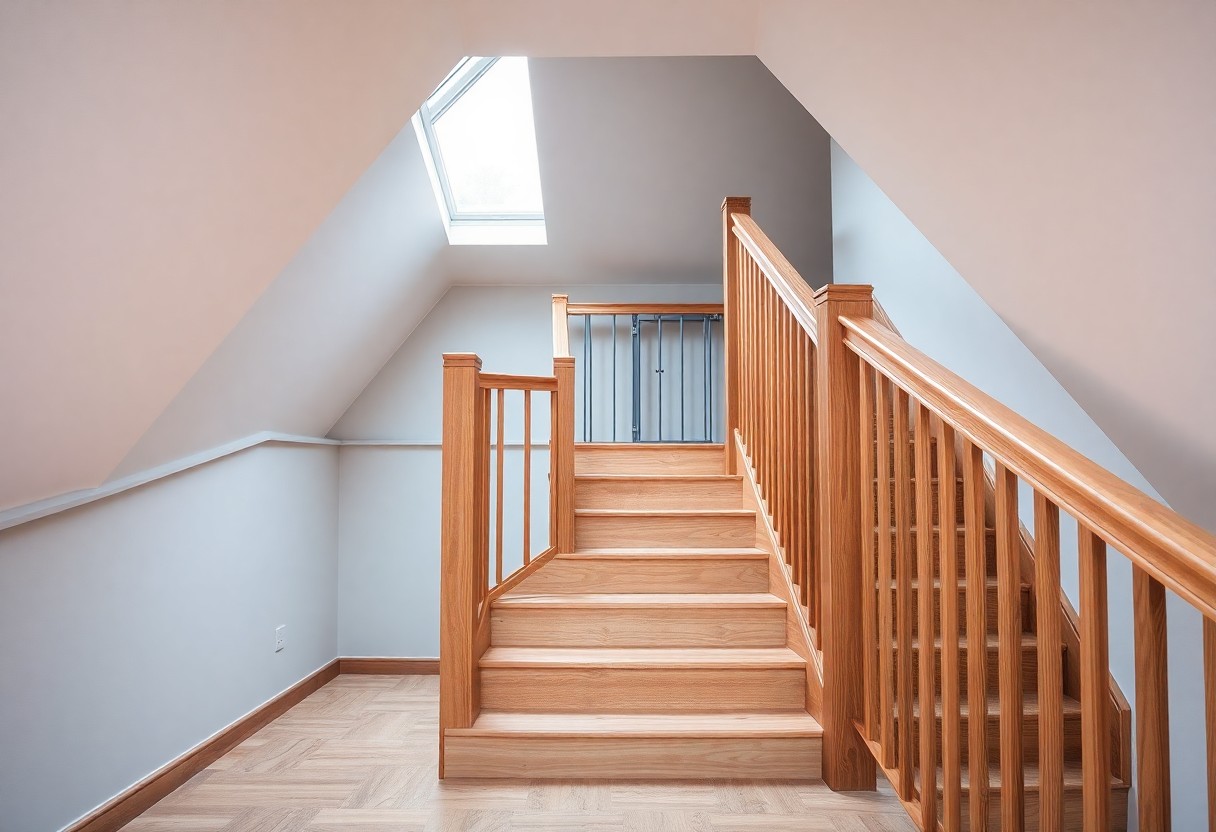
When planning your loft staircase, ensure compliance with building regs: a minimum headroom of 2 m above the pitch line and guarding heights of 900 mm (stairs) or 1,100 mm (landings) where applicable. You should provide a continuous handrail, adequate landing space and well-directed lighting of at least 200 lux on steps to reduce trips. Consider smoke detector repositioning and firm fixings rated for a 0.36 kN load at handrails for added safety.
Railings and Balustrades
You can choose timber, stainless steel or toughened glass balustrades, but keep vertical gaps below 100 mm to prevent a child passing through. Aim for handrail heights of 900-1,000 mm from the pitch line, with returned ends and continuous runs on both sides where possible. Toughened laminated glass must be specified to EN 12150/EN 14449 standards and fixed with anti-rotation brackets to avoid failure.
Non-slip Treads
You should fit anti-slip nosings or abrasive strips on every step, especially on polished timber or tiled flights, since wet or dusty surfaces can multiply slip risk. Use aluminium or PVC nosings with serrated inserts for durability, and select high-grip tapes rated for stair use. Highlight treads with contrasting colours to aid depth perception and reduce missteps on dimly lit evenings.
For best results, apply a 20-30 mm wide abrasive band on the nosing and a contrasting strip of 30-50 mm to improve visibility; aluminium nosings with replaceable inserts are common in conversions. You should aim for slip resistance tested to a Pendulum Test Value (PTV) of at least 36 for domestic stairs, inspect wear annually, and replace adhesive tapes within 1-2 years if edges lift or grit has eroded.
Lighting and Ambience
To shape ambience and maintain safety you should combine layered lighting: aim for 150-300 lux on stair treads and 100-200 lux on landings, use warm-white 2,700-3,000K for comfort and cooler 3,500-4,000K where tasks occur. Fit dimmers and zoning so you can drop levels for evening relaxation or raise them for cleaning. Consider LED nosing strips (typically 300-500 lm per metre) and recessed downlights to avoid glare; poorly lit stairs significantly raise trip risk so prioritise even illumination.
Natural Lighting Options
Install rooflights, dormer windows or light wells to bring daylight deep into the loft; for example, two 78×98 cm rooflights on a 4‑metre run will markedly increase usable daylight. Orient glazing to balance direct sun and diffuse light-south-facing gives more sun, north-facing provides steadier illumination-and use pale finishes and mirrored balustrades to amplify daylight. Add blinds or fritted glass where glare could be an issue; excessive glare can obscure treads and create hazards.
Artificial Lighting Solutions
Specify low-profile recessed downlights spaced and aimed to wash the risers, or install LED strip lighting beneath nosings for uniform tread definition; aim for 300-600 lumens per fitting and a CRI > 80 for accurate colour. Use two-way switching at top and bottom, passive infrared sensors for hands-free activation, and dimmable drivers to tune mood. Keep cabling concealed and protected; exposed wiring near stairs is a safety risk and should meet local electrical standards.
For deeper technical choices, prefer LED downlights of 7-9W (roughly equivalent to a 50W halogen in output) delivering 400-700 lm, and match them with dimmers rated for LED loads. Choose constant-current drivers with short-circuit protection, and IP44-rated fittings near rooflights or damp areas. If you want emergency resilience, add a battery-backed emergency luminaire on the escape route. Practical case: installing 10 × 8W dimmable downlights (≈600 lm each) on a 5‑metre run gives uniform, controllable light while using under 80W total.
Customization Ideas
Built-in Storage Solutions
Under-stair drawers, sliding bins and full-height cupboards let you reclaim otherwise wasted space; typical drawer depths of 300-400mm suit shoes and linens, while a 600mm-wide pull-out pantry fits taller items. You should maintain a minimum 2,000mm headroom and comply with Building Regulations-maximum riser 220mm, minimum going 220mm-so storage never compromises stair geometry or escape routes.
Unique Design Elements
Glass balustrades using 10-12mm toughened laminated safety glass, open risers and concealed steel stringers create a floating effect and boost daylight; note that open risers must meet safety limits (gaps generally not exceeding a 100mm sphere) and handrail height is typically 900-1,000mm from the pitch line. You should always consult a structural engineer for cantilevered treads and bespoke fixings.
For added impact, integrate warm 3,000K LED strips recessed 15-20mm beneath nosings with a proper 12-24V driver, specify laminated glass for balustrades and pick handrail materials-oak or powder-coated steel-to match your loft’s character; these choices influence light, colour temperature and maintenance, so test samples on-site before finalising.
To wrap up
Now you can select a staircase for your loft conversion that balances style, space and safety: opt for a compact spiral for tight footprints, a bespoke timber or glass flight to maximise light and character, or integrated storage and concealed risers to boost practicality; work with a structural engineer and experienced fitter so your design meets building regulations and enhances your home’s value and flow.
FAQ
Q: Which staircase styles work best for compact loft conversions?
A: For tight loft spaces, consider spiral stairs, alternating-tread (space-saving) stairs and compact straight or winder stairs. Spiral stairs occupy a small footprint and can be very stylish but may be less convenient for moving large items. Alternating-tread stairs increase usable pitch without requiring a long run, making them suitable where headroom is limited, though they are less suitable for elderly users or frequent heavy use. Winder or short-flight straight stairs are a good compromise for access and usability. Choose a style that balances available floor area, headroom, frequency of use and the need to move furniture.
Q: What building regulations and safety features should I consider for a loft staircase?
A: Loft staircases must comply with UK Building Regulations and local Building Control requirements. Key considerations include adequate headroom, safe tread depth and riser height, secure handrails and balustrades, and structural support for the new opening and stair loads. Fire safety and safe means of escape may influence design, especially if the loft becomes a bedroom. Acoustic and thermal performance around the stair opening should also be assessed. Always have designs reviewed and approved by Building Control or a qualified professional before installation.
Q: How can I maximise storage and natural light when designing a loft staircase?
A: Integrate built-in storage beneath and around the stair run using cupboards, pull-out drawers or shelving to make efficient use of otherwise wasted space. Open risers and glass balustrades allow light to pass through and give a lighter visual appearance; mirrored panels and pale finishes will further amplify natural light. Positioning the stair near an existing skylight or adding rooflights above the landing can brighten the route. Consider concealed under-step lighting and handrail LEDs to improve safety without compromising storage.
Q: What materials and finishes suit contemporary loft conversions?
A: Popular materials for modern loft stairs include timber (oak or ash) for warmth, steel for a slim structural look, and glass for transparency. Combinations-such as timber treads on a steel frame with glass balustrades-create a contemporary, airy feel. Choose anti-slip nosings and durable finishes on treads where foot traffic is heavy. For a more industrial loft aesthetic, exposed metalwork and open stringers work well; for a cosy finish, fully boxed timber stairs and integrated storage are preferable. Select coatings and fixings that withstand humidity changes in loft spaces.
Q: How much should I budget and how long does installation typically take?
A: Costs vary widely by type and specification: simple loft ladders and basic space-saving stairs are the most economical; prefabricated compact stair systems typically fall in the lower-to-mid price range; bespoke timber or metal-and-glass designs are at the higher end. As a rough guide, modest space-saving solutions might start from a few hundred to a couple of thousand pounds, while bespoke staircases and structural work can run to several thousand pounds. Installation time ranges from a day or two for pre-made units to one or more weeks for bespoke builds including structural alterations. Obtain multiple quotes and factor in Building Control surveys and any additional structural or fire-safety work when planning timescales and budget.