
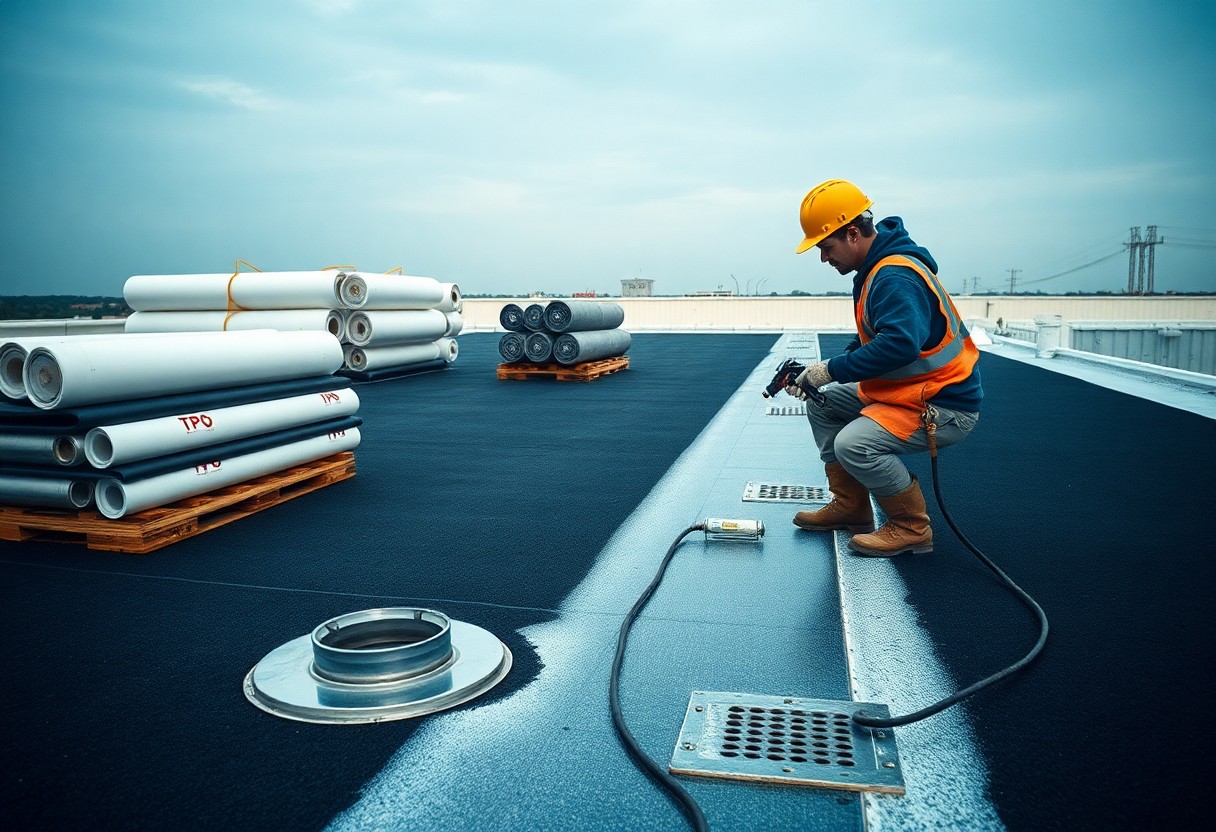
There’s a range of options for flat roofs and you should assess cost, lifespan and maintenance; EPDM and GRP offer long lifespans and low maintenance, PVC and torch-on membranes provide excellent waterproofing, and insulated systems improve energy performance. You must be aware that ponding water can cause leaks and structural damage, so drainage and installation quality are decisive in choosing the right material for your building.
Overview of Flat Roof Types
| Built-Up Roofing (BUR) | Multi-ply bitumen layers with gravel finish; heavy, proven, lifespan 20-30 years |
| Modified Bitumen | Modified asphalt sheets, torch- or cold-applied; good for detailing and patching, flexible in cold |
| EPDM (Single-Ply) | Synthetic rubber, large prefabricated sheets, excellent UV resistance, lightweight |
| TPO (Single-Ply) | Thermoplastic polyolefin, heat-welded seams, reflective and energy-efficient, 15-25 year life |
| PVC (Single-Ply) | Durable thermoplastic, chemical-resistant, heat-welded seams, long service life in commercial roofs |
- Built-Up Roofing (BUR) – heavy, multi-layer protection
- Modified Bitumen – adaptable sheets for complex details
- EPDM (Single-Ply) – cost-effective rubber membrane
- TPO (Single-Ply) – reflective, welded seams
- PVC (Single-Ply) – chemical-resistant, robust option
Built-Up Roofing (BUR)
You’ll find Built-Up Roofing (BUR) uses alternating layers of bitumen and reinforcing felts, typically 3-5 plies, giving exceptional redundancy; installations often weigh more than 20 kg/m² and deliver 20-30 years with regular maintenance, though hot-applied methods carry a fire risk during installation that you must manage with experienced contractors.
Modified Bitumen
You can apply Modified Bitumen as torch-applied or cold-adhered sheets; the SBS- or APP-modified membranes add elasticity or heat resistance respectively, making them suited to roofs with frequent thermal movement and complex penetrations, and typical lifespans range from 15-25 years with proper detailing.
You should note that torch-applied installation accelerates adhesion but introduces a higher fire and surface-burn risk, so you must insist on qualified installers, flameproof procedures and insurance confirmation; alternatively, cold-applied adhesives reduce on-site hazards but may increase labour time and cost.
Single-Ply Membranes
You’ll see three common single-ply choices: EPDM for rubber resilience, TPO for reflectivity and weldable seams, and PVC for chemical resistance; all are lightweight, quick to install in large sheets, and typically last 15-30 years depending on material and seam quality.
When you compare single-ply options, consider that EPDM resists UV and ozone well, TPO offers higher reflectivity to lower cooling costs, and PVC tolerates oils and grease; precise seam welding and substrate preparation are decisive for long-term performance.
After assessing weight, lifespan, maintenance and installation hazards, you can select the material that best matches your roof’s exposure, budget and long-term performance goals.
Key Material Specifications
You should check membrane thickness, weight and fire rating: for example, EPDM commonly comes in 1.14-1.5 mm, TPO/PVC in 1.2-2.0 mm, and modified bitumen is applied in multi-layer build-ups of 3-6 mm. Pay attention to external fire class BROOF(t4) under BS EN 13501-5 and to UV resistance and seam type. For an applied comparison, see The 4 Best Materials for a Flat Roof.
Durability and Lifespan
You can expect EPDM to last around 25-30 years if well installed, PVC/TPO typically 20-30 years, GRP up to 30-35 years, and torch-on felt about 15-25 years. Ponding water and frequent foot traffic will shorten life; seams and flashings are the usual failure points. On commercial roofs, installers who heat-weld seams rather than adhesive-bond often extend service life by several years.
Insulation Properties
You should compare lambda values: PIR commonly achieves around 0.022 W/m·K, EPS ~0.032 W/m·K and mineral wool ~0.035-0.040 W/m·K. To reach a roof U‑value near 0.18 W/m²·K you might need roughly 100-150 mm PIR depending on build-up and ventilation. Also check compressive strength-roofs with traffic need higher-rated boards.
For further detail, consider vapour control and thermal bridging: you must seal board joints and integrate a continuous VCL to avoid interstitial condensation, and choose insulation with a compressive strength of at least 150-200 kPa for pedestrian roofs. Manufacturers publish lambda and compressive data-use those figures when modelling heat loss and structural load capacity for your specific roof.
Cost Analysis of Flat Roof Materials
Costs vary by material, roof size and access; for example, EPDM typically lasts ~25-30 years, PVC ~20-25 years and built-up felt ~10-20 years, with installed prices roughly ranging from £30-£120/m² depending on finish. You can compare real-world performance and cost trade-offs at Flat Roof Materials-Which Perform Best?. Factor in lifespan, warranty and failure risk when assessing which option gives best value for your building.
Initial Installation Costs
Installation often accounts for 40-60% of total project cost due to labour and preparatory works; a 50m² EPDM roof may install for approximately £2,500-£4,000, GRP £3,500-£6,000 and high-end PVC £3,000-£6,500. You should budget extra if stripping existing layers is needed, since removal and structural repairs can double the price on some jobs.
Long-Term Maintenance Costs
Routine inspections typically cost £60-£150 a year, while periodic works-seam resealing or protective coatings-can be £200-£1,500 every 5-15 years depending on material. You must consider that neglect raises the risk of leaks, rot and significantly higher repair bills, especially where ponding or poor drainage exists.
For perspective, on a 50m² roof EPDM might be ~£3,500 installed plus ~£150/year maintenance: over 30 years that approximates £8,000 total. By contrast, felt could be cheaper upfront but may need more frequent repairs, raising lifecycle cost; GRP often sits mid-to-high upfront with lower routine spend. Use lifecycle totals to guide your choice rather than only initial price.
Climate Considerations
When dicking out a flat-roof material you must weigh local factors: northern UK sites face frequent rain and low winter temperatures, while southern or exposed coastal locations see high UV and wind uplift. Choose products rated for your conditions – for example, membranes with high UV stabilisation for sunny areas and mechanical fixings with tested uplift values for windy sites. Pay special attention to ponding water and freeze-thaw cycles, which often cause the most rapid deterioration.
Heat Resistance
You should favour materials that cope with thermal extremes: EPDM resists roughly -40°C to +120°C, while white PVC or TPO offer solar reflectance of about 0.70-0.85, cutting surface temperatures by 10-20°C and often reducing cooling demand by around 10-20% in hot climates. Also note thermal movement – membranes with welded seams (TPO/PVC) tolerate expansion better than heavy bitumen sheets with limited flexibility.
Waterproofing Capabilities
You need a watertight system where seams and details are reliable: welded seams on PVC/TPO and properly bonded EPDM seams reduce leak risk, whereas poorly detailed flashings and drains invite failure. Typical service lives vary – EPDM 20-30 years, PVC 25-30, TPO 20-25, modified bitumen 15-20 – and warranties often depend on correct installation and maintenance.
For deep waterproofing assurance you must focus on detailing: seal penetrations, use continuous flashings and ensure positive falls (BS 6229 suggests minimum falls such as 1:80) to avoid standing water. Carry out flood tests after installation and inspect your roof every 6-12 months; addressing blocked outlets or torn flashings promptly prevents small defects becoming major leaks that shorten the membrane’s lifespan.
Environmental Impact
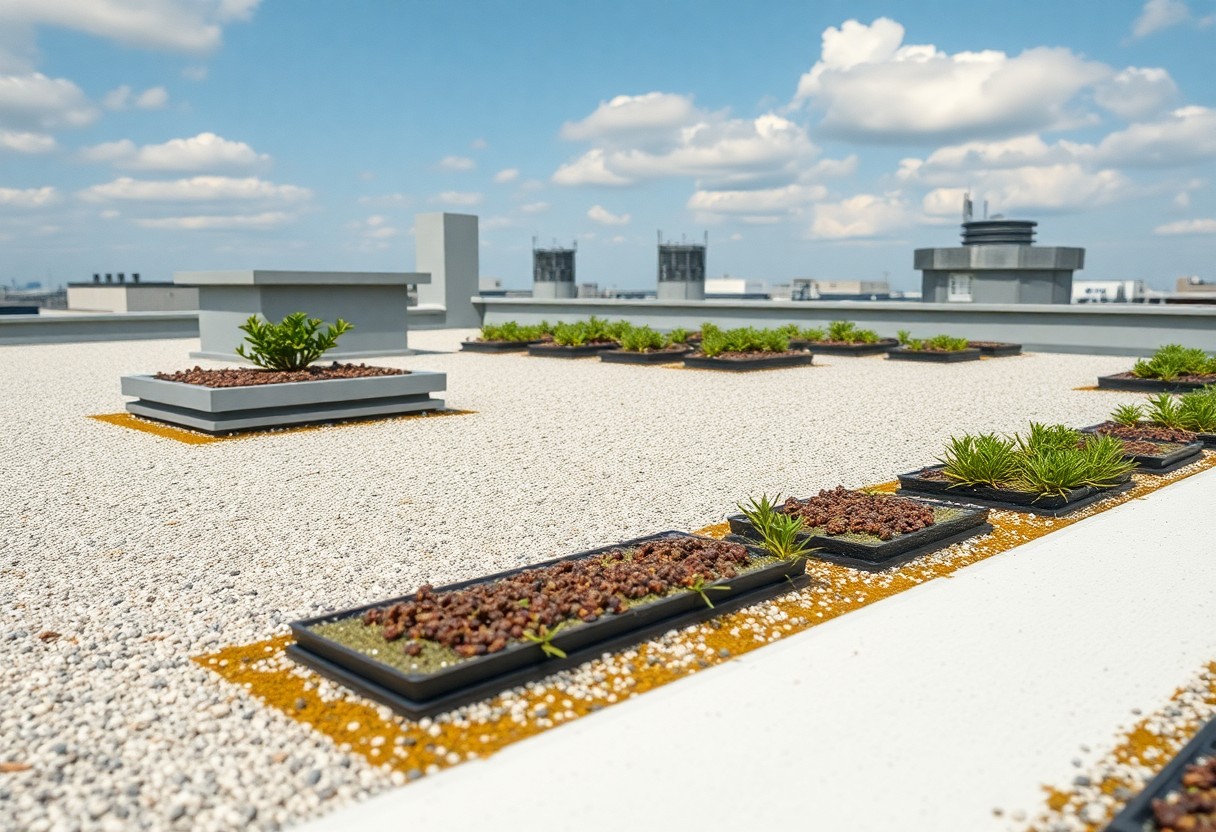
Embodied carbon and end-of-life impacts vary widely between membranes: bituminous systems carry higher fossil-carbon footprints, while single-ply membranes like TPO and PVC offer lighter manufacture emissions but raise disposal concerns. You should weigh recyclability-metal and copper are almost entirely recyclable-against potential hazardous by-products; PVC can release chlorine-containing toxins if incinerated. Green roofs cut runoff and improve biodiversity, with extensive systems able to retain up to 75% of rainfall, reducing urban flood risk and downstream treatment loads.
Sustainable Material Options
Choose materials with long service lives and high recycling value: EPDM often reaches 25-30 years, while copper and aluminium can exceed 60 years and are readily recycled. You can specify membranes with recycled content or select reclaimed metal flashings. Vegetated roofs and recycled aggregate ballast lower lifecycle impacts; for instance, specifying a 30-50mm recycled ballast layer can reduce imported stone use by significant percentages on large roofs.
Energy Efficiency
High-albedo membranes reflect solar radiation-typically 60-80% for white PVC/TPO-which can lower roof-surface temperatures by 10-20°C and cut summer cooling loads by up to 15-20% in warm climates. You should combine reflective membranes with continuous insulation above the deck to avoid thermal bridging, and consider vegetated roofs for additional passive cooling and shading benefits.
Vegetated roofs add thermal mass and delay heat transfer, often reducing peak indoor temperatures and smoothing energy demand; case studies in temperate Europe report annual cooling savings of up to 25% on buildings retrofitted with extensive green roofs. You can also layer 50-100mm of rigid insulation above the membrane or under a warm-roof build-up to further reduce heating losses and lower whole-life energy consumption.
Installation and Maintenance Tips
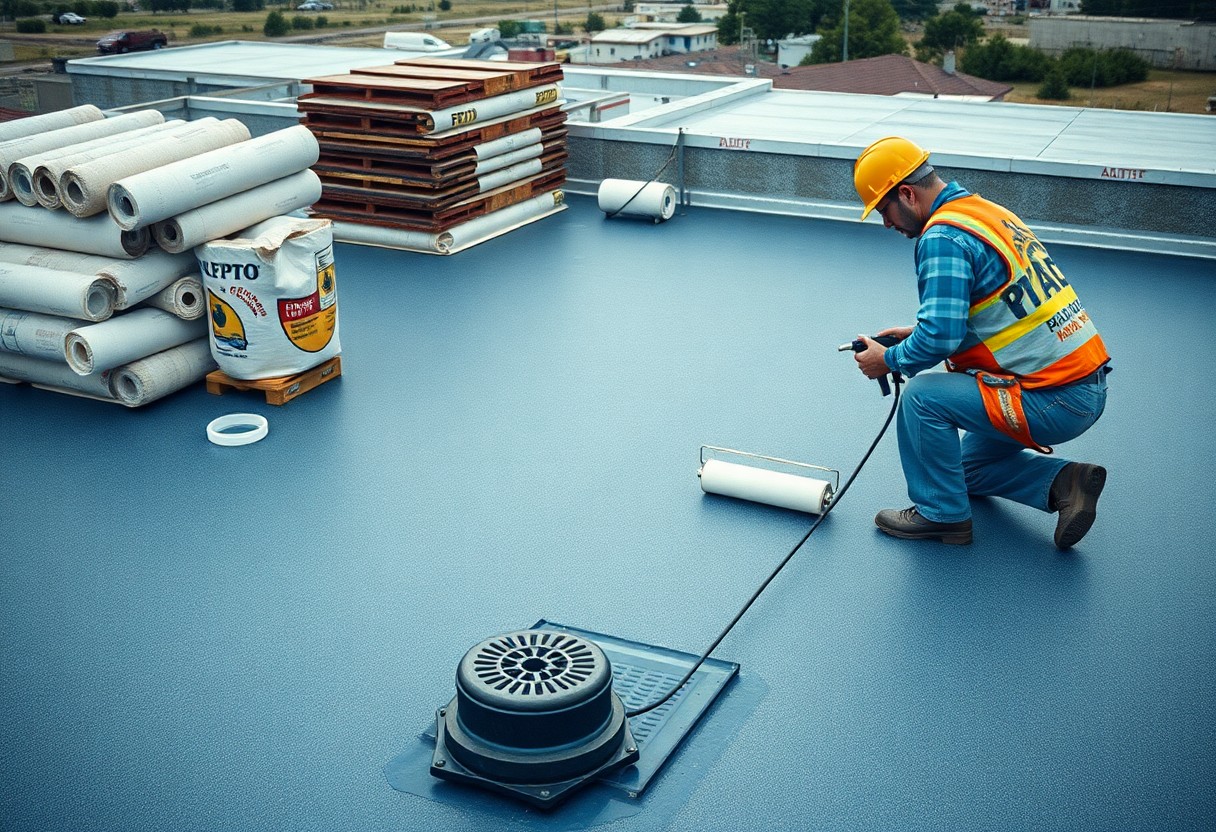
You should inspect flat roofs at least twice a year and after severe storms, checking seams, flashings and outlets; small splits in EPDM or torch-on membranes often predict larger leaks. Use heat-based installation only with trained operatives because of fire risk, and keep gutters clear to prevent ponding which can overload the structure. This extends service life and preserves warranties.
- Inspect twice yearly and after storms; document defects with photos and dates.
- Clear gutters and scuppers monthly during autumn to avoid ponding.
- Reseal seams and penetrations every 5-10 years or sooner if you spot separation.
- Keep vegetation off the roof; moss traps moisture and accelerates decay.
- Arrange a professional survey every 3-5 years and consider infrared scans every 5-10 years.
Professional Installation vs. DIY
You should weigh costs against risk: professional installers typically charge £150-£300 per m² depending on material, and most manufacturers void the warranty after unqualified DIY work. Systems like EPDM and some TPO kits are more DIY-friendly, but complex details-flashings, upstands, rooflights-are common failure points and torch-on methods introduce significant fire risk if mishandled.
Regular Maintenance Practices
You must inspect junctions, flashings and drains twice yearly and after storms; clear leaves monthly in autumn and remove ponding water within 48-72 hours to prevent membrane strain. Repair blisters, tears or seam separation within days using compatible products, and keep a maintenance log to support any future warranty claims.
Use a handheld moisture meter or commission a thermographic survey every 5-10 years to spot trapped wet insulation before rot appears; check upstands, lead or polymer flashings for corrosion or shrinkage and re-seal with manufacturer-approved adhesives. You should also retain copies of invoices and survey reports so you can plan re-cover cycles-typically 15-30 years depending on the material.
Final Words
Now you should consider materials like single-ply membranes (EPDM, PVC, TPO), built-up bitumen, modified bitumen, and liquid-applied coatings; each offers trade-offs in durability, cost, maintenance and ease of installation. Choose EPDM for affordability and longevity, PVC or TPO for chemical resistance and heat reflectivity, modified bitumen for resilience and easy repair, and liquid-applied systems for complex details. Your choice should match building use, climate and budget, and be installed by experienced contractors to ensure watertight performance.
FAQ
Q: What are the leading single‑ply roofing membranes for flat roofs?
A: The three most common single‑ply membranes are EPDM, TPO and PVC. EPDM (ethylene propylene diene monomer) is a synthetic rubber available in large sheets, offering long life (often 25-50 years), ease of repair and good resistance to ozone and UV; it is typically black unless coated for reflectivity. TPO (thermoplastic polyolefin) is heat‑welded at the seams, provides good solar reflectivity and energy performance, and typically lasts around 20-30 years depending on product quality. PVC (polyvinyl chloride) is chemically resistant, weldable at seams for watertight joins, and can be especially suitable where grease or oils may be present; it tends to be more expensive but offers excellent durability and ease of maintenance.
Q: Is modified bitumen a sensible choice for flat roofs?
A: Modified bitumen systems (SBS or APP) combine asphalt with polymer modifiers and are supplied in rolls for torch‑on or cold‑applied installation. SBS‑modified bitumen behaves more elastically at low temperatures and is good for areas with thermal movement, while APP‑modified tends to be more UV resistant and can be installed with a torch or heat‑welded. These systems are robust under foot traffic, provide multiple layers of protection, and commonly achieve service lives of 20-30 years when correctly installed, but they are heavier and may require careful handling and safety procedures during installation.
Q: How do liquid‑applied membranes compare with sheet systems?
A: Liquid‑applied membranes (polyurethane, acrylic, silicone or bitumen emulsions) cure to form a seamless waterproof layer that easily follows complex details, upstands and penetrations. They are applied cold and can be faster to install on awkward shapes, but surface preparation and weather conditions during curing are important for durability. Lifespans vary by chemistry and thickness-typically 10-25 years-and regular inspections and re‑coating schedules may be necessary to maintain watertightness and UV protection.
Q: Are GRP (fibreglass) and built‑up roofing still viable options for flat roofs?
A: GRP (glass‑reinforced polyester) creates a tough, seamless laminate that is highly resistant to water ingress and commonly used for small flat roofs, walkways and balconies; it can last 20-35 years with proper substrate preparation but requires a skilled installer to avoid pinholes and achieve a consistent finish. Built‑up roofing (BUR) uses multiple layers of bitumen and reinforcing felts, sometimes finished with ballast or mineral surfacing, and is long‑lasting and robust against puncture and foot traffic; it can offer 25-40+ years of service but is heavier and involves more disruptive installation than many single‑ply systems.
Q: What factors should influence my choice of flat roof material?
A: Consider climate and UV exposure, expected foot traffic, roof geometry and detail complexity, weight limitations of the structure, fire performance and local building regulations, thermal performance and insulation compatibility, lifecycle cost versus budget, availability of skilled installers, warranty terms, and environmental concerns such as recyclability and surface reflectivity. Matching material properties to site conditions and installer expertise typically matters more to long‑term performance than the material name alone.