
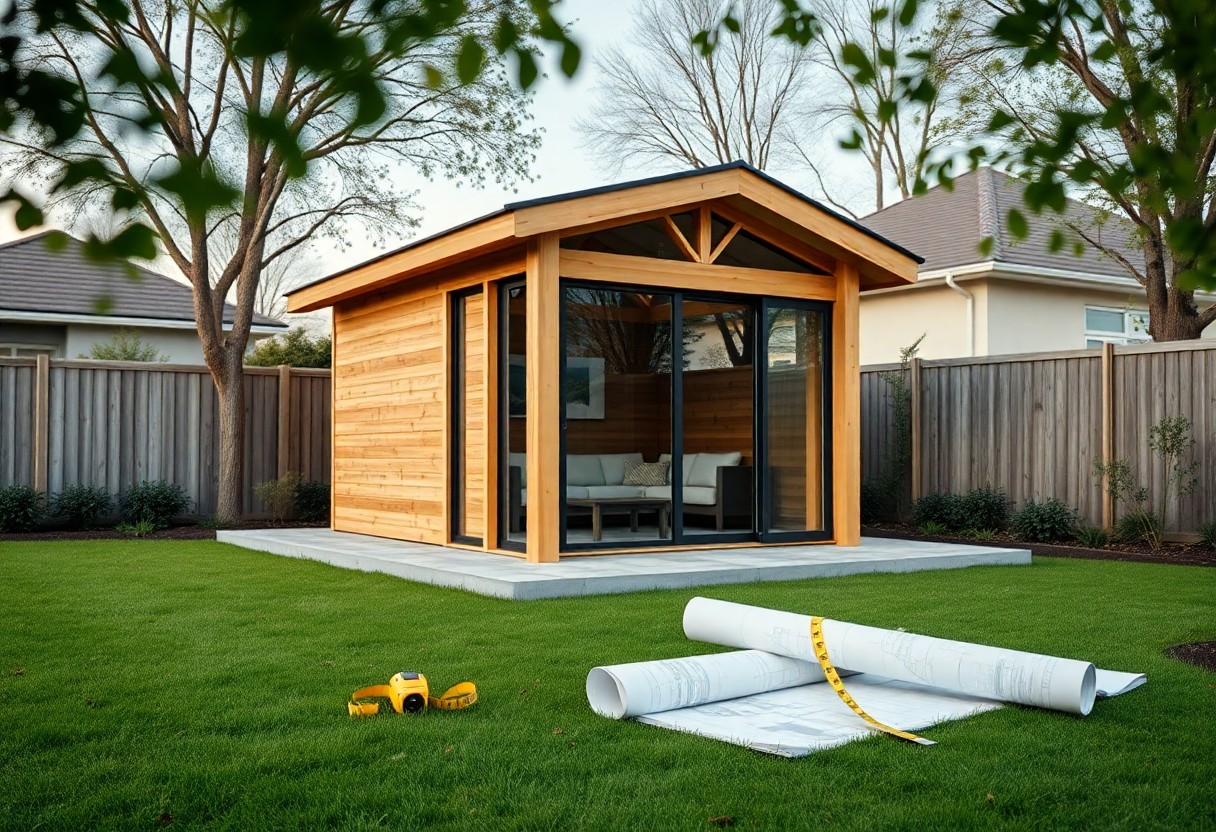
There’s a good chance you can erect a garden office under permitted development rules on size, height, position and use, but whether you must apply depends on your property, conservation area or listed status. You should check boundaries, neighbours and whether the structure’s use counts as an extension of your home; you can often build without permission, yet be aware of the real risk of enforcement action if rules are breached, so obtain assurances or written confirmation where possible.
Most of the time you can erect a garden office under permitted development rights, provided it meets limits on size, height and stays within your property’s curtilage; however, if you live in a conservation area, on a listed building, or in a flood zone you will likely need planning permission, and you must consider neighbour impact and services such as drains and electrics before building.
Understanding Planning Permission
Planning permission determines whether your garden office falls under permitted development or requires a formal application. Permitted development commonly allows outbuildings so long as they do not cover more than half the garden, are no higher than 4m for a dual‑pitched roof or 3m for other roofs, and are not forward of the principal elevation. Exceptions apply if your property is in a conservation area, is listed, or forms part of a flat or new dwelling.
Definition of Planning Permission
Planning permission is the local authority’s written approval for development that exceeds permitted development rights. It is assessed against the local plan and national policy, and householder applications are typically decided within 8 weeks. You can submit a full or outline application, seek pre‑application advice from the council, and appeal if permission is refused or conditions are imposed.
Importance of Compliance
Complying protects you from enforcement action, which can include an enforcement notice requiring removal or alteration of your garden office and potential court fines; costs for remedial work often run into thousands. Planning approval also avoids complications when selling, ensures neighbour disputes are minimised, and demonstrates that the development accords with planning policy and local design standards.
Additionally, you must check building regulations alongside planning rules: foundations, drainage, and electrical work frequently need approval or certification even if planning permission is not required. You should therefore get written confirmation from the council or a building control body, and consider pre‑application advice to reduce the risk of a retrospective application being refused or costly enforcement steps.
Understanding Planning Permission
Many garden offices fall under Class E permitted development, but whether you need formal approval depends on precise limits and local rules: size (no more than half your garden), height (typically up to 4m for dual‑pitched roofs or 3m otherwise, with eaves often restricted to 2.5m near boundaries), location and designation status all matter; exceeding these or building in a conservation area, AONB or on a listed property can lead to enforcement, demolition or fines.
What is Planning Permission?
Planning permission is formal consent from your local planning authority to carry out development; permitted development rights under the General Permitted Development Order let you erect many garden outbuildings without it. You must still meet Building Regulations for structural work, electrics or sanitation, so lack of planning consent does not exempt you from safety and compliance obligations.
When is Planning Permission Required?
You will need permission if your garden office breaches permitted development limits – for example if it covers more than 50% of the original garden, is in front of the principal elevation, exceeds height limits (over 4m dual‑pitched or 3m other roofs) or has eaves above 2.5m when within 2m of a boundary. Designated areas often remove PD rights.
To illustrate, a detached 3m‑high, 4m×3m office set at the rear usually sits within PD, whereas a 5m×4m building with a 3.2m eaves or one in a conservation area likely requires an application. You should check for local Article 4 directions, seek pre‑application advice from the council and note that failure to obtain permission can result in an enforcement notice and mandatory changes or removal.
Garden Office Regulations
You can often erect a garden office under permitted development, but you must meet specific tests on size, use and location; for example, the outbuilding must not be used as a self-contained home and must not cover more than 50% of your garden. You also need to factor in building regulations for electrics, insulation and drainage, and local designations like conservation areas can remove permitted development rights.
Permitted Development Rights
Under Class E of permitted development you may build a single-storey outbuilding without full planning permission provided it sits within the curtilage, is incidental to the house and complies with limits such as the half-the-garden footprint. If you live in a National Park, AONB, World Heritage Site or a conservation area you may have to apply for permission despite Class E.
Size and Height Restrictions
Standard rules cap height at 3m for most roofs and 4m for a dual-pitched roof, while any part of the building within 2m of a boundary should generally keep eaves to 2.5m. The structure must remain single-storey and not exceed half the area of land around the original house; garages and other outbuildings count towards that limit.
If you plan a 4m x 6m office (24m²) in a 200m² garden you’d be under the 50% cap, yet local planning officers still assess visual impact and overshadowing; for instance, a 4m ridge facing a neighbouring window can prompt objections. You should check local authority design guides and consider pre-application advice if your office sits close to boundaries or exceeds typical heights.
Garden Office Regulations
Planning rules mean you can often build without full permission, but only if you meet strict limits: no more than 50% of your garden may be covered by outbuildings, the structure must not be forward of the principal elevation, and special protections like conservation areas or Article 4 directions can remove permitted rights. If your project includes significant services, regular clients or overnight stays, you may need planning permission or building regulations approval.
Size and Height Restrictions
You must keep within permitted development dimensions: no more than 50% of garden area, not forward of the house, and height limits of 4 metres for a dual‑pitched roof or 3 metres for other roofs. If the building sits within 2 metres of a boundary the maximum height drops to 2.5 metres. For example, a 3m x 4m flat‑roof office is acceptable if it sits more than 2m from the boundary.
Use Restrictions and Conditions
The outbuilding must be ancillary to your home – used as an office for your household or occasional remote work. If you run a business with regular staff, clients visiting, or create a separate residential unit, local authorities often treat it as a change of use and will require planning permission; business rates or formal change‑of‑use can follow. In conservation areas or for listed buildings, assume permissions are needed.
More detail: if you fit a kitchen, bathroom or sleeping area the council may judge the office to be a self‑contained dwelling, increasing the chance you’ll need planning consent. Likewise, installing significant utilities or creating dedicated access for staff or customers strengthens the case for a commercial use classification. You can reduce risk by keeping facilities minimal, tying the office to your main house (no separate post), and seeking a pre‑application advice from your local planning authority.
Factors Influencing Requirements
Your need for a planning permission for a garden office hinges on site-specific limits: permitted development allows outbuildings for houses up to a 4 m ridge height (dual‑pitched) or 3 m otherwise, eaves under 2.5 m, and no more than 50% of the garden taken; listed buildings, conservation areas or Article 4 directions often remove those rights. Recognizing how these metrics and local controls interact will determine whether you must apply.
- Height limits: 4 m ridge / 3 m other; 2.5 m max if within 2 m of boundary
- Garden coverage: must not exceed 50% of the curtilage
- Location constraints: conservation area, listed status, Article 4
- Property type: permitted development applies to houses, not flats/maisonettes
Local Council Guidelines
When you consult your local council, expect variation: many councils publish clear guidance and interactive maps, some charge for a pre‑application (commonly £50-£300), and planning officers will flag neighbour amenity, biodiversity or heritage concerns; engaging early with officers and using a pre‑app reduces the chance of refusal.
Property Location and Zoning
Where your property sits affects the rules: if you’re in a conservation area or the curtilage of a listed building, permitted development rights are commonly withdrawn and you’ll likely need full planning permission; areas subject to Article 4 directions can remove PD rights across whole streets or wards, so check council maps and notices.
Delve deeper: Article 4 directions are increasingly used in town centres, while National Parks, AONBs and the Green Belt impose tighter controls and often require applications for outbuildings that would be permitted elsewhere, so you should review the council’s policy documents and speak to planning staff before committing to designs.
Permitted Development Rights
What are Permitted Development Rights?
Permitted development lets you add an outbuilding for a garden office without full planning permission under Class E of the GPDO, provided it is incidental to the house, single‑storey and does not cover more than 50% of your garden. You can often secure certainty by applying for a Lawful Development Certificate, which confirms the works are lawful if you meet the technical limits.
Limitations of Permitted Development Rights
Height and siting limits restrict what you can build: maximum overall height is typically 4 metres for dual‑pitched roofs, 3 metres for other roofs, and 2.5 metres if the building is within 2 metres of a boundary. Permitted rights do not apply on certain designated land (National Parks, AONBs, conservation areas, World Heritage Sites) and you cannot use them to create a separate dwelling.
Practically, you must also avoid building forward of the principal elevation, keep the structure incidental to your home, and be aware that local councils may issue an enforcement notice if limits are breached; for example, covering more than 50% of the curtilage or exceeding height limits commonly triggers action. Additionally, installing services or insulation for regular office use will usually require building regulations approval and may affect the permitted status.
Alternative Solutions
When planning routes stall, you can pursue alternatives such as a modular garden pod or a summerhouse that stays within permitted development dimensions – commonly up to 4m ridge height for dual‑pitched roofs, 3m for other roofs and 2.5m if within 2m of a boundary. You might also seek a Lawful Development Certificate (LDC) to confirm rights; an LDC application currently costs £103 and is usually determined in around 8 weeks, reducing the chance of enforcement action.
Neighbour Consultation
You should notify adjacent owners early and provide scaled plans and elevations; most councils allow about 21 days for comments on householder applications. Offering reduced height, revised siting or landscaping often turns objections into support – for example, dropping eaves below 2.5m or moving the office 1-2 metres from a shared fence can remove visual impact and persuade neighbours to withdraw complaints.
Appeals Process
If your application is refused you can appeal to the Planning Inspectorate by written representations, hearing or inquiry; there is no fee for a planning appeal in England. Appeals are normally decided within a few months, often taking roughly 12-24 weeks depending on complexity and the chosen procedure, so factor this delay into your project timeline.
Prepare a focused appeal pack: include the council’s decision notice, clear site plans, photographs, a concise planning statement referencing the local plan and the NPPF, and a record of neighbour engagement. You increase success odds by addressing the reasons for refusal directly, submitting comparative examples of similar approvals nearby, and obtaining pre‑application advice or professional drawings to demonstrate proportional scale and mitigation measures.
Considerations Before Building
Before you begin, verify permitted development limits: outbuildings must not cover more than 50% of the garden, and heights are capped at 4m for dual‑pitched roofs, 3m for other roofs, or 2.5m if within 2m of a boundary. Check conservation area or listed-building restrictions, flood risk maps and access for cranes or deliveries. Factor in foundations, drainage and insulation so your office meets building-regulation standards and avoids retrospective action.
Location and Site Assessment
Survey your plot for services, slopes and tree protection zones; keep at least 2m from boundaries where possible and allow 1.5-2m clearance for maintenance. Identify underground gas, water and electrical runs before excavating and plan drainage and a soakaway away from neighbours’ foundations. If ground is unstable or clay-rich, budget for reinforced strip or raft foundations and consult a structural engineer.
Neighbour Relations and Considerations
You should notify neighbours early, show simple plans and state hours to minimise objections; where work affects a shared wall or sits on the boundary, serve a notice under the Party Wall etc. Act 1996 and allow time for a response. Good communication often prevents formal disputes that could force a planning application or delay work.
Offer a written schedule of works, proposed start dates and agreed working hours (commonly 08:00-18:00 weekdays), and be prepared for a Party Wall award which may incur surveyors’ fees typically £300-£1,500. Document access arrangements, propose reinstatement terms and, when appropriate, provide temporary screening; these practical steps reduce the chance of complaints escalating to the council or legal action.
Benefits of a Garden Office
You gain a private workspace that frees up your house, boosts productivity and can cut commute time; in practical terms this often means better focus, clearer boundaries between work and home and an attractive selling point for future buyers. Estate agents cite increased demand for homes with dedicated garden rooms, while you also benefit from flexibility to host meetings, store equipment or rent the space as a studio, all without altering your main living area.
Increased Property Value
You may see a tangible uplift in asking price: some agents report a 5-10% increase where a well-built garden office adds usable living or working area. Installations with insulation, double glazing and integrated electrics tend to attract higher offers. Pay attention to size and finish – a 3x3m timber pod will appeal less than a fully insulated 4x4m room with wired internet – and note that compliance with building regs can preserve resale value.
Enhanced Work-Life Balance
You get a clear separation of work and home life that reduces interruptions and mental load, and can reclaim time otherwise lost to commuting; for example, if you previously spent 40 minutes each way, you recover about 80 minutes daily for family or exercise. Establishing a dedicated space helps you switch off at the end of the day and supports consistent routines that boost long‑term wellbeing and productivity.
To make the balance work for you, focus on physical and behavioural measures: soundproof the room, ensure good ventilation and natural light, and set strict start/finish times. Aim for comfortable conditions – roughly 300-500 lux for task lighting and around 18-21°C – and install sufficient sockets, wired internet and a smoke detector. Also check building regulations and electrics so you avoid safety issues that could undermine both comfort and value.
Alternatives to Planning Permission
Permitted development lets you add outbuildings without full planning so long as they don’t cover more than 50% of the garden, aren’t forward of the principal elevation and meet height limits (typically 2.5m where within 2m of a boundary, otherwise up to 3m-4m depending on roof type). You can also use change‑of‑use allowances for certain business activities, or sit temporary/mobile units, but building regulations, fire, drainage and long‑term occupancy risks still apply and can trigger enforcement.
Mobile and Temporary Structures
You can deploy garden pods, converted caravans or shipping containers as temporary offices provided they remain movable, aren’t permanently connected to mains services and comply with size and siting PD limits; typical pod sizes are around 2.4m x 3m. If you install permanent foundations, connect gas or mains drainage, or locate in a protected area, the council will often treat the unit as development and require an application – and you must still meet electrical and fire safety standards.
Planning Applications Overview
If your design exceeds PD limits, is in a conservation area, AONB or listed site, or creates a separate business address, you’ll need a planning application. Householder applications in England usually cost about £206 and are decided in roughly 8 weeks; pre‑application advice from your council can reduce delays and highlight likely conditions.
When you apply you’ll submit location and block plans, elevations, and sometimes a design and access statement; neighbours are consulted and conditions can include removal or restriction of use. Listed buildings require separate consent, and planning permission does not remove the need for building regulations which cover insulation, means of escape and electrics; appeals and discharged conditions can extend the process by months.
Common Misconceptions
Many people assume a garden office always sits outside planning rules; in fact permitted development allows outbuildings up to 4m (dual‑pitched) or 3m (other roofs), but if within 2m of a boundary height is limited to 2.5m and you must not cover more than half the original garden. You also need to watch use (not a separate dwelling), building regulations for services, and the enforcement periods of 4 years for building works and 10 years for a change of use.
DIY Builds vs. Professional Construction
You can save significant cash with DIY kits – typically £2,000-£6,000 for a basic insulated pod – while bespoke professional builds commonly run from £8,000-£25,000. However, incorrect foundations, poor insulation or unsafe electrics can lead to damp, heat loss and voided warranties; professionals supply structural calculations, building‑regulation compliance and certifications that protect you and your insurance.
Temporary Structures and their Implications
Demountable cabins and shed offices may be treated as temporary and less likely to need immediate planning, yet if they are fixed to foundations, connected to mains services, or left in place beyond a short period they risk being classed as permanent; enforcement rules give 4 years immunity for building operations, so duration and permanence matter.
For example, installing mains electricity or a drainage connection usually triggers building regulations and a formal sign‑off by building control or a registered installer under Part P, while running a business that attracts visitors can change the planning assessment. If you want flexibility, choose a fully demountable design on a reversible base and avoid permanent services; if you plan year‑round use, invest in proper foundations, insulation and professional certification to avoid enforcement action and safety hazards.
Case Studies
- 1) You see a suburban London terrace where a 3.5m × 2.8m detached garden office with a flat roof and 2.4m eaves was delivered under permitted development; total cost £8,200; build time 5 weeks; planning permission not required and no neighbour objections recorded.
- 2) You review a Manchester pitched-roof unit 4.0m × 3.5m (ridge 3.9m) in a conservation area: initial application refused, resubmitted with reduced glazing and matching materials; final approval after 14 weeks; total cost £15,800 including fees and design changes.
- 3) You study a semi‑rural Kent project where a 6.0m × 4.0m outbuilding exceeded the 50% curtilage limit; a retrospective planning permission application and redesign reduced floorspace to 48%, enforcement avoided; retrospective costs £3,200; resolution time 6 months.
- 4) You analyse a listed‑building case in a village: proposed 2.5m × 2.5m pod required Listed Building Consent and planning; decision reached in 20 weeks with conditions to use traditional materials; project cost £7,500; two neighbour objections recorded.
- 5) You inspect an urban terrace where a 5.0m × 3.0m rear outbuilding was built under PD but required building regulations compliance for electrics and insulation; inspection passed; total cost £11,000; completion 7 weeks.
Successful Garden Office Builds
You can often proceed without a full application when you keep to common thresholds – typically a dual‑pitched roof up to 4m, other roofs up to 3m, and eaves not more than 2.5m if any part is within 2m of the boundary – and keep outbuildings under 50% of the original curtilage; typical builds finish in 4-8 weeks and cost between £8k-£16k depending on finishes.
Issues Faced with Planning Applications
You frequently encounter refusals due to location in a conservation area or listing, neighbour objections about overshadowing or privacy, breaches of the curtilage limit, or proposals that exceed height limits; those situations can trigger enforcement notices, retrospective applications, and additional costs.
To reduce risk you should seek pre‑application advice from your local authority, use professional drawings and daylight/impact studies where required, and budget for the statutory 8‑week decision period for householder applications; appeals may extend timelines by several months and increase costs if redesigns or materials changes are imposed.
Final Words
Summing up you can often erect a garden office under permitted development, provided it is incidental to your house, within curtilage limits, not forward of the principal elevation, not exceed 50% of the garden, single storey with maximum heights (3m for most roofs, 4m for dual‑pitched, or 2.5m if within 2m of a boundary), not used as a separate dwelling, and not in areas where rights are removed (conservation areas, listed buildings, AONB, national parks, Article 4). Check local planning or obtain a lawful development certificate to be sure.
Final Words
So you can often build a garden office without planning permission under permitted development rights, provided it is single-storey, does not occupy more than half the garden, meets height and distance-from-boundary limits, is not forward of the principal elevation and is not in a conservation area, AONB or adjacent to a listed building; if it breaches those rules or you intend residential use you will need planning permission, and building regulations still apply for electrics, insulation and foundations.
FAQ
Q: Can I build a garden office without planning permission?
A: In many cases yes – a garden office can be built under permitted development rights without the need for planning permission, provided specific conditions are met. The outbuilding must be single‑storey, be incidental to the use of the main house (not a separate dwelling), and must not occupy more than half of the garden or be sited forward of the principal elevation facing a road. However, permitted development rights can be restricted or removed for some properties, so you should verify your property’s status with the local planning authority before proceeding.
Q: What size and height limits apply to a garden office under permitted development?
A: The main limits are: the combined area of all outbuildings in the curtilage must not exceed 50% of the total area of land around the original house; the building must be single‑storey; and height limits depend on roof type and position. If any part of the building is within 2 metres of a boundary its height must not exceed 2.5 metres; otherwise the maximum height is 4 metres for a dual‑pitched roof and 3 metres for any other roof form (including flat roofs). The building must not have a veranda, balcony or raised platform and should not be used as independent residential accommodation.
Q: Are there special restrictions if my house is listed or in a conservation area, AONB or National Park?
A: Yes. Listed buildings always require listed building consent for alterations and any outbuilding that affects the setting may need planning permission. In conservation areas, Areas of Outstanding Natural Beauty, National Parks and World Heritage Sites, permitted development rights are often limited or subject to additional local controls, and you may therefore need to apply for planning permission. Your local planning authority can confirm whether any Article 4 direction or local policy removes or restricts permitted development rights for your property.
Q: Do I still need Building Regulations approval, even if planning permission is not required?
A: Possibly. Building Regulations cover structural safety, thermal performance, ventilation, drainage and electrical safety and can apply independently of planning permission. You are likely to need approval for fixed wiring, permanent heating, drainage connections, and any structural works such as foundations or loadbearing elements. If the office will be used for sleeping accommodation, different standards may apply. Contact your local authority building control or an approved inspector to confirm requirements and obtain any necessary approvals.
Q: What practical steps should I take before building to avoid enforcement action or delays?
A: Check whether your property retains permitted development rights and whether any Article 4 directions, conservation area status or listing affects those rights; consult the local planning authority’s guidance. If you want certainty that no planning permission is required, apply for a Lawful Development Certificate (a decision is usually issued within eight weeks). Confirm Building Regulations requirements and notify or instruct an approved inspector if needed. Check the Party Wall etc. Act if building close to a neighbour’s boundary, inform neighbours and consider materials and siting to minimise visual impact. If in doubt, submit a full planning application to eliminate uncertainty.