
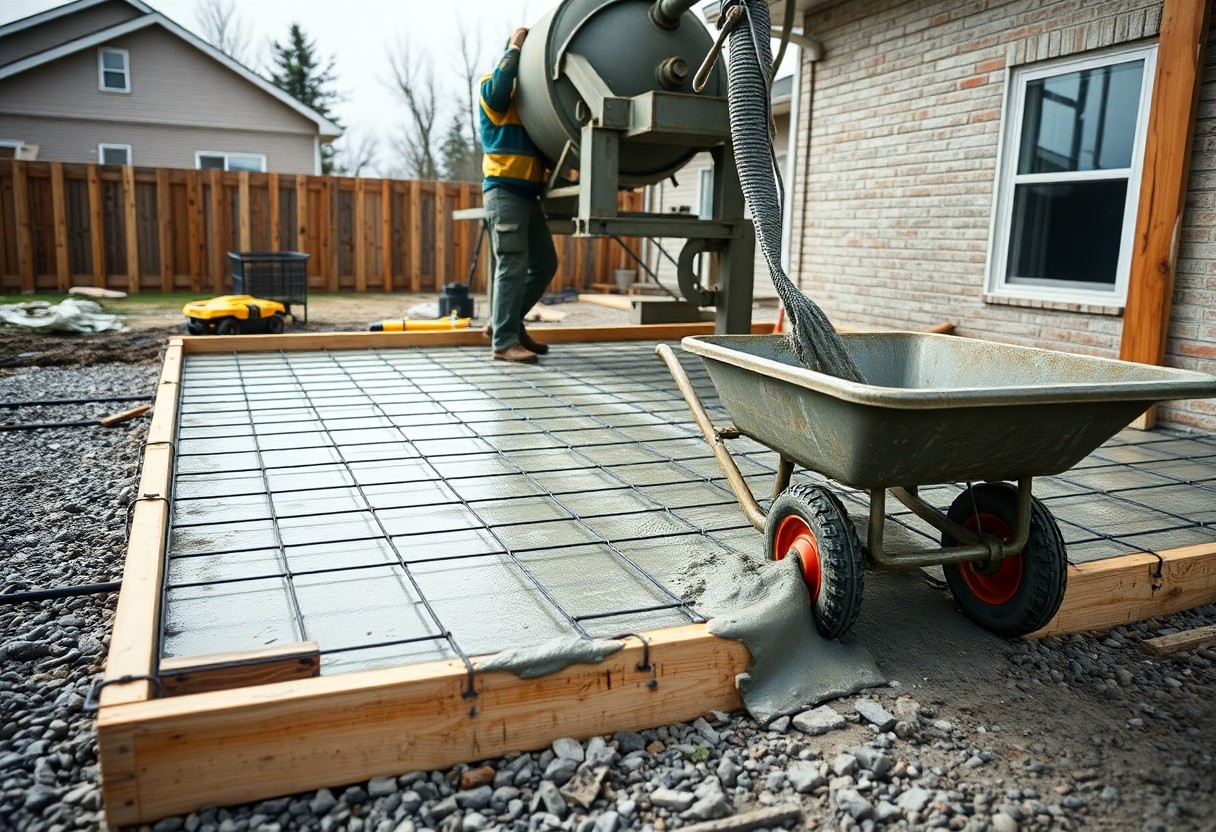
Just as a flat, poured foundation, a concrete slab gives your building structural support for garages, patios and ground-floor extensions; you need one when soils cannot bear concentrated loads or when you require a durable, low-maintenance surface. If your site lacks a stable subgrade or drainage, you risk settling and cracking, so ensure the project includes a properly compacted sub-base and drainage and professional design for safe, long-lasting performance.
What Is a Concrete Slab?
When you need a flat, load-bearing floor or foundation, a concrete slab is a horizontal element cast in place or prefabricated from cement, aggregate and water, often with reinforcement to control bending and shear. Typical domestic slabs are 75-150 mm thick; industrial or structural slabs reach 150-300+ mm, and inadequate jointing or drainage can cause cracking.
Definition and Composition
You assemble a concrete mix from cement, graded aggregates, water and possible admixtures; the water-cement ratio and aggregate grading determine strength and durability, while reinforcement (rebar, mesh or fibres) controls tensile behaviour and curing for 7-28 days ensures targeted compressive strength (commonly 20-40 MPa).
- Concrete slab
- Reinforcement
- Water-cement ratio
- Any curing time affects strength gain
| Material | Cement, sand, coarse aggregate, water, admixtures |
| Reinforcement | Steel rebar, welded mesh, synthetic fibres |
| Typical strength | 20-40 MPa for general use; up to 50+ MPa for specialist |
| Thickness range | 75 mm (domestic) to 300+ mm (industrial) |
| Common issues | Settlement, shrinkage cracking, freeze-thaw damage |
Types of Concrete Slabs
You choose between ground-bearing (raft or slab-on-ground), suspended (beams or hollow-core), post-tensioned and waffle or ribbed slabs depending on span, load and ground conditions; ground-bearing slabs suit stable soils, while post-tensioned slabs let you cover longer spans with reduced thickness and less deflection.
You often size slabs by load: a domestic garage may need 100-150 mm on compacted subbase, a light industrial floor 150-200 mm, and a heavy-duty warehouse slab with heavy wheel loads may exceed 250-300 mm with mesh and additional rebar; soil bearing capacity (kPa), imposed load (kN/m²) and joint layout guide your specification.
- Ground-bearing slab
- Suspended slab
- Post-tensioned slab
- Any waffle/ribbed slab reduces weight for long spans
| Type | Ground-bearing, suspended, post-tensioned, waffle |
| Typical thickness | 100-150 mm (domestic) to 250+ mm (industrial) |
| Span capability | Ground: local only; post-tensioned: spans of several metres with thin section |
| Typical uses | Floors, driveways, basements, multi-storey slabs |
| Advantages | Cost-effective for ground-bearing; post-tensioned saves depth and reduces cracking |
Benefits of Using Concrete Slabs
Durability and Strength
Concrete slabs routinely deliver high compressive performance-typical residential mixes are around 25-40 MPa-and, with proper reinforcement, resist heavy loads from vehicles and machinery. You’ll get service lives commonly in the 50-100 year range; warehouses and industrial floors often exceed 60 years with minimal repair. However, poor subgrade preparation or drainage causes settlement and cracking, so your site preparation and reinforcement choice determine long-term performance.
Cost-Effectiveness
Installed concrete slabs often cost less per m² than suspended floors, particularly when you factor reduced maintenance and an extended service life; typical installed rates in the UK range approximately £50-£100/m² depending on access and ground conditions. You’ll save on ongoing repairs and replacements, making slabs a strong value when you plan for decades of use.
For perspective, a 50 m² single-car garage slab at £50-£100/m² equates to about £2,500-£5,000 installed; that same footprint with more complex foundations or a suspended timber floor can be 1.5-2× the cost. You should also budget for DPM, insulation and any reinforcement-these raise initial outlay but lower life-cycle costs. If groundworks are inadequate, you face extra remedial expenses, so proper site investigation pays off.
Common Uses of Concrete Slabs
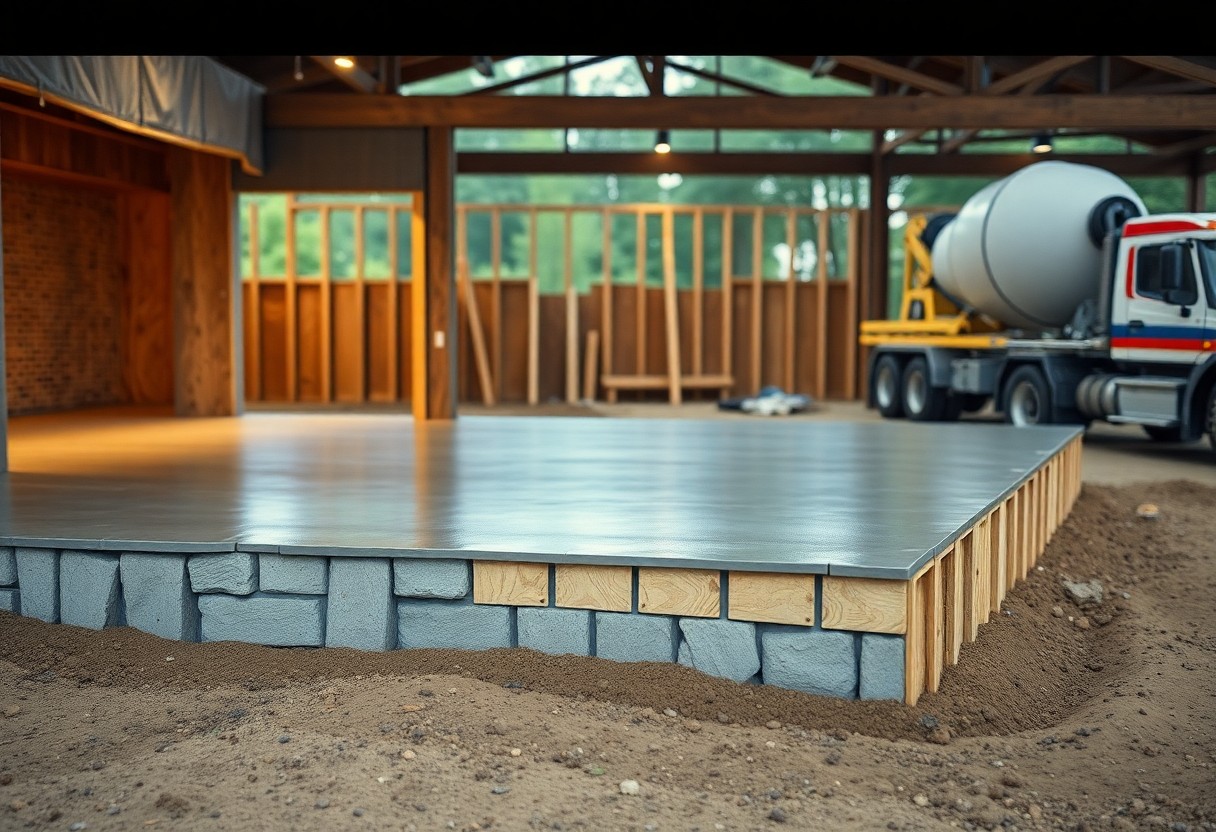
You encounter slabs in patios, driveways, garage bases, warehouse floors and pavements; typical thicknesses range from 50-100 mm for light-use surfaces to 200-300 mm for heavy-duty industrial floors. Domestic patios often use a 75-100 mm slab on a compacted subbase, while driveways commonly require 150 mm with mesh reinforcement. Subbase preparation, drainage and control joints determine long-term performance, so adequate subbase and jointing are as important as concrete strength.
Residential Applications
When you commission a domestic slab, garden paths are usually 50-75 mm, patios 75-100 mm and garage floors 100-150 mm with mesh or fibre reinforcement; ground-bearing floor slabs often target ~150 mm. Underfloor heating requires slab depth and insulation coordination, and a well-compacted subbase prevents settlement. Poor drainage or inadequate compaction leads to differential movement and cracking, so specify proper subbase thickness and control joints to protect your investment.
Commercial Applications
In commercial settings you need slabs that resist forklifts, racking loads and HGV traffic; typical warehouse slabs are 200-300 mm thick with 30-40 MPa concrete and reinforcement or fibres. Joint design, dowels and hard-wearing finishes such as power trowelling with chemical hardeners extend service life. If you under-design for wheel loads, structural failure and expensive repairs can result, so follow engineering specifications closely.
For example, a distribution centre might use a 250 mm slab over a 150-300 mm compacted Type 1 subbase, sized for wheel loads up to 50 kN per wheel; engineers often call for saw-cut control joints every 3-6 m, dowelled joints across aisles and a 28‑day compressive strength of 30-40 MPa. You should allow at least seven days before light traffic and 28 days for full strength, and consider fibres or mesh to reduce cracking and speed up construction.
Factors to Consider Before Installation
Assess the soil bearing capacity, expected live loads and drainage because a domestic slab is often 100-150mm while vehicular use normally requires 150-200mm with reinforcement; check site access for plant, locate underground services and confirm planning constraints, and compare options via Concrete Slab vs. Other Foundation Types. Thou must verify local ground reports and service locations before ordering concrete.
- concrete slab
- site preparation
- drainage
- load-bearing
- climate
Site Preparation
You should excavate to a firm subgrade, strip vegetation and install a 100-150mm compacted hardcore sub‑base to about 95% compaction, place geotextile and a DPM, set falls (typically 1:80) to drainage, mark service runs, and position reinforcement on chairs at mid‑depth; arrange compaction testing and allow moist curing for at least 7 days with full strength by 28 days.
Climate and Weather Conditions
Plan pours around temperature and precipitation: avoid placing concrete when ambient temperatures are below 5°C without protection because strength gain slows, and in hot spells above 25°C use retarders and intensive curing to prevent cracking; select air‑entrained mixes for freeze-thaw exposure and shelter fresh concrete from heavy rain to protect surface finish.
Frost penetration and ground movement vary regionally-designers commonly allow about 300-600mm for frost depth depending on location-so you may need edge insulation or deeper foundations; provide control joints at roughly 3-4m intervals, specify air‑entrained concrete where freeze-thaw is frequent, and, in cold conditions, use heated enclosures, accelerators or insulated blankets to keep the core above about 5°C for the first 48-72 hours.
Installation Process
Step-by-Step Guide
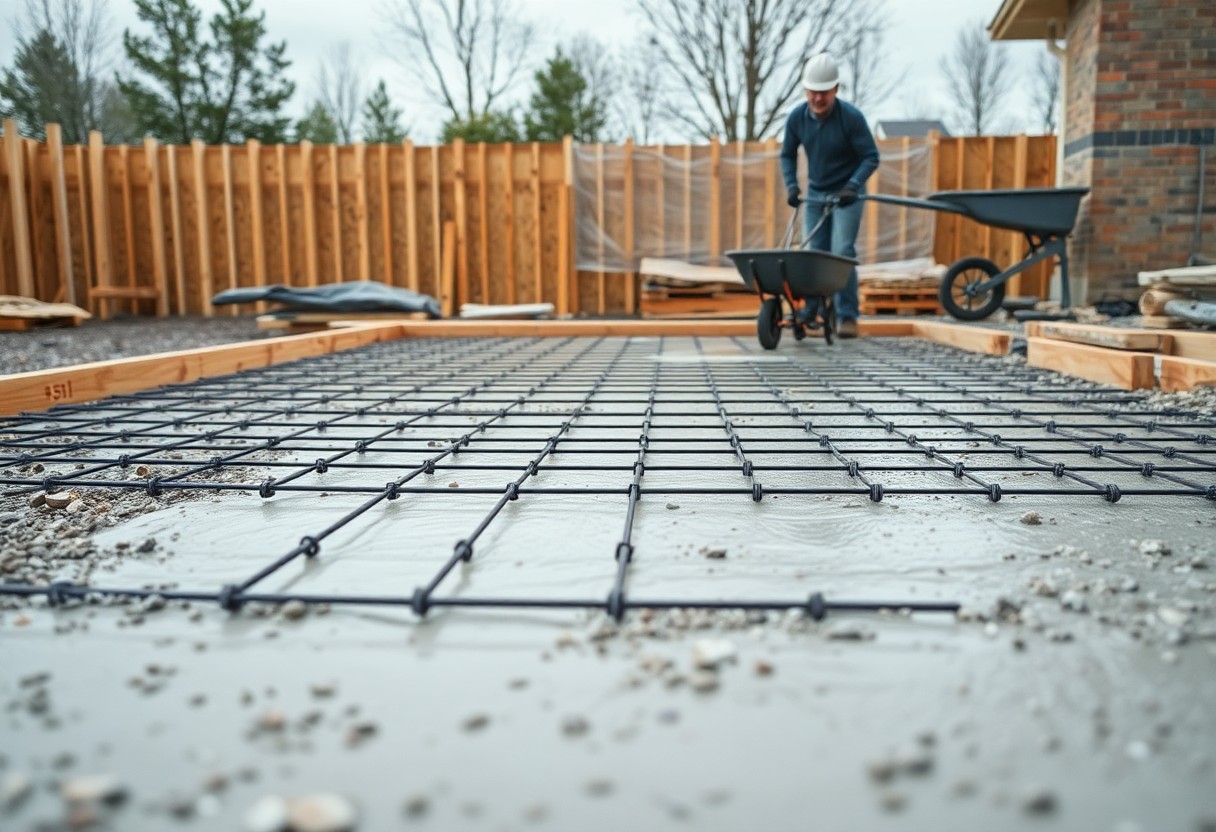
Begin by excavating to the required depth-typically 150-300 mm depending on soil and load; then lay and compact a 100-150 mm crushed stone sub-base to 95% Proctor. Set level formwork, place reinforcement (welded mesh or bars) with 50-75 mm cover, pour a 25 MPa concrete mix, screed and finish. Allow light foot traffic after 24-48 hours, protect and cure for at least 7 days, and expect design strength at 28 days for full loading.
Installation at a glance
| Step | Typical value / check |
|---|---|
| Excavation | 150-300 mm depending on subgrade; remove organic matter |
| Sub-base | 100-150 mm crushed stone; compact to ≥95% Proctor |
| Formwork & levels | Timber/aluminium, checked with spirit level; falls 1:80-1:100 for drainage |
| Reinforcement | Welded mesh or bars; 50-75 mm cover; lap lengths per spec |
| Concrete | 25 MPa typical domestic; 0.1 m³ per m² for 100 mm slab |
| Curing & joints | Saw-cut control joints 12-24 hrs; cure 7 days minimum, 28 days for full strength |
Common Mistakes to Avoid
Poor compaction, inadequate thickness and missing control joints cause most failures; if you skimp on a sub-base or use insufficient reinforcement, expect settlement or cracking. Avoid pouring in heavy rain or frost, and don’t delay saw-cutting-saw joints within 12-24 hours in typical UK conditions to control crack patterns. These errors can lead to structural damage, ponding and trip hazards that are costly to repair.
Mitigate risks by compacting to ≥95% Proctor, specifying a minimum of 150 mm for vehicle-bearing slabs, and using the correct mesh/cover. If your site has poor clay or peat, get geotechnical advice; provide falls of 1:80 for drainage and cure with wet hessian or a curing compound for 7 days. For quantity planning, use 0.1 m³ per m² for a 100 mm slab to avoid under-ordering or excessive waste.
Maintenance and Longevity
Proper care makes a concrete slab last far longer – typical service life ranges from 25-50 years when mixed and placed correctly. You should reseal and inspect joints every 3-5 years, and thicker industrial slabs (typically 150-300mm) resist heavy loads better than residential 100-150mm sections. Routine cleaning, prompt crack repair and correct drainage reduce failure risk; see community practical examples at Is concrete slab a necessity in all structures or it …
Care Tips for Concrete Slabs
You should sweep and wash with a pH‑neutral detergent, avoid de‑icing salts that cause freeze-thaw damage, and keep surface drains clear to prevent ponding. Patch hairline cracks (3mm) with resin‑based fillers and reseal every 3-5 years to maintain surface integrity. Thou should log inspections and repairs so you can spot trends early.
- concrete slab – clean monthly
- sealant – reseal every 3-5 years
- drainage – provide fall of at least 1:80 (12.5mm per metre)
- repair – patch cracks <3mm with epoxy
Signs of Wear and When to Repair
Small hairline cracks under 3mm are often cosmetic, but recurring cracks, sinkage over 10mm across a metre or cracks widening past 6mm indicate structural movement. You should act faster when you see spalling or exposed rebar, as corrosion accelerates failure. Monitor and measure changes seasonally to judge activity.
In one case study a domestic garage slab with 15mm settlement over 2m required underpinning and partial replacement; for cracks under 3mm epoxy injection often suffices, while active or leaking cracks call for polyurethane foam repairs and drainage correction. You should consider overlay or full replacement when more than 25% of the slab is affected or tilt exceeds 30mm.
To wrap up
Considering all points, a concrete slab is a flat, reinforced or plain mass of cured concrete that forms a stable foundation or floor; you need one when your building or hardstanding requires a durable, load-bearing, moisture-resistant base, when ground conditions or local regulations prevent shallow footings, or when speed and cost-effectiveness are priorities.
FAQ
Q: What is a concrete slab?
A: A concrete slab is a flat, horizontal surface of cast concrete used as floors, roofs or bases. It typically consists of a concrete mix poured over a compacted sub-base and often includes reinforcement such as steel mesh or rebar, a damp-proof membrane and expansion/control joints to manage cracking. Slabs are produced as ground-bearing (slab-on-ground) or suspended slabs supported on beams, columns or walls, each suited to different site and structural conditions.
Q: When is a concrete slab the appropriate choice for a building project?
A: A slab is appropriate when you need a durable, level surface for a garage, workshop, patio, driveway, industrial floor or the ground-floor of a low-rise building without a basement. It is commonly chosen where ground conditions are stable and loads are spread relatively evenly, or where a quick, economical ground-bearing solution is preferred. For poor soils, deep frost risk or heavy point loads, alternative foundations (strip footings, raft foundations or piles) may be required.
Q: How is a typical ground-bearing concrete slab constructed?
A: Construction normally involves excavating to the required depth, placing and compacting a granular sub-base, laying a damp-proof membrane, installing formwork and reinforcement, pouring and levelling the concrete, then finishing and allowing the slab to cure. Control joints are formed to control cracking and edges are compacted to prevent spalling. Domestic floor thicknesses commonly range from about 100-150 mm with reinforcement; heavier-duty or industrial slabs are thicker and may include steel fibres or heavier rebar.
Q: What site and design factors determine whether you need a slab and what type to use?
A: Key considerations are soil bearing capacity and type, groundwater level, frost susceptibility, expected loading (vehicles, machinery, buildings), site access and drainage, and local building regulations. Ground investigation or an engineer’s assessment is advisable where soils are soft, contaminated or variable, or where the slab will support heavy concentrated loads. Service runs, insulation and thermal requirements (e.g. underfloor heating) also influence slab design and build-up.
Q: How long do concrete slabs last and what maintenance do they need?
A: A well-designed and constructed slab can last several decades-often 50 years or more-provided drainage is good and loads remain within design limits. Maintenance includes keeping joints clear, sealing surface cracks promptly, maintaining drainage to avoid ponding, and resealing or resurfacing worn finishes. Major repairs for structural failure may require cutting out and replacing sections, injection repairs for hairline cracks or strengthening with overlays or additional reinforcement where appropriate.