
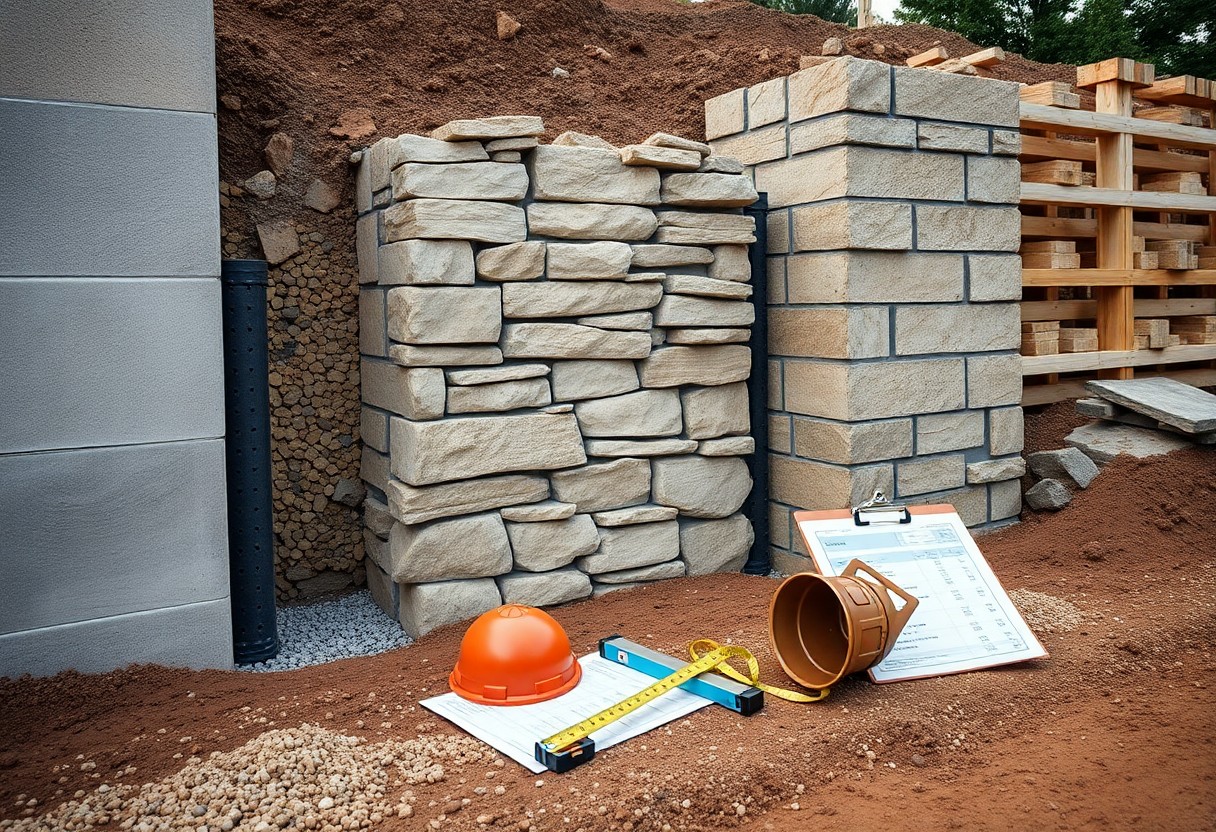

It’s wise to evaluate slopes on your property because a failing retaining wall can cause dangerous collapse and serious property damage, so you should consider types such as gravity, cantilever and piled walls for suitability. Bear in mind that costs vary widely with size, materials and access, and that a well-designed wall delivers stability, erosion control and extra usable land while reducing future repair costs.
Understanding Retaining Walls
Definition and Purpose
You rely on retaining walls to hold back soil and resist lateral earth pressure; common materials include cast concrete, reinforced block, timber sleepers, gabions and mechanically stabilised earth. For domestic projects heights typically run from 0.6 m to 3 m; walls over 1 m usually require structural design and planning permission. Effective drainage-subsoil drains, weep holes and free‑draining backfill-is vital to prevent hydrostatic pressure and catastrophic failure.
Common Uses and Applications
Garden terraces and raised beds often sit between 0.3-1.5 m, driveway and boundary walls commonly reach 0.6-1.2 m, while highway, bridge and riverbank works can exceed 2-5 m. You choose gabions for flexible erosion control, timber for short, cost‑effective walls and reinforced concrete or mechanically stabilised earth for heavy loadings; erosion, overtopping and poor drainage are the key risks on water‑facing or high‑load structures.
In a typical 12 m suburban slope project contractors installed three 0.9 m concrete‑block terraces with geogrid anchors extending 1.2 m into the fill at 0.4 m vertical spacing; this stabilised the slope and increased usable garden area by roughly 25%. You should inspect for settlement, blocked drains and tree‑root intrusion, as these are frequent causes of long‑term deterioration, while routine clearing of weep holes maintains performance.
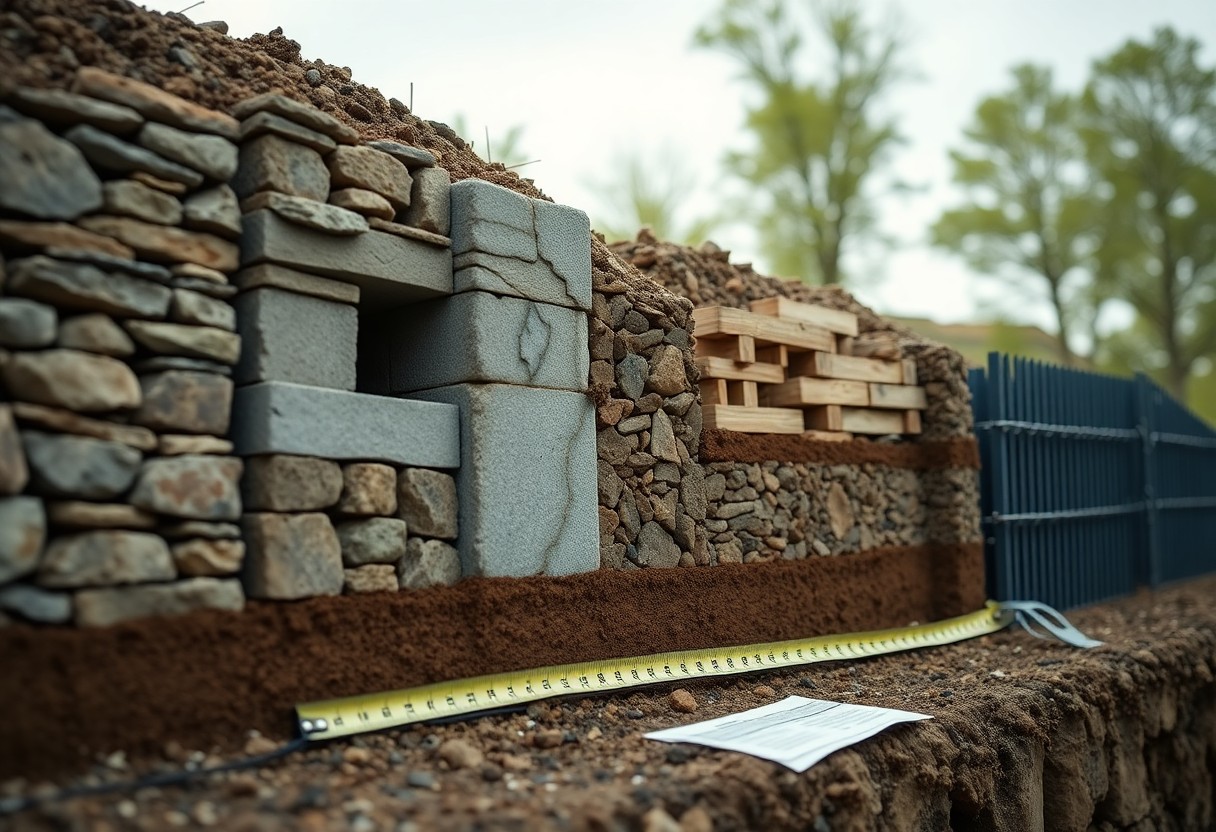
Types of Retaining Walls
- Gravity walls – rely on mass and friction to resist lateral loads
- Cantilever walls – use a reinforced concrete stem and base slab for leverage
- Reinforced walls (MSE) – incorporate geogrids or geotextiles for slope stability
- Anchored walls – use tiebacks or anchors for high or temporary loads
- Composite/hybrid – combine methods for constrained sites or aesthetic needs
| Gravity walls | Stone/concrete; best for low heights (typically up to 1.5-3.0 metres); minimal reinforcement. |
| Cantilever walls | Reinforced concrete; common for 2-6 metres; efficient use of materials but needs good foundation. |
| Reinforced walls | MSE systems with geogrids; used for 3-20 metres; rapid construction and cost-effective for long runs. |
| Anchored walls | Tieback anchors or ground anchors; suitable where heights exceed 6 metres or space is limited; requires testing. |
| Composite/hybrid | Mix of facing types and reinforcement; selected for site constraints, drainage control, or visual requirements. |
Gravity Walls
You use gravity walls when loads are modest and you want a simple solution; dry-stacked stone or mass concrete walls typically control short slopes, with most garden applications under 1.5-2.0 metres. Their behaviour depends on weight and friction, so you must ensure a competent foundation and subsoil bearing capacity; in one UK council scheme, a 1.2-metre dry stone wall has lasted over 40 years with minimal maintenance.
Cantilever Walls
You select cantilever walls for mid-height requirements where material efficiency matters; a reinforced concrete stem and slab transfer overturning to the base, so walls of 2-6 metres are typical. Designers often provide a stem thickness of 200-300 mm for a 4-metre example and base widths around 0.8-1.2 metres, with drainage behind the stem to prevent hydrostatic pressure.
You should note that a cantilever design needs detailed geotechnical input: at 4 metres a common layout includes a heel and toe proportioned to resist sliding and overturning, reinforcement detailed for bending and shear, and a drained backfill; contractors often use temporary works to ensure stability during excavation, and inadequate drainage or shallow founding strata are frequent causes of underperformance, so specify a site-specific soil report.
Reinforced Walls
You opt for reinforced (MSE) walls when you need rapid construction and economy over long runs; these systems use geogrids or geotextiles tied into compacted backfill and can reach 3-20 metres depending on design. Typical motorway embankment solutions in the UK use modular block facings with geogrids at 0.3-0.5 m vertical spacing to manage settlements and deliver a durable facing.
You will benefit from MSE walls where differential settlement tolerance is required: in one transport project replacing a 12-metre soil slope, MSE with geogrids cut construction time by 30% versus a traditional concrete wall and reduced imported concrete volume by roughly 60%, though rigorous compaction control and drainage remain imperative to long-term performance.
Anchored Walls
You rely on anchored walls when height, surcharge or restricted base width makes other methods impractical; active or passive anchors (tendons) are drilled into competent strata and tensioned, making them ideal for deep basements and waterfront works where walls often exceed 6 metres. Load-testing of anchors is standard practice to verify capacity and set pre-tension.
You must be aware that anchor durability governs life-span: anchors are commonly 5-15 metres long depending on geology, grouted and often sleeved for corrosion protection, and require regular inspection; failure modes include anchor corrosion or bond loss, so specify protective systems and confirm test loads of at least 1.25 times the working load for safety verification.
Assume that you will engage a structural engineer and obtain local approvals for any wall over 1 metre or where public safety is affected.
Factors Affecting Retaining Wall Costs
Your costs vary with materials, height, site preparation and drainage, and you should budget for labour, permits and possible engineering reports; simple timber sleeper walls can be under £100/m², while reinforced concrete or natural stone often exceed £200-£300/m². Unexpected ground or access issues typically add 15-50% to quotes. The How Much Does a Retaining Wall Cost in 2026? guide provides regional examples and ranges.
- Materials (timber, concrete, stone)
- Height/size
- Site conditions (soil, groundwater)
- Drainage and backfill
- Labour, access and plant
- Permits and engineering
Material Choices
If you pick timber sleepers, expect lower upfront cost (£40-£100/m²) and a service life around 10-25 years; concrete blocks usually cost £70-£200/m² with high durability, while natural stone can be £150-£350/m² but adds aesthetic value. You should weigh maintenance, lifespan and local sourcing – reclaimed stone might save on material but raise labour time.
Size and Height
Any wall under about 1 metre often avoids formal structural approval, while walls above ~1-1.2 m typically need a structural design and reinforced foundations, which can double costs; you should expect per-metre prices to climb steeply with height due to deeper bases and additional reinforcement.
When you increase height, lateral earth pressures rise non-linearly: for example a 2 m high, 10 m long concrete wall may require a reinforced footing, geogrid tie-backs and proper drainage, adding several thousand pounds compared with a 0.6 m decorative wall; pay attention to surcharge loads (driveways, buildings) which often necessitate retaining anchors or heavier-footing design to prevent failure.
Site Conditions and Preparation
Soil type, slope gradient and groundwater determine excavation depth, foundation design and drainage needs; clay and peat demand deeper footings or piled solutions, while free‑draining sand reduces drainage works. You should also consider access – tight sites raise labour and plant hire costs significantly.
For complex sites you will likely need a site investigation or geotechnical report; removing rock or dewatering can add thousands – for instance, cutting out 5 m³ of rock may cost £1,000-£3,000 depending on breaking and disposal. You should budget for temporary works, haulage and reinstatement, and plan drainage to protect the wall and avoid costly repairs.
Installation Process
Planning and Design
Survey the site and test the soil; if the retained height exceeds 1.0 m you will usually need building control approval and a structural design. Assess surcharge loads (driveways, gardens) and pick materials-gabions, timber, concrete block or reinforced concrete-accordingly. Provide a drainage strategy, typically a 100 mm perforated drain and free‑draining backfill. Allow for planning constraints, access for machinery and a detailed drawing showing footing depth, often 300-450 mm for small domestic walls.
Construction Steps
Excavate to the designed level, setting out batter and footprint; for most small walls you place a concrete footing typically 300-450 mm deep and compacted sub‑base. Lay blocks or formwork, incorporating a frost‑free DPC and install a 100 mm perforated drain at the base wrapped in geotextile. Backfill in 150 mm lifts with 20 mm crushed stone and compact to specification; cap units and finish with surface drainage directed away from the wall. Poor drainage risks structural failure.
Take a typical 1.2 m block wall: dig a footing 450 mm deep by 600 mm wide, pour C20 concrete and lay the first course level. Use geogrid reinforcement every second or third course into compacted Type 1 fill, tie into soldier piles if present, and fit a 100 mm perforated drain behind the base. Compact backfill to >95% relative density in 150 mm lifts; if you exceed 1 m retained height, get an engineer’s design and building control sign‑off to avoid collapse.
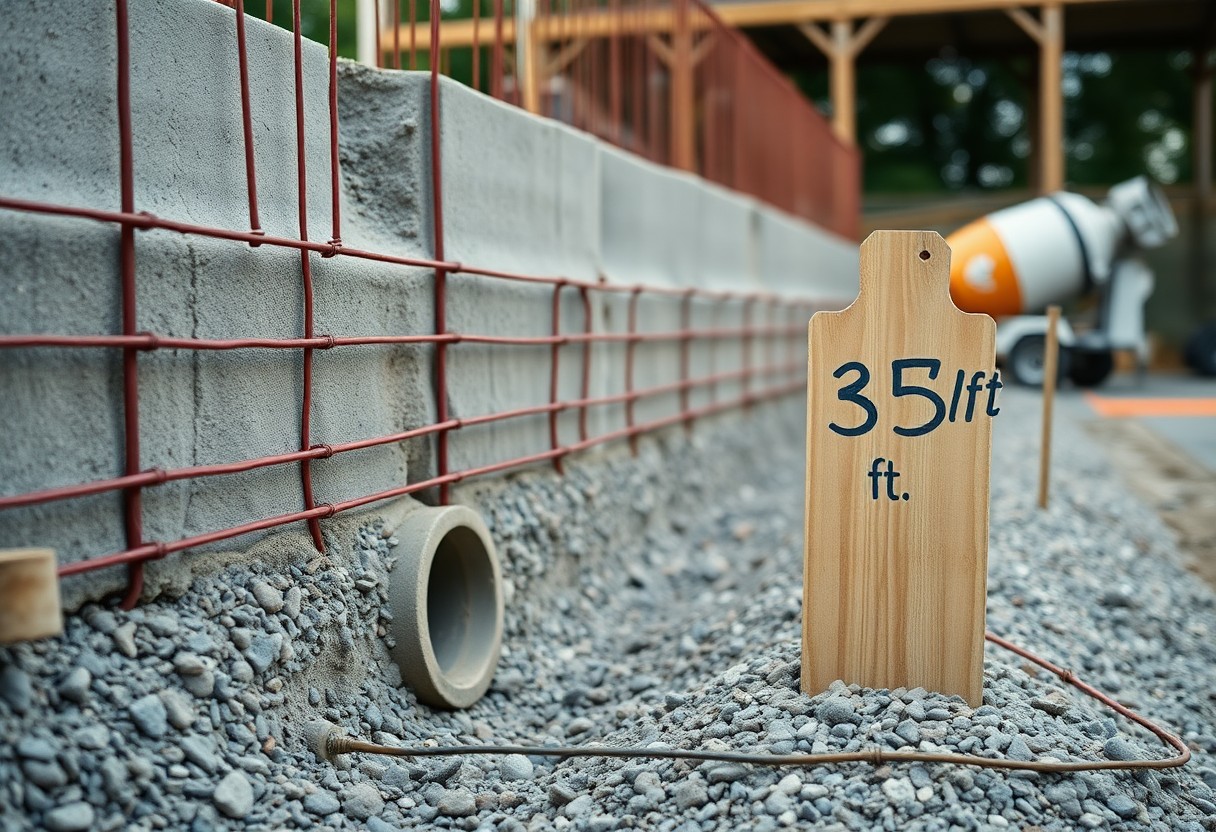
When You Need a Retaining Wall
If your site shows a level change of roughly 0.6-1.0 m, repeated slope movement, or erosion undermining paths and foundations, you should consider a retaining wall; minor garden edging under 0.3-0.5 m often doesn’t need structural work. You’ll want an engineered solution where soil pressure or poor drainage exists, and for up‑to‑date cost benchmarks consult How Much Does a Retaining Wall Cost to Build? [2026 Data].
When to choose a wall
| Issue | When a wall is needed |
| Slope >0.6-1.0 m | Provides structural support and level terraces |
| Soil slippage after rain | Requires drainage and reinforced design |
| Undermined paths/foundations | Prevents further structural damage |
Signs You Might Need One
You’ll often spot early warning signs such as new or widening cracks in external walls or patios, persistent pooling at the base of a slope, leaning fences, or exposed tree roots where soil has washed away; if these develop over weeks or months after storms, they point to active movement and higher risk to structures.
Signs at a glance
| Sign | What it indicates |
| Widening cracks | Soil movement affecting foundations |
| Leaning fence or wall | Lateral soil pressure increasing |
| Repeated erosion | Insufficient drainage or vegetation |
Comparison with Other Solutions
When you compare retaining walls with alternatives, consider lifespan, cost and site constraints: concrete or stone walls last 40-50+ years but cost more; timber sleepers suit low heights and budgets yet need replacement within 10-20 years; gabion baskets are quick and drain well for slopes up to 2 m but occupy more space.
Comparison of solutions
| Solution | Best for / trade‑offs |
| Concrete/stone wall | High durability, higher upfront cost, engineered design |
| Timber sleepers | Lower cost, shorter life, suitable for low walls |
| Gabions | Good drainage, flexible, bulkier footprint |
| Vegetation/bioengineering | Cheap, long to establish, not for heavy loads |
Also weigh maintenance and long‑term value: concrete and stone often deliver the best lifecycle cost despite higher installation prices, while timber may double replacement costs over decades; if you need load‑bearing support near buildings, choose an engineered wall to avoid structural failure.
Maintenance and Upkeep
Carry out inspections at least twice a year-spring and autumn-and within 48 hours after heavy storms. You should clear weep holes, cut back roots and surface vegetation, and sweep or jet drainage runs; blocked drainage increases hydrostatic pressure and accelerates failure. Every 5-10 years consider re-pointing and renewing coping where mortar has eroded. Watch for bulging, leaning or new vertical/cracked joints, as these signs demand immediate professional assessment.
Regular Inspection
Inspect visually and by touch: probe mortar joints, check for hairline and widening cracks, and note any new gaps at the base. If cracks exceed 3-5 mm or you record horizontal movement over 10 mm within a season, photograph and log the change and seek a structural check. You should monitor monthly after heavy rain; efflorescence, saturated backfill or displaced copings point to drainage failure.
Repairing Common Issues
Minor repairs you can handle include re-pointing eroded mortar, resetting loose blocks, and unblocking weep holes; a small DIY re-pointing job may take a day for a short run. For drainage, fit a perforated drainpipe wrapped in geotextile and replace fines with free-draining granular backfill to reduce pressure. Engage an engineer immediately if the wall shows bulging, significant tilt or collapse.
For more substantial fixes, cut out deteriorated mortar to 15-20 mm and use an appropriate mortar (lime-based on historic masonry, cement for modern concrete blocks), install weep holes every 1-2 metres, and consider geogrid reinforcement for battered walls. Small repairs (repointing, localized block replacement, basic drainage) commonly cost under £500-£2,000, whereas structural remedies (soil nails, anchors, partial rebuild) often run from about £3,000 to £15,000 depending on length and access; a typical 6 m wall with drainage upgrade and partial rebuild can take 2-4 days on site.

Summing up
Drawing together, when considering retaining walls you should assess types-gravity, cantilever, piled or gabion-and their costs, which vary by height, materials and ground conditions; you need a wall for slope stabilisation, erosion control, terracing or boundary changes, and should factor in drainage, maintenance and planning consent while consulting a qualified engineer for your site.
FAQ
Q: What is a retaining wall and when might I need one?
A: A retaining wall is a structure built to hold back soil and prevent erosion or collapse of a slope. You need one when ground levels change significantly – for example to terrace a garden, support a driveway or prevent a bank from sliding onto a path or building. Warning signs include leaning or bulging soil, new or widening cracks in the ground or nearby structures, persistent saturation or slumping after heavy rain, and any situation where added loads (vehicles, buildings, large planters) are applied near an edge.
Q: What types of retaining walls are commonly used and what are their pros and cons?
A: Common types are: gravity walls (stone, gabion baskets) – simple, low-maintenance, best for lower heights but bulky; timber sleeper walls – attractive and economical for low to medium heights but shorter lifespan and vulnerable to rot; reinforced concrete or cantilever walls – suitable for medium to high walls with long life but higher cost and need for engineered foundations; modular/segmental block systems – quick to install, flexible and often reinforced with geogrid for greater height; anchored or piled walls (sheet piles, soil nails) – used where space is limited or for deep excavation, more expensive and typically engineered. Choice depends on height, ground conditions, appearance, budget and access for construction.
Q: How much does a retaining wall cost?
A: Costs vary greatly with height, materials, ground conditions and engineering requirements. Typical UK ranges per linear metre for garden walls: timber sleepers £80-£200; gabion £150-£350; concrete/blockwork or modular block £150-£400; natural stone £250-£700; reinforced or engineered concrete and piled solutions £300-£1,000+. For whole projects expect small domestic walls (low height, short length) £1,000-£5,000; larger engineered walls commonly £5,000-£30,000+ depending on complexity. These figures exclude VAT and any specialist surveys, drainage works or party-wall agreements which can add cost.
Q: What factors most influence cost and long-term performance?
A: Key factors are wall height and length, soil type and drainage conditions, presence of groundwater, nearby surcharge loads (vehicles, structures), access for plant and materials, foundation requirements and whether geotechnical or structural design is needed. Good drainage (weep holes, drainage pipe, free-draining backfill) and a properly designed foundation markedly improve lifespan; poor drainage is the most common cause of failure. Site clearance, scaffolding, retaining of services and any party-wall or neighbour-related works also increase cost.
Q: Do I need planning permission, building-control approval or a structural engineer?
A: Often you will need professional input. As a rule of thumb in the UK, retaining walls over 1 metre adjacent to a public highway or over about 2 metres elsewhere may trigger planning or building-control requirements, but exact rules vary by local authority. Structural engineering is advisable for walls over 1-1.2 metres, any wall carrying significant surcharge loads, or where ground conditions are poor. You may also need a party-wall award if the wall is on or close to a shared boundary. Always check with your local authority and get at least one structural assessment and several contractor quotes before committing.