
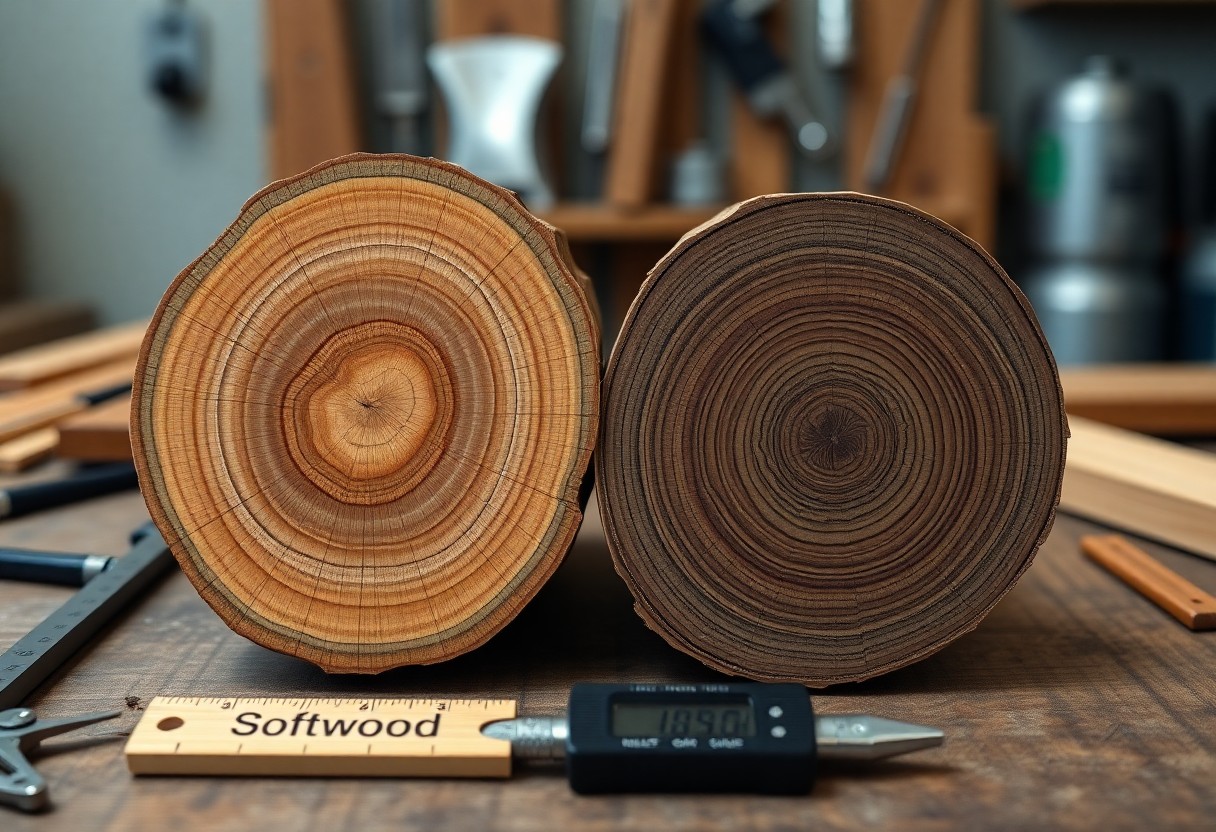
Many people ask whether you should choose softwood or hardwood for your project; to help you decide, consider that softwoods grow faster, are lighter and usually cheaper, while hardwoods are denser, more durable and better for heavy-wear uses. Also be aware that wood dust can be hazardous and some timbers burn more readily, so you should prioritise safety and certified sustainable sources when selecting materials.
Definition of Softwood
Softwood comes from gymnosperm trees such as pines, spruces and firs; their seeds develop in cones and most are evergreen. You’ll notice they generally grow faster than many hardwoods-commonly reaching harvestable size in 20-60 years-so they dominate commercial forestry. They tend to be less dense and more resinous, which makes them easier to mill but also often more flammable; their resin content increases fire risk in some applications.
Characteristics of Softwood
Typically, softwoods have a straight grain and lower density, often ranging from 300-700 kg/m³, so you’ll find them lighter and easier to handle than many hardwoods. They accept nails, screws and adhesives well and machine cleanly, which makes them common in framing, joinery and mouldings. However, you must account for knot weaknesses and variable shrinkage when specifying structural members.
Common Softwood Species
Examples you’ll encounter most are Scots pine (Pinus sylvestris), Douglas fir (Pseudotsuga menziesii), Sitka spruce (Picea sitchensis), larch (Larix) and western red cedar (Thuja plicata). Each has distinct uses: Douglas fir for heavy framing, Sitka spruce for aircraft-grade spars and musical instruments, and larch or cedar for durable exterior cladding. Availability and price vary by region, with pine and spruce often the most economical.
When comparing species, note practical metrics: Douglas fir typically offers higher strength-to-weight with densities around 500-600 kg/m³, Sitka spruce is lighter at about 350-450 kg/m³ but prized for stiffness, while larch and treated pine can reach 500-700 kg/m³ for exterior work. You should also consider treatment and service life-western red cedar gives natural decay resistance, whereas pressure-treated softwoods provide longer life in ground contact.
Definition of Hardwood
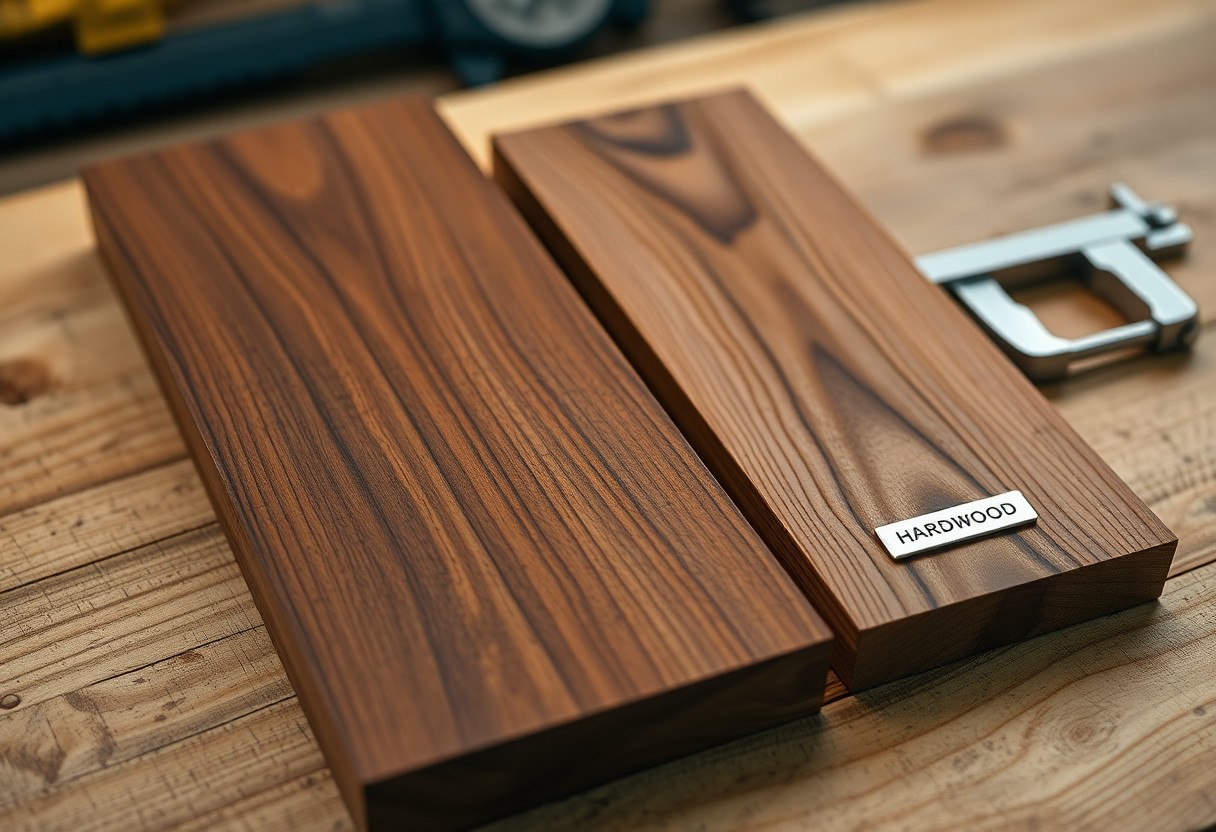
Botanically, hardwoods are derived from flowering, seed-bearing angiosperm trees, typically broad-leaved and often deciduous; they are not defined by hardness alone. You’ll encounter species that grow more slowly, produce tighter growth rings and generally yield denser, more stable timber than many softwoods. In practice that density translates into long-lasting furniture, flooring and veneers, while also influencing cost and supply-tropical hardwoods like teak and ipe being notably more expensive and slow-growing than temperate oaks and maples.
Characteristics of Hardwood
Hardwoods usually show pronounced grain, visible pores and a wide range of densities-from about 0.5 to 1.0 g/cm³ for common temperate species-affecting wear resistance and finish. You’ll find Janka hardness values vary markedly (hard maple ~1,450 lbf; white oak ~1,360 lbf), so selection depends on purpose: floors need high hardness and stability, while turned objects favour easier workability. Be aware that some species’ dust can be irritant or sensitising, so you should use extraction and PPE when machining.
Common Hardwood Species
Among the frequent choices are oak, maple, walnut, cherry, mahogany, teak and beech, each with distinct colour, grain and uses; oak and maple are widespread for flooring, walnut for high-end furniture and veneers, while teak and ipe serve outdoor projects for their weather resistance. You’ll notice price, availability and sustainability certifications vary: European oak and beech are often affordable and FSC-certified, whereas genuine mahogany and some tropical species carry higher cost and sourcing scrutiny.
For specifics, white oak (Quercus alba) rates ~1,360 lbf Janka and resists rot when finished; hard maple (Acer saccharum) sits near ~1,450 lbf, making it ideal for heavy-use floors and butcher blocks. Black walnut (~1,010 lbf) is prized for colour and workability but commands premium prices; ipe is extremely hard (~3,680 lbf) and exceptionally durable outdoors, though its dust and dense machining require care. Your choice should balance hardness, stability, cost and environmental impact.
Key Differences Between Softwood and Hardwood
Density and Strength
You’ll find softwoods typically range from about 300-600 kg/m³ (Scots pine ≈420 kg/m³, Douglas fir ≈530 kg/m³) while common hardwoods sit around 600-900 kg/m³ (English oak ≈700 kg/m³). That means hardwoods usually resist wear and denting better-important for flooring and furniture-whereas softwoods give you lighter, easier-to-handle framing. Exceptions exist: balsa is a very light hardwood and yew is a relatively dense softwood, so always check species-specific data for structural work.
Growth Patterns and Environmental Impact
Softwoods (conifers) grow faster, often on 20-60 year rotations like Sitka spruce plantations, so you can sequester carbon quickly and get timber sooner; hardwoods usually need 60-200 years (oak coppice or high forest), supporting richer native biodiversity and long-term habitats. Monoculture softwood stands may increase pest and fire vulnerability, while mixed broadleaf systems boost wildlife and resilience-factors you should weigh when choosing timber for landscape or construction projects.
In practice, denser hardwoods store more carbon per cubic metre – roughly about 1 tonne CO₂/m³ for many hardwoods versus nearer 0.5 tonne CO₂/m³ for lighter softwoods – but fast-growing softwood plantations lock carbon quickly into buildings and products. You’ll also want to look for certified sources (FSC/PEFC) and favour mixed-species or continuous-cover management to reduce pest, disease and fire risk while maximising long-term ecosystem and climate benefits.
Uses of Softwood
Construction and Building Materials
In construction, you find softwoods such as Scots pine, spruce and Douglas fir dominating framing, roof trusses and studwork; they are commonly graded to EN 338 classes like C16 and C24, providing predictable strength for 2x4s and joists. Plantation-grown timber reaches harvest in 25-40 years, making it cost-effective, while pressure-treatment or preservative coatings are often applied because untreated softwood is more prone to rot and insect attack. Manufacturers also use softwood for plywood, OSB and external cladding where weight and price matter.
Furniture and Millwork
For furniture and millwork, you often choose pine, cedar or spruce where workability matters: these species machine easily, take nails and screws well, and accept paint or clear finishes. Their lower density makes pieces lighter and cheaper, yet knots can affect visual finish, so you may select knot-free grades for visible tops. Many mass-produced items and interior mouldings use softwood for consistent availability and affordability.
Delving deeper, you should note softwood densities typically range 350-550 kg/m³ compared with oak at ~700 kg/m³, influencing durability and feel; furniture-grade timber is usually kiln-dried to 8-12% moisture content for stability. You will see softwood in shelving, panelling, skirting and decorative mouldings, and in Scandinavia plantation pine is a traditional choice-IKEA and similar manufacturers use engineered softwood panels to balance cost, sustainability and performance.
Uses of Hardwood
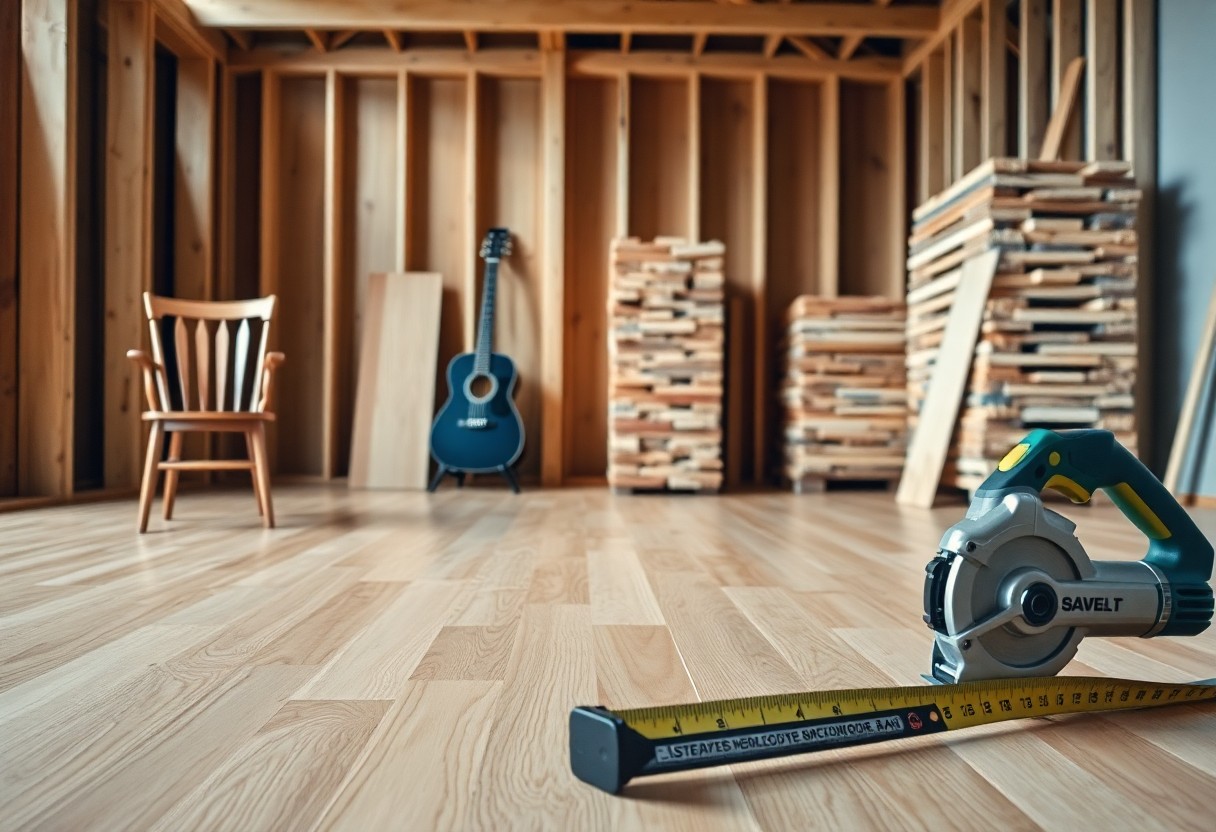
You encounter hardwood in furniture, structural joinery, flooring, boat decks and musical instruments because of its high density and durability; densities commonly range from ~500 to over 1,000 kg/m³. You’ll also see hardwood used for veneers, tool handles and turned objects where strength and appearance matter. Manufacturers choose species for specific properties – for example, stability for cabinets, acoustic response for instruments, and oil-resistance for marine timbers – making hardwood a go-to when performance and lifespan matter.
Flooring and Cabinetry
For flooring and cabinetry you’ll often pick oak, hard maple or walnut: white oak rates ~1360 lbf and hard maple ~1450 lbf on the Janka scale, so they withstand heavy wear. You can expect solid hardwood floors to last 30-100 years with maintenance and be refinished 3-5 times depending on plank thickness; cabinet doors made from stable quartersawn boards reduce cupping and seasonal movement in kitchens.
Specialty Products and Crafts
When crafting instruments or fine objects you’ll use species chosen for tonal clarity, workability and appearance – Sitka spruce for soundboards, maple for necks, ebony for fingerboards and rosewood for backs and sides. You’ll appreciate that exotic hardwoods deliver superior density and aesthetic contrast, which is why luthiers and master turners pay premiums for well-seasoned, defect-free blanks.
Digging deeper, you’ll find specific trade-offs: ebony’s extreme hardness (Janka >3000 lbf) gives superb wear resistance for fingerboards but makes machining demanding; teak’s natural oils and dimensional stability suit decking and boat trim, while walnut’s straight grain favours carving and gunstocks. You must be aware of legal and health issues: CITES-listed species and allergenic or toxic wood dust (e.g. rosewood, cocobolo) require permits and dust control. Aim for 6-8% moisture content for interior joinery to minimise movement and ensure long-term fit.
Cost Comparisons
Typical UK retail prices per cubic metre (approx.)
| Softwood | Hardwood |
|---|---|
| Scandinavian pine: £150-£350/m³; Spruce: £120-£300/m³; treated softwood decking ~£8-£20/m² | Oak: £700-£1,500/m³; Walnut: £1,200-£2,500/m³; tropical hardwoods (teak/mahogany) often £2,000+/m³ |
Pricing Trends and Market Factors
You’ll see short-term swings driven by supply shocks and demand cycles: COVID-related mill closures and the 2021 surge pushed some species up by as much as 50-100%, while recent stabilisation trimmed prices. Key drivers include:
- Supply: harvest levels, import restrictions
- Demand: construction booms, DIY market
- Policy: tariffs, sustainability rules
Recognizing these forces helps you time purchases and choose species that balance cost and availability.
Long-term Value Considerations
You should weigh initial outlay against lifespan and maintenance: hardwoods like oak can last 80-100+ years with refurbishment, while untreated softwoods often need replacement or major treatment every 10-25 years; this affects lifecycle cost and resale appeal.
For example, an oak floor at £40/m² installed, sanded and refinished periodically, can amortise to under £0.50/m²/year over 80 years; a softwood alternative at £15/m² that needs replacement after 20 years works out higher over four decades. You’ll also gain higher resale value and easier refinishing with dense hardwoods, whereas softwoods may require chemical treatments or thicker protective coatings to approach similar longevity.
Final Words
Summing up, when choosing between softwood and hardwood you should weigh growth rate, density, durability, cost and intended use; softwoods offer lighter, faster-growing, economical options for framing and panelling, while hardwoods provide greater density and longevity for flooring and furniture, so your project’s needs determine the best timber.
FAQ
Q: What is the primary difference between softwood and hardwood?
A: Softwood and hardwood are classified botanically: softwoods come from gymnosperm trees (mainly conifers such as pine, spruce and fir) and hardwoods from angiosperm trees (deciduous species such as oak, maple and walnut). Hardwoods generally have a more complex cellular structure and often produce denser, more durable timber; softwoods typically grow faster, are lighter in weight and have a simpler grain. The terms do not always equate to actual hardness-some softwoods can be harder than certain hardwoods.
Q: Which type of timber is better for furniture and flooring?
A: Hardwood is commonly preferred for high-end furniture and long-lasting flooring because of its density, wear resistance and attractive grain patterns (for example oak, maple or teak). Softwood such as pine or cedar is used for rustic furniture, panelling or budget flooring where cost, lighter weight and ease of machining are priorities. Choice depends on desired appearance, expected wear, budget and maintenance expectations.
Q: How do softwood and hardwood compare in terms of strength, durability and maintenance?
A: Hardwoods tend to outperform softwoods in compressive strength, impact resistance and longevity, making them suitable for structural elements, heavy-use floors and heirloom furniture. Softwoods are generally easier to work with, take nails and screws well, and can be treated or engineered for improved durability. Maintenance for both types depends on finish, exposure to moisture and use; hardwood floors often require refinishing over decades, while softwood surfaces may need more frequent protective coatings if used in high-traffic or exterior situations.
Q: What are the environmental and sustainability considerations when choosing softwood versus hardwood?
A: Environmental impact depends on species, forest management and harvesting practices rather than the softwood/hardwood label alone. Softwoods typically grow faster and can be a more renewable option if sourced from sustainably managed plantations. Many hardwoods grow more slowly and may be over-harvested; however, sustainably certified hardwoods (FSC, PEFC) and reclaimed hardwood can be environmentally responsible choices. Consider certification, local sourcing, life-cycle carbon storage and whether the product is engineered or reclaimed to minimise ecological footprint.
Q: How can I tell whether a piece of timber is softwood or hardwood and what should I look for when buying?
A: Identification can be done by examining the grain, weight and growth rings: hardwoods often show tighter grain and visible pores, are heavier for size and may display distinct colour variations; softwoods have simpler, straighter grain and are lighter. When buying, check species name, grade, moisture content (kiln-dried is preferable for interiors), certification labels, intended use rating and finish options. Ask suppliers about origin and treatments, and request samples or inspection to ensure the timber suits your project’s structural and aesthetic needs.