
Staircase design must meet precise standards so you can rely on safety and functionality: uniform riser heights and consistent tread depths, minimum headroom, and secure handrails and balustrades. You should ensure adequate slip-resistant nosing, well-lit routes, proper landings and clear fire escape provisions, plus compliant gradients and guarding to protect users and ensure your staircase complies with building regulations.
Understanding Building Regulations
Overview of Building Regulations
Approved Document K (fall protection) and Part M (access) in England and Wales set prescriptive limits you must follow for stairs: riser heights commonly up to 220mm, headroom typically around 2.0m, and handrail heights roughly 900-1000mm. You will submit either a full plans application or a building notice to Building Control or an approved inspector, and inspections take place at key stages such as after structural work and before completion.
Importance of Compliance
Non-compliance raises real hazards: uneven rises and inadequate headroom sharply increase fall risk, and local authorities can issue enforcement notices or require costly alterations; additionally, your insurance may be invalidated for unauthorised changes. You should factor compliance into budgets and timelines to avoid delays at sale or handover.
Beyond safety and enforcement, practical measures you must check include consistent riser dimensions within a flight, continuous handrails on at least one side, non-slip treads and adequate lighting; implementing these reduces accident claims and can prevent remedial costs that often run into the thousands of pounds if Building Control demands rectification.
Key Design Elements
When you design stairs, focus on geometry, guarding, handrails, headroom and surface finish. Use a maximum riser of 220mm, minimum going of 220mm and satisfy the rule 2R+G between 550-700mm. Provide vertical headroom of at least 2,000mm and handrail height between 900-1,000mm. Ensure a clear width of around 900mm for comfortable use and specify adequate lighting and slip resistance.
Dimensions and Specifications
You must set risers no higher than 220mm and goings no less than 220mm, applying the 2R+G comfort rule (550-700mm). Maintain a clear width of about 900mm in dwellings, vertical headroom of 2,000mm, and handrail heights of 900-1,000mm. Avoid inconsistent tread depths or excessive nosing projection that create tripping hazards.
Materials and Construction
You should choose materials to match use: concrete or steel for communal and escape stairs, and suitably treated hardwood or engineered timber for private flights. Fit non-slip nosings, use fixings rated for structural loads, and provide guarding with gaps no greater than 100mm. Make sure connections resist wear and that surfaces are protected against corrosion and moisture.
You should specify concrete of at least C25/30 where subject to heavy use, and use hot‑dip galvanised or appropriately coated steel (BS EN ISO 1461) for corrosion resistance. If you select timber, insist on kiln‑dried, seasoned boards with suitable fire or preservative treatment. Set slip resistance targets (Pendulum Test PTV > 36) and detail connection capacities and maintenance access to maintain long‑term safety.
Safety Features
You must provide guarding where a fall of more than 600mm is possible, keep risers consistent and generally within a maximum of about 220mm, and ensure headroom and pitch comply with the relevant standards; detailed limits are available in Building Codes for Stairs and Stairways. You should treat irregular rises or narrow goings as a significant hazard and eliminate them during design.
Handrails and Balustrades
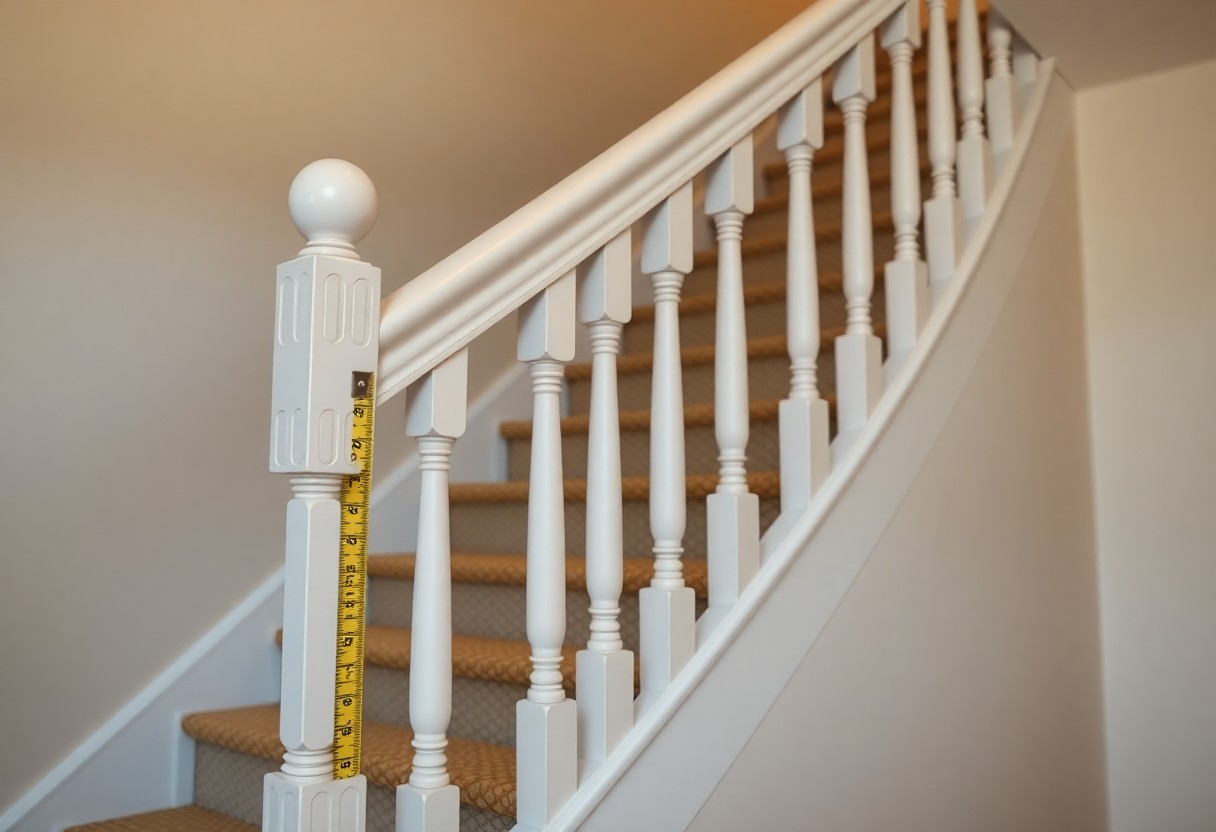
You should install continuous handrails on both sides where stairs are wider than one metre, set between 900-1000mm above the pitch line with a comfortable grip (typically 40-50mm diameter), and fit balustrades that do not permit a 100mm sphere to pass through; these measures resist falls and meet common regulatory load and opening criteria.
Non-slip Surfaces
Non-slip finishes must be specified by use: stair nosings, abrasive strips or textured treads reduce slip potential, and many specifiers reference the British pendulum test (BPN) when selecting materials, aiming for a practical threshold such as a BPN above 36 for external pedestrian routes.
Choose durable non-slip treatments like aluminium nosings with abrasive inserts, textured porcelain or bonded grit; you should inspect tread wear regularly because slip risk rises when surfaces are wet, worn or contaminated, and replace or refurbish nosings once grip declines to maintain compliance and safety.
Accessibility Considerations
Compliance for Disabled Access
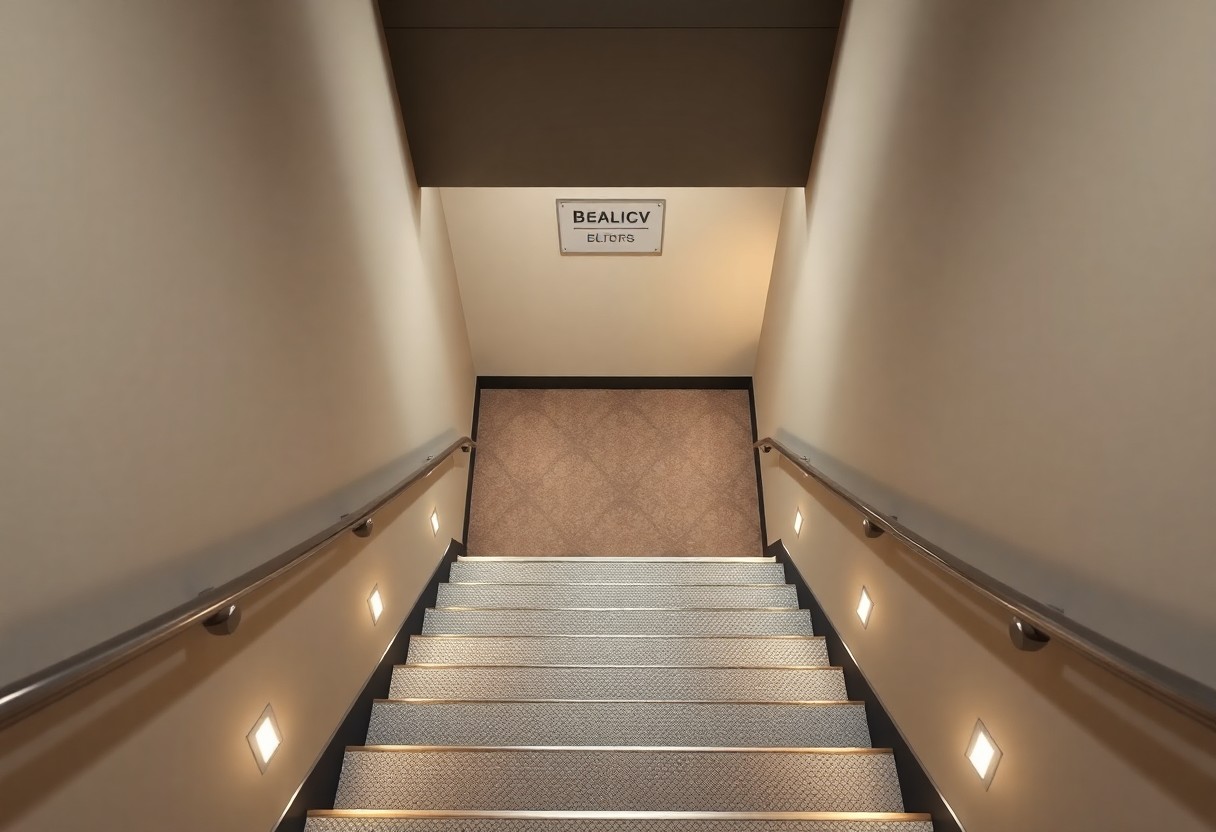
Part M of the Building Regulations demands you provide reasonable access for disabled users, including handrails on both sides that are continuous and set at a consistent height (typically 900-1000mm), contrasting tactile nosings on steps to aid the visually impaired, and level access to principal entrances. You must also ensure consistent riser heights and adequate clear widths (designs commonly aim for around 900mm to accommodate standard wheelchairs) so evacuation routes remain usable for all.
Provision of Alternatives
Where stairs prevent access, you can specify alternatives such as ramps, platform lifts, through‑floor lifts or stairlifts; note that stairlifts do not convey wheelchairs and so are suitable only for ambulant users. You should assess space, user needs and emergency egress: platform lifts work well in constrained layouts, while ramps need substantial run length and non‑slip surfacing to be safe.
Costs and practicalities vary: a domestic stairlift typically ranges £2,000-£6,000, a platform lift £6,000-£18,000 and a through‑floor lift £8,000-£25,000, and a 1:12 ramp requires 12m of run for a 1m rise so may be impractical indoors. Ensure alternatives meet building control/planning requirements and factor in annual servicing and safe evacuation procedures when selecting solutions.
Common Compliance Issues
Poor Design Practices
You often encounter stairs where one or two errors create the biggest risks: risers above 220mm, treads under the recommended 220mm going, or headroom less than 2,000mm that forces stooping. You also see balustrade gaps wider than 100mm, absent or poorly positioned handrails (ideal height 900-1,000mm), and slippery nosings; these defects increase trip and fall incidents and typically trigger enforcement from building control.
Changes in Regulation Standards
You must accept that standards evolve: post-2017 fire-safety scrutiny tightened expectations for egress, materials and compartmentation, so a stair compliant in 2005 may now fail on smoke separation or handrail robustness. You should check the current Approved Documents and local guidance because retroactive reassessments are common, especially for communal and high-rise blocks.
You can manage this by commissioning a measured survey and risk assessment that compares your staircase to present rules; installers often recommend fitting non-slip nosings, upgrading handrails to 900-1,000mm, and adding infill to reduce 100mm gaps. You’ll find many defects are remediable without full rebuild, but documentation and sign-off from building control remain important.
Ensuring Compliance
If you want a staircase that passes inspection, check riser heights, tread depths and handrail positions against the code: for example, the IBC limits risers to 7 in (178 mm) and variation between risers to 3/8 in (9.5 mm), while handrails are typically 34-38 in (865-965 mm) above the tread. Also inspect for insufficient headroom and uneven nosings. For a detailed comparison of US standards see OSHA vs IBC – Differences between IBC & OSHA stairs.
Consulting Professionals
When you engage an architect, structural engineer or an approved inspector early, they can produce stamped drawings, perform load calculations and advise on compliant materials and fixings. For complex staircases-steel spiral stairs, long flights or mixed-use buildings-having a competent designer avoids costly rework and ensures sign-off by building control or an approved inspector.
Regular Inspections
You should inspect staircases visually and physically at set intervals: at least every 12 months, or every 6 months for high-traffic or industrial stairs. Check for loose handrails, worn treads, corrosion, missing nosings, slip resistance and adequate lighting; log defects and prioritise repairs that present immediate danger.
During inspections, you must measure riser/tread dimensions with a tape, confirm riser variation ≤ 9.5 mm, verify handrail heights and maintain minimum headroom of about 2 m (6 ft 6 in). Photograph defects, record dates and remedial actions, isolate any area with imminent risk and complete permanent repairs within a short, documented timeframe.
Final Words
So you make a staircase compliant with building regs by ensuring your riser heights are consistent and tread depths adequate, providing sufficient headroom, secure handrails and guarding at the correct heights, non-slip finishes, appropriate lighting and fire-resistant materials, properly sized landings and structural integrity; you should follow current Approved Documents, obtain relevant approvals and inspections, and engage qualified designers and builders.
FAQ
Q: What building regulations and standards govern staircase design in the UK?
A: The principal statutory requirements come from the Building Regulations, principally Approved Document K (protection from falling, collision and impact) and Approved Document M (access to and use of buildings) where accessibility is a consideration. Relevant British Standards include BS 5395-1 for geometric design of stairs and BS 8300 for inclusive design. Designers and builders should refer to these documents for detailed prescriptions and to local building control for site-specific requirements.
Q: Which geometric dimensions must a compliant staircase meet?
A: Stairs must provide safe, consistent geometry: maximum riser height is typically 220 mm and minimum going (tread depth) typically 220 mm. Variations between the largest and smallest riser or going in a flight should be kept to a tight tolerance (commonly within 5 mm) to avoid trips. Minimum clear headroom is normally 2.0 m. Flights must be of suitable width for use and escape; check Approved Document K and BS 5395-1 for precise width requirements by building type.
Q: What are the handrail and guarding requirements for compliance?
A: Handrails must be provided at a consistent, comfortable height (generally 900-1,000 mm above the pitch line), be continuous along the flight, and have a suitable gripping profile. Where a flight is wide or required by use, handrails should be provided on both sides. Guarding (balustrades) must prevent people falling and avoid openings that would allow a 100 mm diameter sphere to pass through. Handrail terminations and extensions should be arranged to reduce snagging and aid safe use, following Part M for accessible routes.
Q: What finish, nosing and lighting features are required for safety and accessibility?
A: Treads should be slip resistant in the expected conditions of use and have consistent nosing profiles; nosings should be clearly distinguishable from the tread by contrast in tone or texture to aid users with reduced vision. Lighting must provide even, glare-free illumination across flights and landings; emergency lighting is required where escape routes need to be safe in a power failure. Materials and finishes must perform reliably over time and in the building’s intended environment.
Q: How is compliance demonstrated and who inspects the staircase?
A: Compliance is demonstrated through proper design documentation, building control submissions and on-site inspections by local authority building control or an approved inspector. Use of a competent designer and installer, adherence to Approved Documents and relevant BS standards, and provision of as-built drawings and certificates (where applicable) will support approval. Where doubt exists, early engagement with building control prevents costly remedial work.