Just when you plan foundations you must assess loads, soil and frost; typical domestic strip depths are 0.9-1.2 metres, but poor or made ground can require much deeper or piled foundations – failing to do so carries a high risk of subsidence and structural damage, while properly engineered foundations will secure your building and prevent… How Deep Should Foundations Be in the UK?
Just when you plan foundations you must assess loads, soil and frost; typical domestic strip depths are 0.9-1.2 metres, but poor or made ground can require much deeper or piled foundations – failing to do so carries a high risk of subsidence and structural damage, while properly engineered foundations will secure your building and prevent movement for decades.
Importance of Foundation Depth
Your foundation depth directly controls risk of excessive settlement and differential movement; shallow footings on weak soils often lead to cracking, while deeper footings increase bearing and reduce settlement. For domestic work you commonly see shallow strip depths of about 0.6-1.0 m, whereas piled solutions can extend to tens of metres for heavy commercial loads or poor ground. Design choices should reflect anticipated loads, frost exposure and nearby trees to avoid costly remedial works.
Load-Bearing Capacity
Match your foundation depth to the soil’s bearing capacity: dense sand and gravel often exceed 150-200 kN/m2, allowing shallow footings, but soft clays may be under 50 kN/m2 and demand deeper footings or piles. A typical two‑storey house may impose bearing pressures up to about 100-150 kN/m2, so you’ll apply factors of safety and possibly increase depth to spread loads and limit settlement.
Soil Type Considerations
Different soils behave very differently: sand/gravel drains and supports well, silts and clays store water and can compress, while peat and organic layers are highly unsuitable and usually require piling. For example, on London Clay you might need a deeper foundation or pile solution because of shrink‑swell tendencies; peat almost always demands piled foundations to reach competent strata.
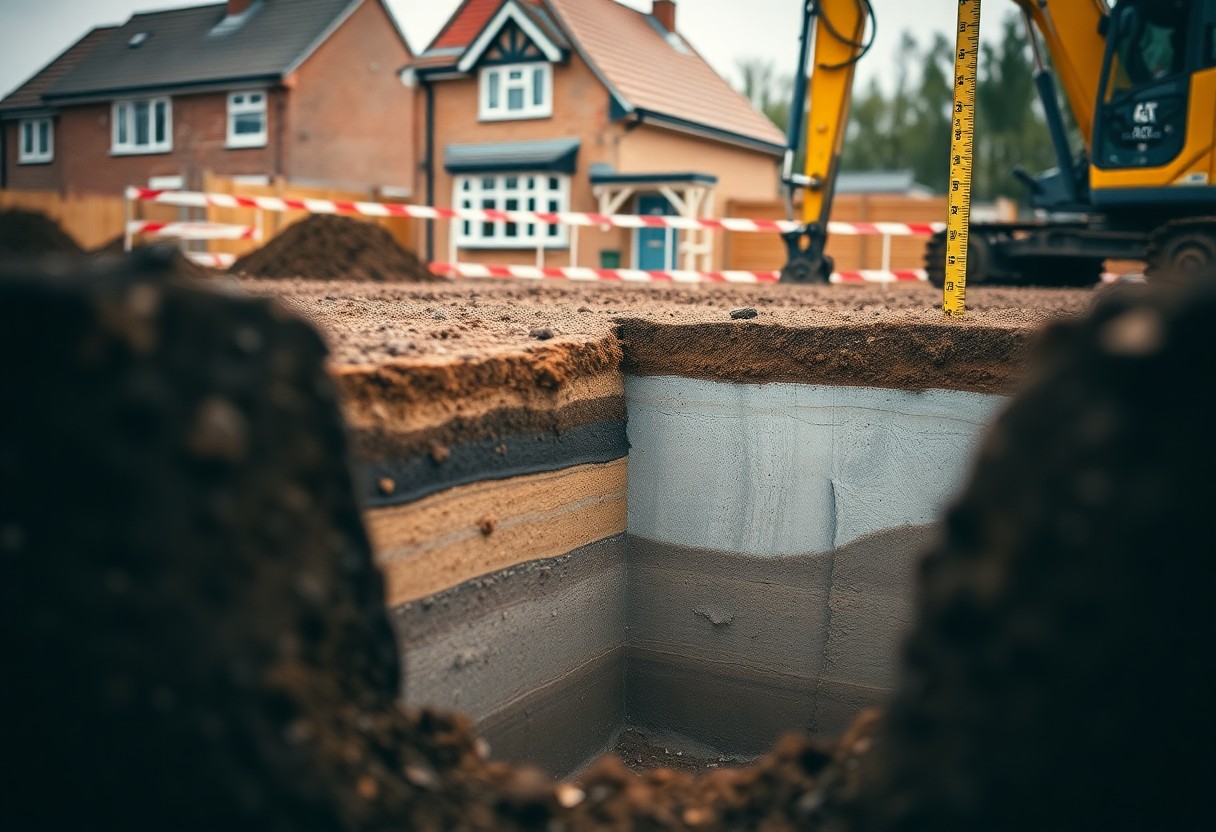
Commission a site investigation to quantify the risk: follow BS 5930 with boreholes and lab tests to obtain SPT values, cohesion and angle of internal friction. With results you can decide whether a 0.6-1.0 m strip is safe, or whether you need deeper footings or piles to 5-15 m; in urban redevelopment projects a 3-4 borehole programme to 3-5 m often reveals enough variation to finalise depth and foundation type.
Regulations and Guidelines
Building work must comply with the Building Regulations, with structural design following Approved Document A and the geotechnical standards of Eurocode 7 (BS EN 1997‑1); designers also reference BS 8004:2015 for practical foundation practice. Your proposal will be checked by building control or an approved inspector, and non‑compliance can lead to enforcement notices and may invalidate your insurance or mortgage conditions.
Building Codes in the UK
Approved Document A directs you to Eurocode 7 for geotechnical design, while BS 8004 gives practical guidance. For instance, small domestic strip footings are commonly sized to bear on sound strata at depths of 0.9-1.2 m; where allowable bearing capacity drops below 100 kN/m² you will typically need piled or raft foundations, and many housebuilders follow NHBC standards for repeatable practice.
Local Authority Requirements
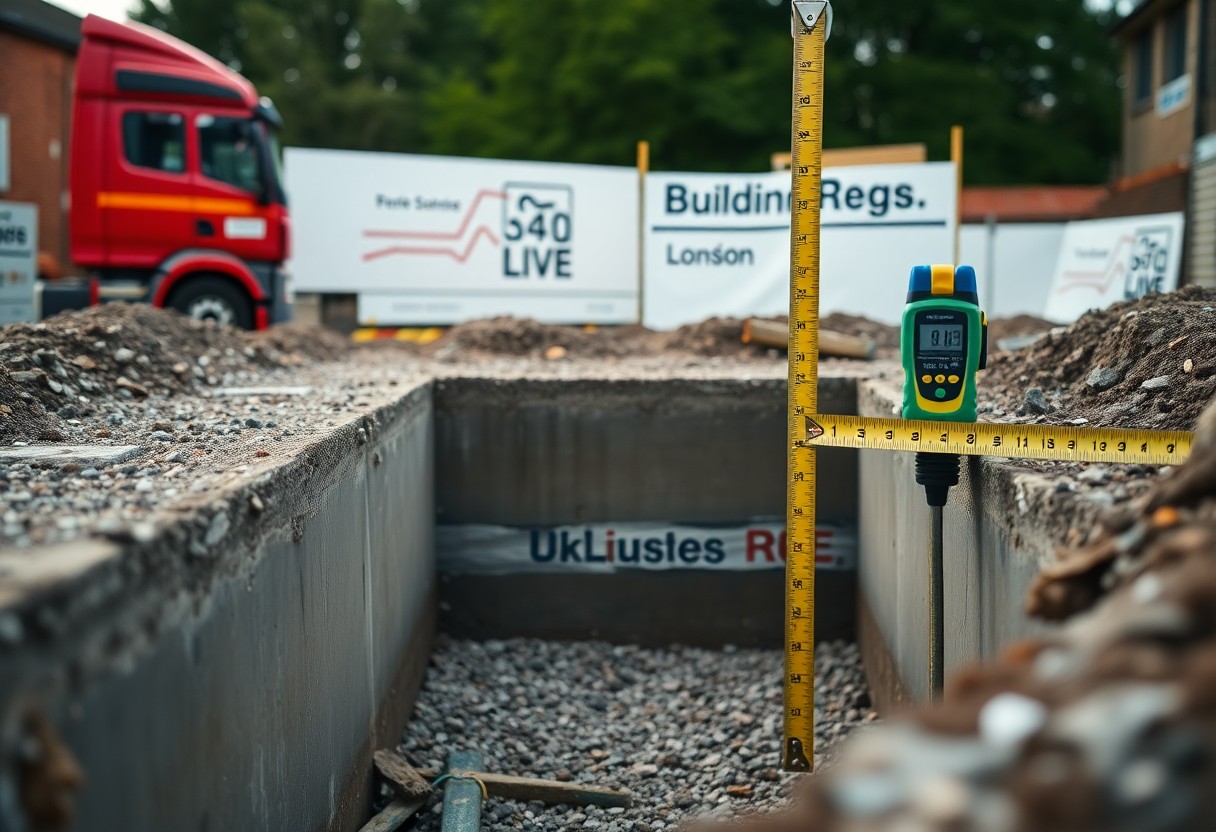
Your local authority will expect either a building notice or full plans approval and often requests a site investigation-trial pits or boreholes-if ground conditions are variable or contaminated; application fees vary by council, typically between £150-£600 for plan checks, and failing to notify can trigger enforcement action.
Many councils insist on an inspection of foundation trenches before backfilling, so you must book inspections and provide S.I. reports plus structural calculations indicating recommended depths and bearing pressures. As a benchmark, remedial piling where foundations prove inadequate can cost £30,000-£60,000 for a typical semi‑detached house, so ensure your paperwork and inspections are in order.
Factors Influencing Foundation Depth
You should weigh site soils, loading and water together: typical shallow foundations range from 0.6-1.2 m, but weak strata or high groundwater may force piled solutions to 10-20 m. Clay can produce several centimetres of movement in dry summers, while peat or made ground can compress by tens of centimetres, driving up cost and risk. Recognizing how these variables interact lets you set safe, economical depths.
- Soil type – clay, sand, chalk, peat, made ground
- Load – imposed loads, point vs distributed
- Frost depth and freeze-thaw cycles
- Groundwater level and seasonal fluctuation
- Vegetation (trees causing desiccation in clay)
- Regulations and planned drainage/SUDS
Climate and Weather Conditions
Winter frost penetration in most lowland UK rarely exceeds about 450 mm, though exposed uplands can approach 600 mm; repeated freeze-thaw cycles increase frost heave risk and raise the effective depth you must protect against, while sustained heavy rainfall elevates the water table, so you should factor drainage, insulation or deeper foundations into your design.
Site-Specific Geology
Local geology governs bearing capacity and movement: London Clay commonly exhibits pronounced shrink-swell behaviour of several centimetres, chalk and sandstone often permit shallower footings, and peat or deep made ground usually necessitates piling or ground improvement; you must commission boreholes to confirm strata and parameters before sizing foundations.
Laboratory tests (Atterberg limits, consolidation, CBR) plus in‑situ SPT/CPT data let you predict settlement and choose depth: an SPT N‑value below 5 points to very soft ground likely needing piles, whereas N‑values above 30 suggest competent layers for shallow footings. Typical allowable bearing pressures vary widely, roughly 50-300 kN/m², so your geotechnical report will dictate whether shallow footings, piled foundations or ground improvement is the most economical, low‑risk solution.
Types of Foundations
- Shallow foundations – strip, pad and raft options for firm near-surface soils and low-rise dwellings.
- Deep foundations – bored piles, driven piles and caissons when bearing strata lie deep or loads are high.
- Piled foundations – transfer loads through weak near-surface deposits to competent layers, common in London clay.
- Raft foundations – spread loads over large areas, often used on compressible or variable soils.
- Combined solutions – ground improvement, underpinning or piles beneath rafts for difficult sites.
| Strip | Typically 0.9-1.2 m depth for domestic load-bearing walls; simple to construct. |
| Pad | Point loads beneath columns; common depths 0.5-1.0 m depending on soil strength. |
| Raft | Used on soft clays or made ground to spread loads across entire footprint. |
| Bored piles | Diameter 300-1200 mm, lengths often 5-25 m in UK urban sites; low vibration. |
| Driven piles | Steel or concrete, efficient for compressible fills; lengths vary widely by site. |
Shallow Foundations
You will choose shallow foundations where competent strata sit close to the surface; for example, strip footings at 0.9-1.2 m under domestic walls or pad footings at 0.5-1.0 m under column loads. They are generally the most cost‑effective option and faster to build, but you must assess settlement risk on silty or organic soils and avoid building near large trees without mitigation.
Deep Foundations
You turn to deep foundations when bearing layers lie beyond practical shallow depths or when loads exceed what shallow spreads can support; bored piles of 5-25 m are typical in UK city projects, while driven piles suit made ground. They reduce differential settlement and are imperative for tall structures and sites with high water tables.
Bored and driven systems differ: bored piles minimise vibration for adjacent structures, whereas driven piles can be quicker and cheaper on suitable sites; pile diameters commonly range 300-1200 mm and design loads vary from 100 kN for small piles to over 2000 kN for large production piles. You should commission a geotechnical site investigation (typically 2-6 boreholes per small residential plot, more for complex sites) to size piles and decide between pile cap, pile‑raft or combined solutions. Perceiving the ground conditions will guide whether a deep foundation or strengthened shallow foundation is the safest, most economical choice.
Common Foundation Depths in the UK
Residential Buildings
You’ll commonly find strip foundations for typical two‑storey houses at around 0.9-1.2 metres depth; small extensions or garden walls often use 0.6-0.9 metres. Raft slabs replace deep trenches on poor ground, with slab thicknesses typically 150-300 mm, and piled rafts used where loads or made ground demand it. If your site sits on shrinkable clay or imported fill, designers frequently specify depths beyond 1.2 metres or opt for piles.
Commercial Structures
For commercial buildings, shallow pads or strips might be around 1.0-1.5 metres for single‑storey warehouses, but multi‑storey offices and retail blocks commonly use bored or CFA piles to 5-30 metres. Raft foundations appear where bearing capacity is low, with slab depths of 300-1,000 mm. For example, a six‑storey office in Manchester used 12-15 metre piles to reach dense sands beneath made ground.
You should commission a site investigation to BS 5930 and Eurocode 7 (BS EN 1997) standards so engineers can choose bored, driven or CFA piles based on load, settlement and vibration limits. High water tables or basements require sheet piling, propping and waterproofing; getting depth or pile type wrong risks significant differential settlement that damages adjacent structures, so close coordination with your geotechnical engineer minimises that risk.
Foundation Depth for Various Building Types
| Single-family homes | Typically 0.9-1.2 metre strip or trench-fill foundations |
| Multi-storey buildings | Raft 1.0-2.0 metres; piles commonly 10-30 metres to bearing strata |
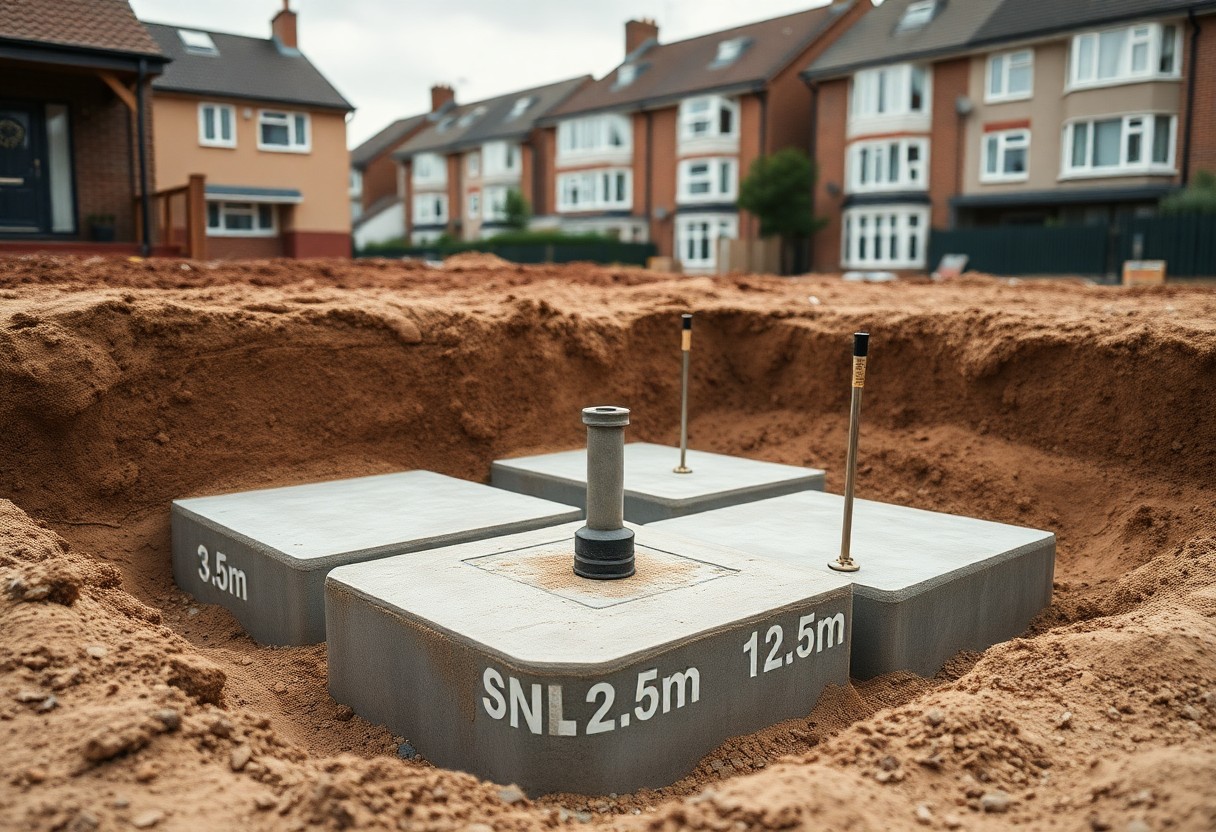
| Basements | 2.5-4.0 metres with retaining structure and tanking |
| Light industrial / warehouses | 1.0-1.5 metres – pads or shallow slabs |
| Outbuildings / sheds | 0.5-0.8 metre shallow strip or pads |
- foundation depth depends on imposed loads and ground investigation
- ground conditions such as soft clay or high water table demand deeper solutions
- piles mitigate settlement where shallow strata are weak
- raft foundations spread load and reduce differential settlement on compressible soils
- Proximity to trees or adjacent excavations affects depth and temporary works
Single-family Homes
For your single-family homes, shallow strip foundations to about 0.9-1.2 metres suit typical brick or timber houses; you should order a trial pit to 1.5-2.0 metres if perched water or made ground is suspected. On London clay near mature trees you may need deeper footings or a raft to limit seasonal heave, and an engineer will give specific sectional depths based on the site investigation.
Multi-storey Buildings
You will generally choose a raft for uniform loads or piles where shallow strata are inadequate; rafts commonly sit at 1.0-2.0 metres, whereas bored piles for apartment blocks or offices often reach 10-30 metres to competent bearing layers, with load per pile typically 500-2,000 kN depending on design.
When you plan a multi-storey building expect detailed ground investigation (boreholes, CPT) and laboratory testing to size piles and rafts; a six-storey example in central Manchester used 24 bored piles to 22 metres with monitoring during driving to control settlement, and you must account for temporary works, vibration control near adjacent structures and potential groundwater management. High water table and nearby live services increase risk and cost. Perceiving the additional site investigation, temporary works and monitoring requirements will help you allocate budget and programme time.
Summing up
Now you should weigh ground conditions, loadings and local building regulations when deciding foundation depth in the UK; shallow footings can suffice on competent subsoils, but weak ground, high loads or groundwater often necessitate deeper footings or piled solutions, so commission a site investigation and follow your structural engineer’s recommendation.
FAQ
Q: What factors determine how deep foundations must be?
A: Foundation depth is set by ground conditions, the load from the building, nearby structures, groundwater level, frost susceptibility, and the presence of trees or filled ground. A site-specific ground investigation (trial pits, boreholes and laboratory tests) and a structural/geotechnical engineer’s design are normally required to establish the correct depth for a particular site.
Q: What are typical foundation depths for domestic houses in the UK?
A: For light domestic buildings on good, undisturbed subsoils, shallow strip foundations commonly range from about 600 mm to 900 mm below finished ground level. Internal shallow footings may sometimes be shallower (around 450 mm) where loads and ground permit, but external strip foundations are often designed at a minimum of about 600 mm to guard against frost and local variation. Where the soil is weak or the loads are higher, rafts, piled foundations or deeper footings will be specified.
Q: How does frost influence foundation depth in the UK?
A: Frost penetration in much of the UK is modest, typically up to roughly 450 mm, but it can be greater in exposed or upland locations. To prevent frost heave, designers commonly set external foundation bases at or below about 600 mm, or follow site-specific frost-depth data. For critical or exposed sites, a geotechnical assessment will advise the required depth or alternative protective measures.
Q: When will piled or deep foundations be necessary?
A: Deep foundations are used where near-surface soils cannot safely carry the load, where there is made ground, peat or compressible clay, or where heavy or tall structures, retaining walls or basements are involved. Piles or deep bored footings transfer loads to competent strata at greater depth; these can extend several metres to tens of metres depending on the site. A ground investigation and engineer’s design determine the need for, and type and depth of, deep foundations.
Q: Do Building Regulations state a fixed minimum foundation depth?
A: Building Regulations do not prescribe a single universal depth. Compliance is achieved by following structural design principles in Approved Document A, relevant British Standards and Eurocodes (for example BS 8004, Eurocode 7) and by using site-specific geotechnical information. Building Control will require evidence of a competent design and, where necessary, a ground investigation report and engineer’s calculations.