
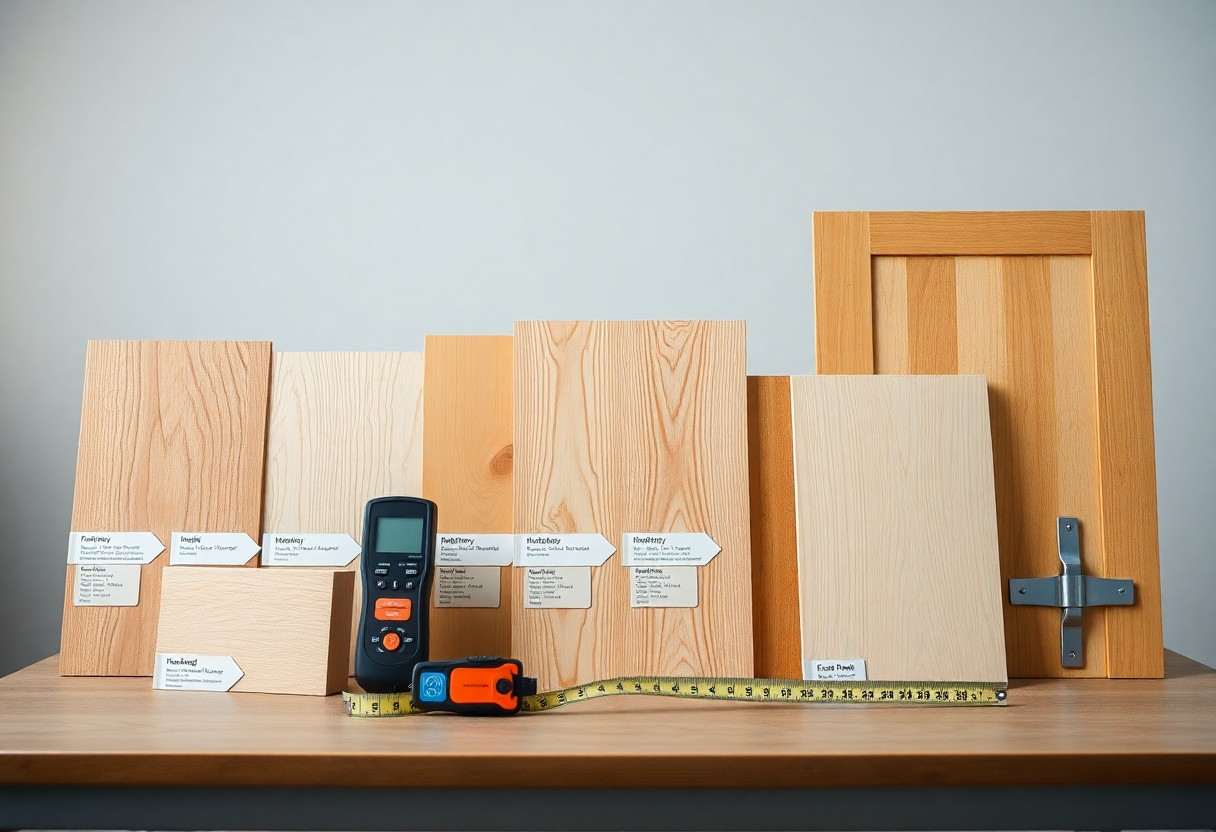
You need to balance appearance, longevity and maintenance when selecting timber for your internal doors; hardwoods like oak and mahogany deliver superior durability and a premium finish, while cheaper softwoods may be lighter on price but can warp, rot or attract pests in high humidity, so proper sealing and adequate ventilation are necessary to protect your investment and ensure long-term performance.
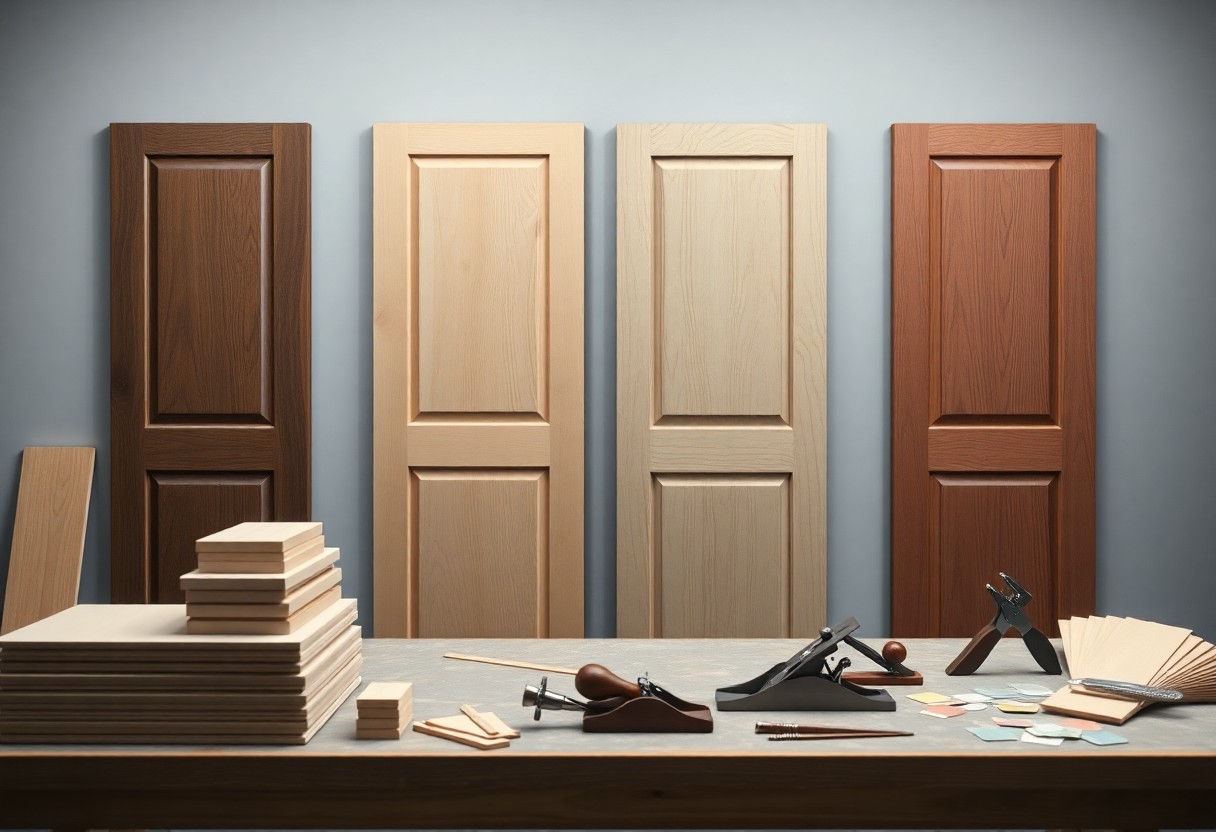
Understanding Wood Types
You’ll see species differ in density, grain and stability: oak (~700 kg/m³) resists wear, pine is lighter and cheaper, and engineered constructions control movement; typical internal door moisture content targets 8-12% and common thicknesses run 35-44 mm. Knowing how species, moisture and construction interact helps you predict finish behaviour and long‑term fit.
- internal doors
- solid wood
- engineered wood
- oak
- pine
| Oak | Dense, hardwearing, rich grain; favours high‑traffic rooms |
| Pine | Soft, economical, dents more easily but takes paint well |
| Mahogany | Stable, premium appearance and price; excellent for traditional styles |
| Ash | Tough, springy timber with open grain suited to contemporary finishes |
| Engineered | Layered core with veneer or HDF face delivering superior stability |
Solid Wood
You get genuine grain and the option to sand and refinish solid wood doors multiple times; oak’s density (~700 kg/m³) gives long service life, but you must acclimatise blanks because solid sections move seasonally and can warp if exposed to prolonged humidity swings, so you’ll need controlled storage and humidity around 8-12% for best results.
Engineered Wood
Engineered doors use a plywood, HDF or finger‑jointed core with a veneer or foil face, which significantly reduces seasonal movement so the door stays true in kitchens or bathrooms; typical veneer thickness is 0.6-2 mm and standard door depths are 35-44 mm, giving you a stable, cost‑effective alternative to solid timber.
You should check core type and edge sealing: an HDF face gives a smooth paintable surface while a thin veneer limits how many times you can sand or refinish, so if you expect heavy refinishing choose a thicker veneer or solid timber; also verify finish and seals around the edges for moisture resistance and warranty coverage.
Popular Wood Species for Internal Doors
You’ll commonly see oak, maple, pine and cherry on supplier lists because each offers distinct trade-offs in hardness, stability and finish behaviour. Hardness spans roughly ~400-1,450 lbf (Janka), so you should match species to traffic and finish: oak and maple suit high-use rooms, pine is cost-effective for painted doors, and cherry gives warm colouration for formal spaces.
Oak
Oak provides a strong, open grain and long-term durability, with European and white oak often rated around 1,200-1,360 lbf (Janka). You’ll find it resists wear, takes stains evenly, and is chemically stable enough for glazed doors and heritage mouldings; choose quarter-sawn oak for maximum dimensional stability in humid houses.
Maple
Maple is prized for its tight, uniform grain and high wear resistance – hard maple sits near 1,450 lbf (Janka) – so you can expect excellent scratch resistance and a smooth finish that suits modern, minimalist doors. If you prefer a pale, consistent look, maple’s neutrality makes it ideal for clear finishes or light stains.
For finishing, you should be aware maple’s density can cause blotching with thin stains; using gel stains, dye stains or a sanding sealer prevents uneven absorption. Also consider that the hardness makes machining edges and routing more demanding, so ask your joiner to use sharp tooling and pre-drill hardware holes to avoid tear-out.
Pine
Pine is a softwood with excellent workability and lower cost, commonly used for painted internal doors; depending on species the Janka ranges from about 380-870 lbf. You should expect visible knots and greater susceptibility to dents and scratches, making pine best where budget and ease of painting trump heavy wear resistance.
When you choose pine, decide between knotty or clear grades: knotty pine gives character but needs knot filler and stabilising finishes, while clear pine suits smooth painted surfaces. Also bear in mind softwoods move more with humidity, so allow for seasonal gaps and fit doors with adjustable hardware.
Cherry
Cherry brings a fine, satiny grain and warm red-brown tones that deepen with light exposure; American black cherry typically measures around 950 lbf (Janka). You’ll get an elegant, aged appearance without heavy staining, ideal for private rooms and cabinetry-style doors where colour development is desirable.
Because cherry darkens significantly within months to years, you should plan placement and finishing accordingly: use UV-stable clear coats to control the rate of colour change and expect natural variation between boards. Also note supply and price are higher than common species, so factor that into your budget.
Factors to Consider When Choosing Wood
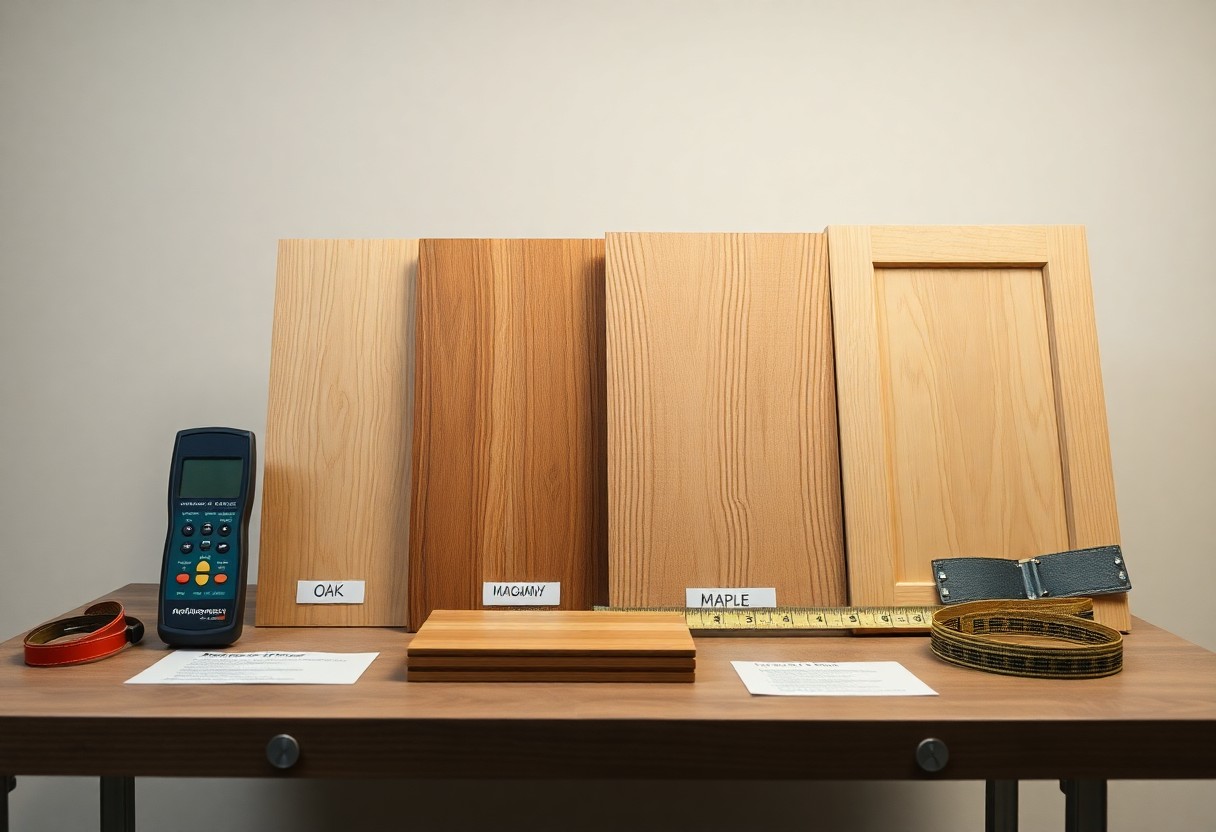
When deciding on wood for internal doors, assess moisture, traffic and finish compatibility; for example, oak tolerates heavy use while softwoods dent more easily. You should compare durability using Janka values-English oak ≈1,200 lbf, hard maple ≈1,450 lbf-and check sustainability marks. For a wider species comparison see Types of Wood | Best Wood Types & Species For Doors. After narrowing options, order samples to check real finishes and grain.
- Durability: Janka hardness, stability and finish wear.
- Aesthetics: grain, colour, matching to décor.
- Cost: purchase, installation and life‑cycle value.
- Availability: local supply, lead times and certification.
Durability
You should prioritise durability for high‑traffic doors: oak (~1,200 lbf) and hard maple (~1,450 lbf) far outlast Scots pine (~380 lbf). Engineered door cores improve dimensional stability in humid rooms, veneers reduce movement, and proper sealing can cut seasonal swelling by around 60-80%. Choose species and finishes aligned to room humidity and use to avoid warping and frequent repairs.
Aesthetics
You will see big visual differences between species: aesthetics range from the open, characterful grain of oak to the tight, pale grain of maple; walnut and mahogany offer deep, formal tones. Veneers replicate exotic looks affordably, while grain direction and panel style affect perceived scale-vertical grain can make doors seem taller.
When specifying appearance, factor how finishes alter tone-staining can shift a door’s hue by 10-25% and clear lacquers deepen grain contrast. You can combine glazed panels, routed details or mixed species for feature doors; for example, an oak door with a walnut inlay provides contrast without the cost of a full walnut leaf.
Cost
You should budget for total cost: typical supply‑only prices run about £50-£150 for softwood doors, £150-£400 for standard hardwoods and £350-£900 for bespoke or engineered doors. Installation and ironmongery commonly add £50-£250 per door, so factor fitting and finish into your per‑door outlay.
Assess life‑cycle economics: a £400 oak door lasting 25-30 years can be cheaper long‑term than a £100 softwood replaced every 7-10 years. Also compare warranties-many hardwood doors offer 5-10 year guarantees-and include periodic refinishing costs, usually every 8-15 years depending on exposure.
Finishing and Maintenance
You should apply 2-3 coats with light sanding between each coat using 180-220 grit, allowing about 4-6 hours dry for water-based and up to 24 hours for oil-based products; polyurethane gives durable protection but moisture and prolonged sun exposure still cause swelling and fading. Knowing to monitor indoor humidity (aim 40-60%) and recoat high-traffic doors every 3-5 years will keep your doors performing and looking their best.
Staining and Painting
You can accentuate hardwoods like oak with transparent stains to show the grain, while softwoods such as pine often take an opaque paint finish better after knot-sealing; oil-based stains penetrate deeper but need solvent cleanup, whereas water-based options dry quicker (4-6 hours) and have lower odour. Knowing to test your chosen stain or paint on an offcut or hidden edge prevents costly colour mismatches and finish surprises.
- Stain – use on oak, mahogany; enhances grain.
- Paint – ideal for pine or MDF; requires primer.
- Oil-based – deeper penetration, longer cure.
- Water-based – faster dry, lower odour.
Care Tips
You should clean doors with a soft, lint-free cloth and a pH-neutral solution, avoid abrasive scouring pads and bleach, and attend to spills within minutes to prevent finish damage; check and tighten hinge screws every six months and keep door hardware lubricated to prevent sticking. Knowing that maintaining stable humidity and dealing with chips promptly will prevent warping and costly replacements.
You can tackle stubborn marks on sealed wood with fine (0000) steel wool plus a light wax polish, while painted surfaces respond best to a gentle touch-up using matching paint; schedule a light maintenance routine-wipe dust weekly, wax or oil annually for natural finishes, and lubricate hinges with silicone spray as needed. Knowing that small quarterly checks and an annual upkeep plan typically extend door life by several years and reduce replacement costs.
- Cleaning – soft cloth, pH-neutral cleaner.
- Hardware – tighten screws, lubricate hinges.
- Wax – apply annually to oiled finishes.
- Humidity – keep between 40-60% to prevent swelling.
Environmental Impact of Wood Choices
You should weigh embodied carbon, biodiversity loss and transport when choosing internal doors; tropical hardwoods like mahogany have been linked to severe deforestation and long supply chains. Opting for locally sourced European oak or engineered veneers cuts miles and often emissions – transport can add 5-15% of lifecycle CO2. For practical comparisons see Choosing Wood Interior Doors: What Are the Options?
Sustainable Sourcing
Choose reclaimed doors or veneers to reduce demand for new timber; reclaimed wood may be decades old and avoids fresh milling emissions. You can also favour fast‑growing plantation species such as poplar or paulownia, or specify engineered cores that save up to 80% of high‑grade solid timber compared with solid doors. Ask suppliers for documented provenance and local mill options to cut transport impacts.
Certification Standards
Familiarise yourself with FSC and PEFC labels: PEFC covers roughly 300 million hectares globally while FSC certifies around 200 million hectares, each providing chain‑of‑custody systems. You should look for declarations like FSC 100%, FSC Mix or PEFC endorsement on product literature, since they indicate how timber was managed and tracked through manufacture.
Demand the supplier’s Chain of Custody (CoC) code and check label specifics: FSC 100% guarantees fully certified material, whereas FSC Mix can include controlled or recycled content under FSC rules. For contracts or high‑spec jobs insist on supplier CoC documentation and batch traceability; many UK specifiers now require these to verify claims and avoid greenwash.
Customization Options
You can specify glazing, panel profiles, veneers, bespoke sizes and acoustic cores to tailor performance and appearance. For example, glazed lights may occupy up to 40% of the door face, while acoustic cores can reduce sound transfer by up to 35dB. Standard UK heights remain 1981mm with common widths 610-915mm, but you can order custom widths, full-length veneer runs or painted finishes to match your scheme.
Design Trends
Current trends favour minimalist flush doors and classic shaker styles in natural oak or painted deep hues such as petrol blue and muted green. Glazed panels with black framing create a contemporary feel, while reclaimed timber and mixed-material insets appear in boutique renovations. Many fitters now specify matte, low-sheen finishes and contrasting matt black ironmongery to add presence without heavy ornamentation.
Hardware Selection
Choose mortice locks for solid doors and tubular latches for routine rooms, with a privacy set for bathrooms. Aim for handles in satin chrome, antique brass or matt black, and fit three hinges to a standard 1981mm door for stability. If the door is an FD30 assembly or acoustic-rated, specify matching fire-rated or acoustic hardware to preserve the door’s performance.
Prefer ball-bearing hinges on heavy or solid oak doors to prevent sagging, and select locks certified to BS EN 12209 or security-grade items to BS 3621 where relevant. Fit intumescent strips and an approved closer on any FD30 door; installers typically use long screws (around 60mm) into the frame for a secure fix. Incorrect hardware has led to failed fire tests, so match certification to your door’s rating.
To wrap up
The best wood for internal doors balances durability, aesthetics and your budget: oak offers strength and a classic grain, maple provides a smooth, pale finish, and engineered options deliver stability and value; select according to your room’s traffic, finish preferences and maintenance capacity, and consult suppliers for grading and moisture control to ensure long‑lasting performance.
FAQ
Q: Which wood is best overall for internal doors?
A: European oak is widely regarded as the best all-round timber for internal doors due to its combination of strength, attractive grain and good dimensional stability. It resists dents and wear better than most softwoods, takes stains and finishes evenly, and suits both traditional and contemporary interiors. For a premium look consider American walnut or sapele mahogany for richer colour and finer grain, while engineered oak panels offer similar appearance with reduced movement in varying humidity.
Q: What is the best wood for painted internal doors?
A: Poplar, softwood such as kiln-dried pine and medium-density fibreboard (MDF) are excellent for painted internal doors because of their smooth, even surfaces and minimal open grain that would otherwise show through paint. Poplar and primed MDF provide a very stable substrate for multiple paint coats, while finger-jointed pine is a cost-effective option. Ensure timber is properly sealed and primed to avoid knot bleed and to keep the final finish uniform.
Q: Which timber performs best in humid or variable climates?
A: Engineered timber doors, rift-sawn oak and tropical hardwoods such as teak perform best where humidity fluctuates because they are less prone to warping and cupping. Engineered doors built with a stable core and a hardwood veneer combine the appearance of solid wood with improved dimensional stability. Proper finishing, adequate sealing on all edges and controlled indoor humidity will further reduce movement regardless of species.
Q: What are the best budget woods for internal doors without compromising quality?
A: Kiln-dried pine, poplar and veneered panels over a solid or engineered core offer the best balance of cost and performance. Hollow-core doors with a veneered surface are very economical for low-traffic rooms, while solid-core pine or engineered doors give better sound insulation and longevity for modest extra cost. Choose well-dried, certified timber and quality veneers to avoid rapid deterioration and to allow future refinishing.
Q: How should I choose the right wood for my doors based on style and lifespan?
A: Match the timber’s grain, colour and hardness to the room’s décor and expected use: hardwoods like oak or walnut for high-traffic areas and formal spaces, softer species or painted options for subtle, modern looks. Consider door construction (solid, engineered, hollow), finishing options and maintenance: hardwearing finishes extend life, while veneers or paint enable easier colour changes. Check sustainability certification (FSC) and allow for seasonal movement when installing to ensure long-term performance.