07414 577346

Send us a message

Tell us a little about the project and a member of the team will come back to you.

Budget before you excavate

Soakaway Costs in Surrey: 2026 Planning Guide

A transparent guide to the investigations, excavation, storage, pipework, access and reinstatement decisions that shape a domestic soakaway quote.

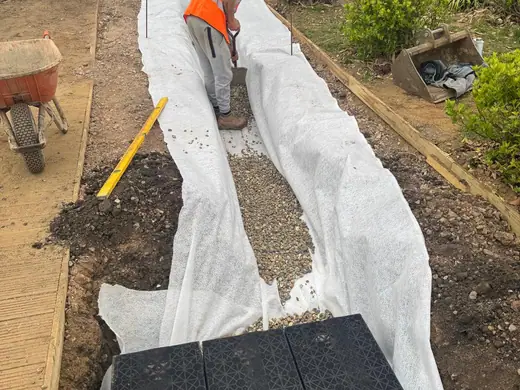
Attenuation crates and a prepared soakaway trench during an A Jones Contractors installation
Planning guide Survey-led advice, clearly explained.

The direct answer

What should you budget for a soakaway?

As an early 2026 planning allowance, professionally installed domestic soakaway projects are often discussed in a broad range of roughly £2,000 to £8,000 or more. That is not a quotation: a small accessible replacement and a deep, engineered system beneath paving are fundamentally different jobs. Ground evidence and a defined reinstatement finish are what turn a range into a useful price.

  • Do not compare prices until each quote covers the same investigation, capacity and reinstatement.
  • Cheap excavation can become expensive when access, spoil or ground conditions were omitted.
  • Ask what happens if testing shows a soakaway is not suitable before installation starts.
Broad early allowance
Approximately £2,000–£8,000+ for many domestic scenarios
Highest-impact factors
Testing, capacity, depth, access, spoil, pipework and finish
Best comparison
Like-for-like scope, not the headline total alone

Make the right decision

The eight parts behind the total

A clear quote should show what has been allowed for, even when the work is priced as one package.

01

Survey & investigation

Time to diagnose the existing system, review levels, inspect pipework and decide whether infiltration evidence is needed.

02

Design & capacity

Storage volume, crate strength, inlet position, silt control and safe separation from buildings and constraints.

03

Excavation

Machine and labour time increase with depth, awkward geometry, wet ground, support needs and restricted access.

04

Spoil handling

Excavated volume expands. Loading route, classification, disposal and any reusable material need to be allowed for.

05

Crates & geotextile

System volume, loading requirement, wrapping method, base preparation and manufacturer components affect material cost.

06

Pipework & access

Longer runs, multiple inlets, chambers, rodding points, protection and difficult falls add time and materials.

07

Reinstatement

Topsoil and seed differ greatly from matching established paving, resin, asphalt or a landscaped garden.

08

Risk allowance

Unknown services, undocumented drains, roots, groundwater and hidden structures should be addressed transparently.

Compare clearly

Three example cost scenarios

Swipe across to compare every column

ScenarioUsually lower or higher?Why
Accessible lawn, short pipe run, simple finishLower endEasy plant access, limited reinstatement and a clear route
New driveway system with channels and pavingMiddle to upper rangeMore runoff, traffic-rated components and careful surface reinstatement
Deep or restricted site with slow ground and extensive pipeworkUpper range or alternative solutionMore investigation, labour, removal, capacity and design risk
Repair to an inlet or chamber onlyPotentially below a full replacementOnly when the existing storage and surrounding ground are still viable

Devil in the detail

Ask what is below the headline price

A useful proposal says what feeds the system, how its size was selected, where it sits, how it can be inspected, what surface will be restored and which unknowns could change the scope.

Talk through your site

From question to clear scope

How to get a more dependable quote

No unexplained leap from problem to price. Each step reduces uncertainty and makes the next decision easier.

  1. 1

    Describe the problem

    Share affected areas, rain pattern, recovery time and any previous repair.

  2. 2

    Measure connected areas

    Approximate roofs, patios and drives that send water to the system.

  3. 3

    Show the access

    Provide the narrowest width, route, steps, turns and parking constraints.

  4. 4

    Agree investigation

    Define inspection, testing and assumptions before installation is priced.

  5. 5

    Specify the finish

    State whether the area is lawn, planting, paving, driveway or future construction.

  6. 6

    Compare the scope

    Check capacity, disposal, pipework, access points and reinstatement line by line.

Prepare once, quote better

Questions to ask every contractor

These questions reveal whether a price is based on a real drainage plan or just a provisional excavation allowance.

  • What evidence supports a soakaway here?
  • What connected surface area is allowed for?
  • What storage volume and crate loading are included?
  • Where will silt be captured and maintenance accessed?
  • How are spoil and surplus materials handled?
  • Exactly what finish is reinstated?
  • Which assumptions could change the cost?

Useful questions

Before you commit to the work

Clear answers now prevent expensive assumptions being buried later.

Why do soakaway quotes vary so much?

They may cover different storage volumes, investigation, access, excavation, disposal, pipe length and reinstatement. A low quote that excludes testing or finishing is not directly comparable with a complete package.

Is replacing crates always the most expensive part?

Not necessarily. Access, excavation, spoil removal and reinstating a driveway or landscaped garden can outweigh the crate material itself.

Can a blocked soakaway be cleaned instead of replaced?

Sometimes the inlet, chamber or pipe can be cleared, but a silted or collapsed crate system is harder to recover. The surrounding ground must also still be capable of accepting water.

Should percolation testing be included?

Where infiltration is uncertain or the project requires formal evidence, testing should be agreed before final design. The quote should state whether it is included or assumed.

Does a larger soakaway always solve flooding?

No. More storage cannot correct a blocked inlet, reversed fall, unsuitable ground or water entering from outside the designed catchment. Diagnosis comes first.

A practical next step

Turn the site details into a clear scope

Send photos, the property location and what happens during rain or construction. We will help identify the most useful next survey.